





Every digital marketing budget runs into the same crossroads: put money into ads to generate results now, or invest in content and optimization to build an asset that pays off later.
The wrong answer is expensive either way, whether in burned budget or in months of waiting with nothing to show.
The good news is that choosing between SEO or paid traffic does not have to be a guess. Timeline, available budget and how competitive your market is will point to which channel deserves priority at each stage of the business.
In the sections below you will find a direct comparison between the two channels, a practical decision matrix and the path to combining them without wasting budget.
What is the difference between SEO and paid traffic?
The difference between SEO and paid traffic lies in how you win visitors. SEO attracts clicks organically, with no cost per visit, through relevant content and technical optimization.
Paid traffic buys immediate visibility on ad platforms, charged per click or per impression. One builds an asset, the other rents an audience.
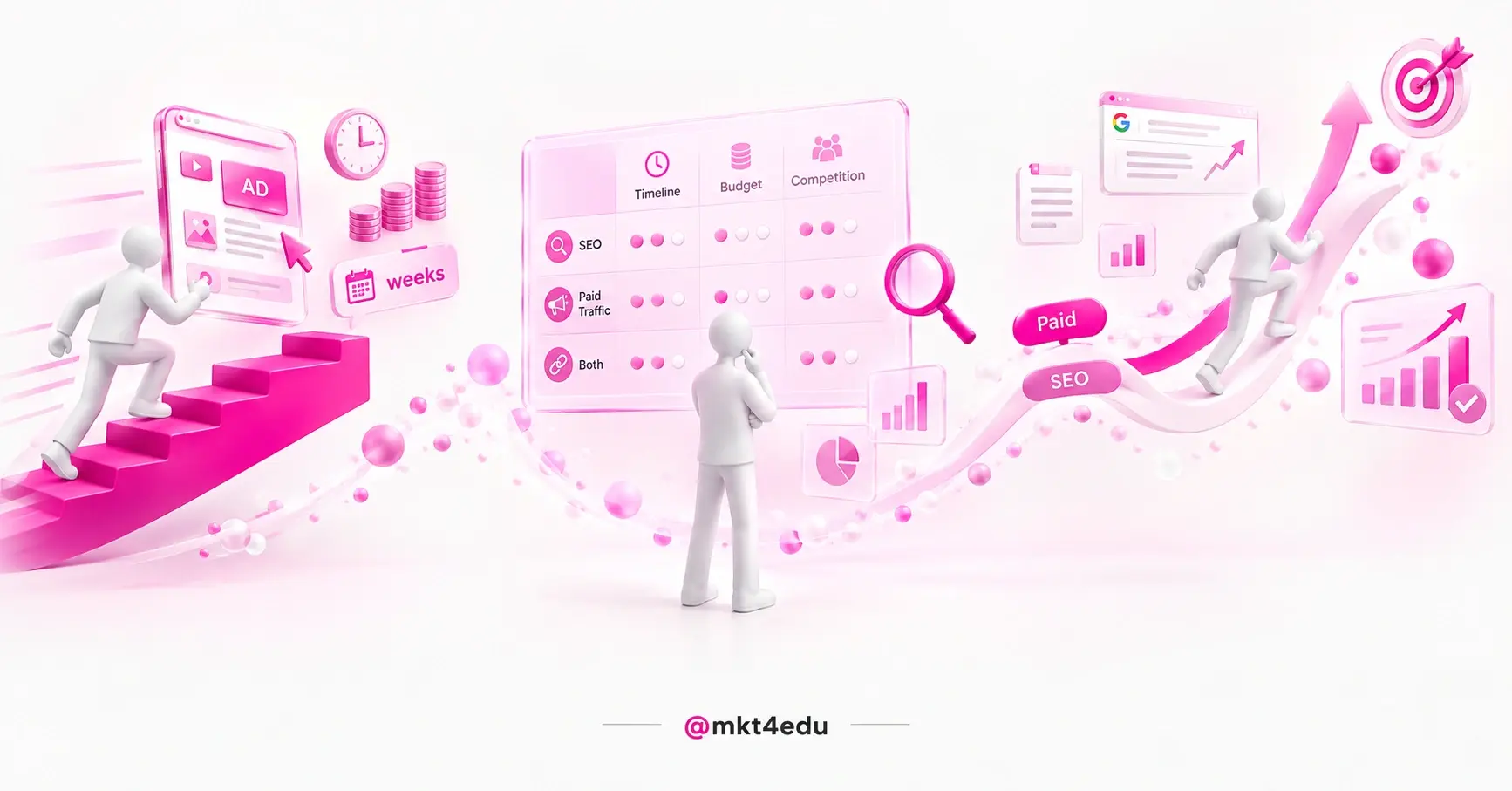
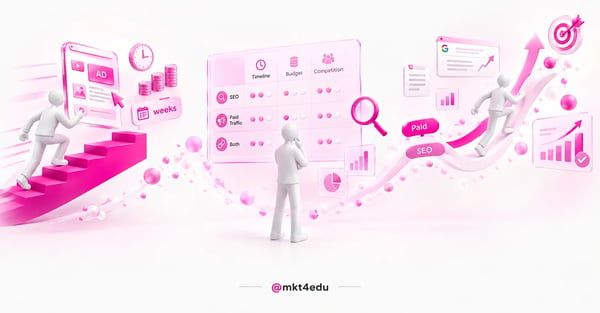 Caption: choosing between SEO or paid traffic comes down to timeline, budget and competition, not channel preference
In practice, SEO works to make your pages show up in organic results when someone searches for what you offer. The investment goes into content, site structure and authority building.
Paid media, on the other hand, works like an auction for attention. You define audience, budget and bid, and the platform serves your ads within minutes, and understanding how paid traffic works on each platform helps you size that investment.
Both channels compete for the same space: the screen of the person searching. The difference is who pays for each click, and when.
What do SEO and paid traffic deliver, and how fast?
Paid traffic delivers visitors within hours: campaign approved, ad live, clicks coming in. SEO can take a few months to build consistent traction, but the traffic you earn compounds and keeps arriving with no cost per click.
One channel is speed, the other is compound effect.
That difference in pace fools a lot of people. Ads look more efficient because results show up in the first week, while organic demands patience before it produces numbers.
The volume at stake, however, favors organic. A BrightEdge study that became a market reference found that 53% of trackable website traffic comes from organic search, more than any other single channel.
On the other hand, paid traffic is the only lever capable of generating predictable demand in days. Anyone who needs to fill the sales calendar this month will not solve that with SEO.
Organic vs paid traffic: which costs less over the medium term?
When you compare organic traffic with paid, organic tends to cost less per visitor over the medium term. The cost of SEO is concentrated up front, in content and optimization, and dilutes as traffic grows.
With paid, every visit has a price, and costs per click rise along with competition.
The math of paid media is linear: doubling results requires something close to doubling the budget. In crowded markets, the auction pushes bids up continuously.
SEO flips that logic. The same article that cost a few hours to produce can attract visits for years, which drives cost per lead down over time.
That does not make organic free. It requires editorial consistency, periodic reviews and a healthy technical foundation, and the return depends on keeping that investment active.
When should you invest in ads?
Invest in ads when the result cannot wait: a product or campaign launch, seasonal demand windows, validation of a new offer, or markets where your brand has no organic presence yet.
In those scenarios, paid traffic buys the time SEO has not had to build.
A few signs indicate that paid media should come first:
- Short timeline: sales or enrollment targets with a fixed date will not wait for organic to mature.
- Offer under validation: ads test messages, audiences and pages within weeks, producing fast learning.
- Organic competition locked up: if page one is dominated by strong brands, ads guarantee presence while authority is built.
- Strong seasonality: peak periods concentrate demand and reward whoever shows up at the right moment.
The risk of this path is dependency: when the budget stops, the traffic stops with it. That is why the operation needs method, with structured paid traffic management inside an SEM strategy that protects the budget.
When does prioritizing SEO make more sense?
Prioritize SEO when the business can invest a few months before the return, when there is recurring search demand for what you sell and when the goal is to reduce dependence on paid media.
Organic builds an asset that appreciates over time instead of renting an audience click by click.
The numbers support that bet for anyone with staying power: the analysis on whether SEO is worth it shows how the channel pays for itself when measured by accumulated return, not by the first month.
Organic is also the front door to AI answers. Semrush research on AI visibility indicates that visitors arriving from those tools convert 4.4 times better than traditional search visitors, and what feeds those answers is optimized content.
To speed up that build, structured SEO work combines content, technique and authority from the start, shortening the path to traction.
How do you decide between SEO and paid traffic?
The decision between SEO and paid traffic comes down to three questions: how soon you need results (timeline), how much you can invest on a recurring basis (budget) and how contested your market is in search (competition).
Cross those answers and you get the priority for the moment, not a permanent choice.
Here is how those criteria organize into a decision matrix:
|
Criterion |
Prioritize paid traffic |
Prioritize SEO |
|
Timeline |
Results needed in days or weeks |
Return acceptable within a few months |
|
Budget |
Recurring budget to sustain campaigns |
Capacity to invest in content and technique before the return |
|
Competition |
Organic page one dominated by strong brands |
Niches and specific searches still underexplored |
|
Business stage |
Launch, seasonality or offer validation |
Stable operation seeking lower acquisition cost |
Table: The more answers in the left column, the more urgent paid media becomes; the more on the right, the greater the potential of organic right now.
If your answers split across both columns, you are in the most common scenario: the business needs both channels, in different doses and with a clear role for each.
How do you combine SEO and paid traffic in practice?
SEO and paid traffic combine in a feedback loop: search term reports from ads reveal the keywords that convert and feed the content plan, while organic authority improves page experience and tends to make media auctions cheaper.
In practice, paid traffic works as the laboratory for organic. Headlines and hooks that perform in ads point to the angles worth turning into evergreen content.
The reverse path pays off too. Someone who arrives through the blog can be reached by remarketing, turning readers into sales opportunities for a fraction of the cost of a cold audience.
That combination gains an extra layer with AI search, where structuring content with answer engine optimization techniques increases the odds of the brand being cited in the answers that now share space with ads.
The end goal is journey coverage: showing up in the ad, in the organic result and in the AI answer for the same search multiplies touchpoints without multiplying waste.
Common questions about SEO or paid traffic
So, SEO or paid traffic: where should you start?
Start with the criterion that puts the most pressure on your business today. If cash flow demands results this quarter, ads come first, with SEO planted in parallel.
But if the operation is stable and acquisition cost is the sore point, flip the order and reserve paid media for strategic windows.
The most expensive mistake is not picking a channel, it is treating the choice as permanent. The matrix of timeline, budget and competition shifts as the business grows, and the strategy has to move with it.
If you want to design that combination using the numbers from your own operation, talk to the mkt4edu team. The assessment shows where each dollar invested performs best: paid, organic or both.


.jpg)






















 Portugal