


Almost every operation that wants to sell more starts by asking for more leads. It is the most expensive reflex in digital marketing, because it treats volume as the cure for what is usually an efficiency problem. Conversion rate exists to undo that confusion: it shows how much of what comes in actually advances, and where the advance stops.
The practical difference shows up in the arithmetic. Doubling the top at the same conversion doubles the cost and returns the same proportional profit.
Fixing the stage that loses most improves the result without spending more. That is why mature digital marketing strategies start by measuring before buying media.
What is conversion rate and why does it measure efficiency?
Conversion rate is the percentage of people who complete the expected action against the total who had the chance to complete it. In the sales funnel, that action changes by stage: becoming a lead, becoming an opportunity, closing a contract. What does not change is the nature of the indicator, which measures efficiency rather than size.
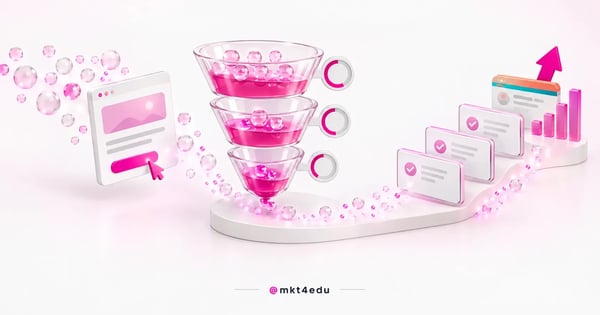 Caption: Conversion rate measured stage by stage shows where the funnel loses leads and which step responds best to page and approach adjustments.
That distinction organises the budget decision. Volume answers "how many arrived"; conversion answers "how many were worth it".
Two operations with the same lead count can produce opposite results. The one that converts better spends less for the same revenue, leaving margin to invest elsewhere.
What conversion rate really is, in practice, is the implicit price of each sale. When it falls, cost per result rises even though no media rate has changed.
How do you calculate conversion rate at each sales funnel stage?
The formula is one: those who advanced divided by those in the previous stage, multiplied by one hundred. What changes is where you apply it. Measuring only visitor-to-customer produces a number that is true and useless, because it does not point at the passage that failed.
Sales funnel stages usually yield four measurable passages. Here is how that organises in a typical operation:
|
Passage |
Example |
Conversion |
Who fixes it |
|
Visit to lead |
1,000 to 80 |
8% |
Page and offer |
|
Lead to qualified |
80 to 32 |
40% |
Criteria and nurturing |
|
Qualified to opportunity |
32 to 18 |
56% |
Commercial approach |
|
Opportunity to sale |
18 to 6 |
33% |
Proposal and negotiation |
|
End to end |
1,000 to 6 |
0.6% |
Nobody, in isolation |
Table: Illustrative conversion rate by funnel passage, with the end-to-end number on the final row.
The last row explains the problem of measuring only the final result. That 0.6% is accurate and tells you nothing: it does not reveal that the biggest loss sits in the first passage, which dropped 92% of people at the door.
Knowing how to calculate lead conversion rate with this breakdown becomes a simple routine. Build the four passages, follow the series for a few weeks and watch which one swings most.
Learning how to calculate lead conversion rate per passage is what separates a diagnostic meeting from a meeting spent lamenting the final number.
A conversion rate calculator solves the arithmetic but not the definition. Without a written agreement on what characterises each stage, each team calculates under different criteria and the series loses comparability.
What is each conversion rate drop telling you?
Each passage fails for a different reason, and that is the biggest gain of measuring by stage. The drop has an address: saying conversion fell helps nobody, while saying conversion between lead and qualified fell points straight at the qualification criteria.
A loss between visit and lead is almost always page and offer. A promise that does not match the ad, a form that is too long, or a value proposition the visitor cannot grasp in five seconds.
A loss between lead and qualified is about source and criteria. The channel may be bringing people outside the profile, or the qualified leads criteria may be poorly written, letting through those with neither intent nor budget.
A loss between opportunity and sale is commercial. A badly built proposal, wrong timing in the buying journey, or no follow-up at the moment interest peaked.
That separation avoids the most expensive decision in the funnel: cutting top-of-funnel budget when the bottleneck was in the approach. Analysing funnel data stage by stage is what prevents that mistake.
Video: Audio version on how to increase conversion rate at each stage of the sales funnel (in Portuguese).
How do you create a landing page that sustains conversion rate?
To create a landing page that converts, three decisions come before design: one promise, one action and the fewest possible fields. A page offering three things at once splits attention and drops conversion, however impeccable the layout.
Continuity between ad and page is the most underrated factor. Someone who clicked a specific promise and lands on a generic page feels they took a wrong turn, and leaves.
Among landing page design tips to improve conversion, the ones that usually move the number are plain. A button visible without scrolling, real proof instead of adjectives, fields cut down to what the team will actually use, and fast loading on mobile.
Good landing page design tips to improve conversion are worth little without testing: what works for one audience can sink the result for another, and only measurement separates the two cases.
This work is the territory of CRO (Conversion Rate Optimization). CRO marketing tests variations of promise, form and visual hierarchy to find what your audience responds to, not what worked in somebody else's case study.
Optimizing conversion rate this way compounds. Each percentage point won at the entrance multiplies through every later stage, because the whole funnel works with more raw material at the same cost.
The CRO marketing behind that gain is incremental by nature, and optimizing conversion rate in short cycles accumulates results without a full site rebuild. It helps to remember that CRO and user experience solve different problems on the same page.
How do you increase sales conversion rate at the commercial stage?
Sales conversion rate improves when the commercial team receives fewer people and better people. It sounds counterintuitive, but high volume with loose qualification burns the calendar on conversations that never close, and that lost time never returns to those with real intent.
The starting point is a written qualified leads criteria, accepted by both teams. Without it, marketing delivers everything and sales discards without logging the reason, which erases the information that would fix the channel.
Response time comes next. Contact made while interest is hot converts better than the same contact days later, and it is the cheapest variable to fix in any operation.
Anyone asking how to increase sales conversion rate should start there, because speed of response costs nothing and moves the number within a single week.
Inbound sales strategies enter here with method: a defined cadence, diagnostic questions before the proposal, and a logged reason for every loss. Good cadence on a bad list only accelerates frustration.
The buying journey also defines what to say and when. Someone comparing options needs clear differentiation, not a discount; someone who already decided needs an easy path to close. Understanding the purchase journey changes the conversation and, with it, the conversion.
Inbound marketing strategies sustain this work in the medium term, because they feed the funnel with people who arrive informed, which shortens the commercial stage.
People arrive informed because of the content planning that came before. It decides which question each piece answers and where it enters the buying journey, which is why content planning moves conversion rate without touching a single line of the page.
Combined, inbound marketing strategies and inbound sales strategies reduce dependence on volume: the team talks to fewer people and closes more.
How do you turn conversion rate into a decision routine?
Conversion rate becomes a decision when it has a reading cadence, an expected range per stage and an agreed action for when it leaves that range. Without those three, it is just another number on a monthly slide nobody uses to change anything the following week.
The right cadence is weekly for top-of-funnel passages and fortnightly for commercial ones. Page conversion reacts fast to change; commercial conversion depends on the cycle and needs longer to mean anything.
The expected range comes from your own series, never from a market average. Three months of history under one stage definition is already enough to tell normal swing from a real drop.
The agreed action closes the loop. If page conversion drops two points, someone revises promise and form that week; if the commercial one drops, someone audits loss reasons. Without an owner and a deadline, the indicator becomes an observation.
The marketing strategies behind this design do not depend on new tooling. They depend on a funnel built for the real audience and on a single record where both teams see the same number.
That is also what gives digital marketing strategies predictability, because the decision to expand or cut budget comes from observed conversion rather than from the feeling of the month. Landing pages and lead conversion sit at the entrance of that same system.
Frequently asked questions about conversion rate
What should you prioritise first to improve conversion rate?
Prioritise the passage with the largest absolute loss, not the lowest percentage. A stage losing 900 of 1,000 people has more to give back than one losing 12 of 18, even if the second percentage looks worse.
After that, settle definitions before tooling. Write what characterises each stage, agree it with both teams and recalculate the series under the new criteria. A good share of mysterious drops disappears in that clean-up.
With definitions settled and the critical passage identified, change one thing at a time. Altering page, offer and cadence in the same month makes it impossible to know what worked, and you lose the learning along with the gain.
If your operation already knows where it loses and needs method to fix it, that is where structured CRO work stops being an occasional test and becomes a process. mkt4edu works on conversion across the whole journey, from page to close. To review your funnel with us, talk to our team.












 Portugal