
Most colleges do not have a lead volume problem, they have a conversion problem. The campaign delivers applicants, the registrar's office receives documents, the sales team makes calls, and the intake still closes below target. Each area does its part, but nobody sees the whole candidate, from first click to enrolment.
That gap between areas is what RevOps consulting fills. Instead of buying more traffic or switching tools, it looks at the funnel as a single system, finds the points where the applicant disappears, and designs process, integration and metrics so that lead leakage stops being invisible.
The context calls for that rigour. According to Semesp's 16th Higher Education Map, based on the 2024 census, Brazil reached 10.2 million enrolments, with private institutions accounting for 79.8% of them and distance learning already at 50.7%. More competition per candidate, more channels and less tolerance for waste.
What is RevOps consulting and what does it solve in student recruitment?
RevOps consulting is the service that aligns marketing, sales and service into a single revenue process, with shared data and common targets. RevOps was born in the technology market, and in student recruitment it takes on a concrete objective: giving every lead a defined path to enrolment, with an owner, a deadline and a metric.
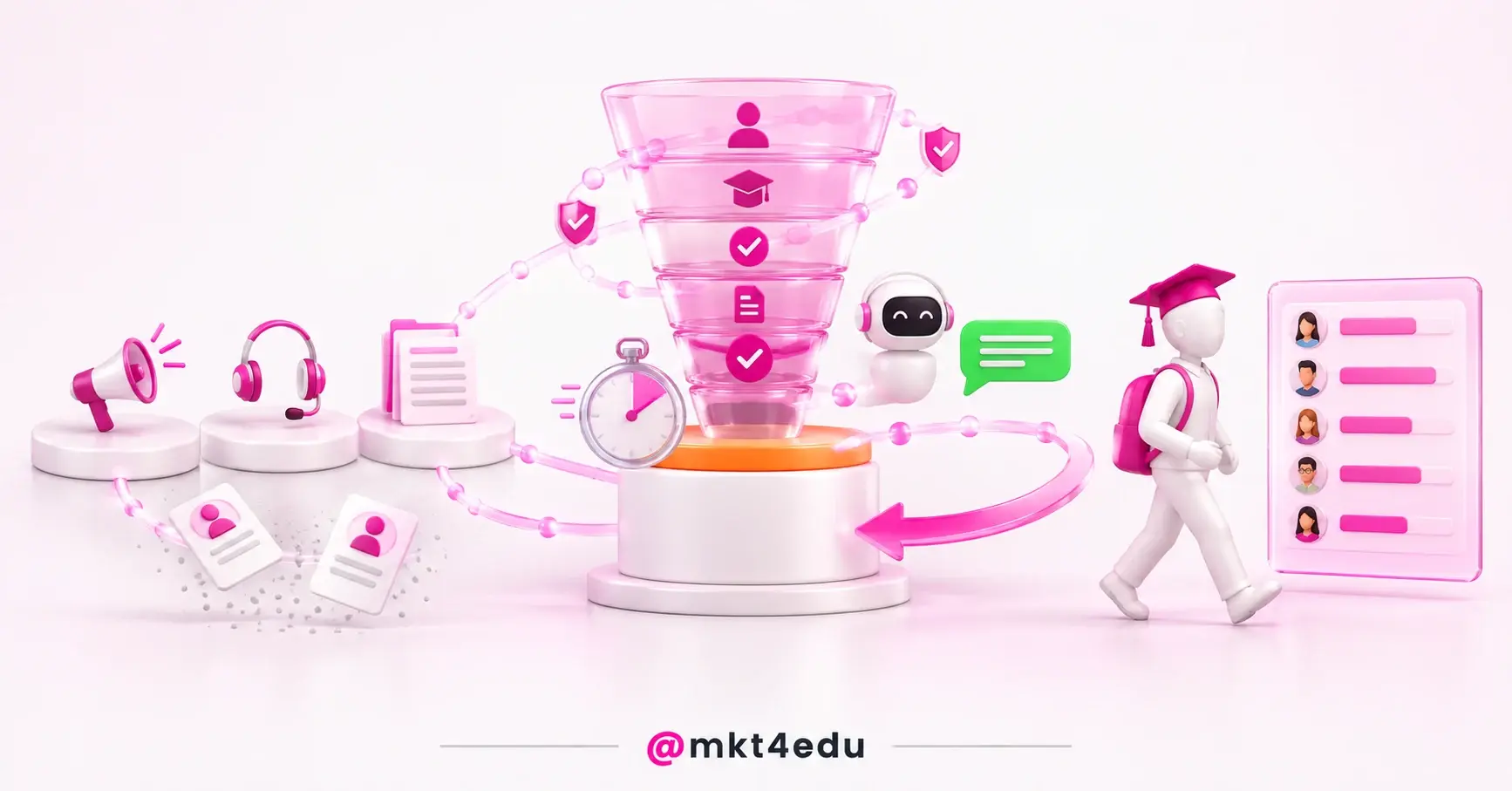
 Caption: RevOps consulting follows the candidate from first contact to enrolment, leaving no applicant stuck in the queue
The difference from the traditional model is the scope. An agency optimises campaigns, a CRM implementer configures the tool and the sales team works the lists it receives: each one measures its own slice.
RevOps consulting measures the whole, from cost per lead to revenue per intake, and is held to the result at the end of the funnel, not in the middle.
It is worth separating generic educational consultancy from applied RevOps. Traditional educational consultancy tends to deal with portfolio, pricing and programme positioning.
RevOps consulting is operational: it goes into the lead spreadsheet, the CRM pipeline and the documentation queue to find out why the applicant did not become a student.
So the service talks both to Educational marketing strategies and to the registrar's daily routine. The goal is not to generate more leads, but to make sure the leads already paid for reach the end of the process.
In many cases the gain in enrolments comes with no increase in media budget, purely from making better use of what already comes in.
Why does a college lose leads between application and enrolment?
A college loses leads between application and enrolment because that stage sits in no man's land. Marketing counts the application as a completed conversion, sales only sees whoever is already in the CRM, and the registrar steps in when documents arrive. The candidate, who is comparing two or three institutions, goes uncontacted at the moment of decision.
The leaks repeat across institutions of very different sizes, and five of them show up most often:
- Response time: the applicant fills in the form and gets the first human contact days later, once they have already chosen another option.
- Lead with no owner: the candidate lands in a generic queue, with no assigned adviser and no deadline for the next step.
- Marketing and sales on separate data: the source, the programme of interest and the interaction history stay in the media platform, and sales receives only a name and a phone number.
- Application with no follow-up: the entrance exam happens, the result comes out, and nobody follows the approved candidate through to enrolment.
- Documentation as a barrier: the document submission stage has no reminder, no easy channel and nobody to resolve pending items.
None of these leaks appears in the campaign report, which is why they last so long.
Cost per lead can even fall while the enrolment rate per applicant gets worse, because the problem sits beyond the point marketing measures.
On response time, the most cited reference is a March 2011 Harvard Business Review article, The Short Life of Online Sales Leads, whose public conclusion is blunt: the authors' research shows that most companies are not responding nearly fast enough.
The study comes from another market and another decade, and much of the data circulating from it sits behind a subscription, so it is worth treating as a principle rather than a numerical reference: interest is perishable, and the candidate filling in a form today is comparing institutions today.
What your institution can measure without relying on any study is its own average time between application and first human contact. That number is usually the first surprise of the diagnosis.
How does the funnel diagnosis work in RevOps consulting?
The funnel diagnosis is the first deliverable of RevOps consulting, and it consists of reconstructing, with real data, the candidate's path at each stage: lead, applicant, approved, documentation and enrolled. For each transition, the consultancy measures volume, conversion rate, average time and owner, always by source channel and by programme.
The starting point is collection. The consultancy gathers CRM exports, media platform reports, sales spreadsheets and academic system records.
It is common for that data not to talk to itself at all, and that difficulty is already the diagnosis's first finding.
Every funnel rate is compared across channels and across programmes, because the average hides the problem. A typical example: the overall applicant-to-enrolled rate looks reasonable, but the programme with the biggest media budget converts at half the average.
Without the cut by channel and by programme, the institution keeps investing where it gets the least back. Measuring the conversion rate by channel is what exposes that imbalance.
The funnel diagnosis also measures time. How long does the applicant wait for the first contact? How many days separate approval from enrolment? Those answers show whether the bottleneck is process, people or tooling.
Video: the 4RevOps measurement plan, the kind of definition RevOps consulting delivers before touching the funnel
The output of that work is a prioritised map of leaks. The consultancy points to the three or four problems that, once fixed, return the most enrolments in the next cycle, and defines how each fix will be measured.
How does marketing and CRM integration cut lead leakage?
Marketing and CRM integration cuts lead leakage because it guarantees that every candidate enters the system with source, programme of interest, history and owner defined, the moment they convert. When that handover is manual or partial, the lead arrives late, incomplete or not at all, and the sales team works without context.
Integration here is not just connecting the form to the tool. It involves at least four connections: the media platforms sending source and campaign, the application system sending the candidate's status, the CRM distributing the lead to an adviser with a deadline, and the academic system sending the enrolment back to close the loop.
That last connection is the most neglected. Without the enrolment returning to the CRM, marketing never knows which campaign produced a student, only which produced a lead, and optimises for the wrong indicator.
HubSpot CRM is a common choice in that design because it concentrates marketing, sales and service in the same contact base, with trained people and ready-made integrations available in the market.
In student recruitment, CRM implementation for education has to reflect the real stages of the admissions process, not a generic sales pipeline.
The expected result of marketing and CRM integration is simple to describe and hard to reach without method: no lead without an owner, no applicant without a scheduled next step, and no enrolment without a known source.
That is the standard the HubSpot CRM service at mkt4edu pursues in colleges.
What changes in applicant-to-enrolment conversion with RevOps?
With RevOps, converting applicants into enrolled students stops depending on each adviser's individual effort and starts following a process: a nurturing sequence per stage, a defined response deadline, automation of whatever is repetitive, immediate response from an SDR agent and prioritisation by lead scoring. The candidate gets the right contact at the right moment.
The nurturing sequence is the first element. Each funnel stage gets a message sequence with a clear objective: confirm the application, remind about the exam, celebrate the approval, guide the documentation, answer scholarship questions.
A well-designed communication sequence reduces the silence between stages, which is where the applicant goes cold.
The second element is the SLA (Service Level Agreement) between marketing and sales. Marketing commits to lead volume and quality; sales commits to a maximum time to first contact and a number of attempts.
Without that written agreement, each area blames the other for the missed target. Automation holds the agreement up: automatic lead distribution, documentation reminders and an alert for any applicant idle for more than 48 hours.
For the first contact, many colleges have started using an AI (Artificial Intelligence) SDR agent, especially on WhatsApp. The agent replies in seconds, qualifies the interest and books the conversation with an adviser, and that is the scope of AI agents applied to recruitment.
The value of an SDR agent integrated with the CRM is that it records every interaction in the same place the adviser works.
Video: lead scoring on the mkt4edu channel, the prioritisation RevOps consulting brings to the sales team
Lead scoring completes the design. With points for programme, engagement and stage, the sales team prioritises whoever is closest to enrolling instead of calling in order of arrival.
AI-powered lead qualification makes that ranking dynamic, adjusted as the candidate interacts.
On results, mkt4edu reports, in its work with Red Balloon, a 24% increase in enrolments and a 47% reduction in cost per lead, plus a CRM implementation at ESPM. The numbers come from the agency itself and serve as an illustration of scope, not as a guarantee for any institution.
Which metrics does RevOps consulting track through to enrolment?
RevOps consulting tracks metrics at every funnel transition, always with a named owner and an associated business question. The goal is not a good-looking dashboard, but making sure every number has someone responsible for improving it and a decision it informs.
The choice of metrics follows the funnel order, from lead to revenue. Here is how it is organised at a typical college:
|
Stage |
Metric |
Question it answers |
Owner |
|
Lead |
Cost per lead by channel and programme |
Where does the budget produce the cheapest contact? |
Marketing |
|
Lead to applicant |
Application rate and time to first contact |
Is the lead being worked in time? |
Sales |
|
Applicant to approved |
Exam attendance and approval |
Is the applicant reaching the admissions process? |
Sales and registrar |
|
Approved to documentation |
Documentation completed within the defined deadline |
Is the paperwork blocking the decision? |
Registrar |
|
Documentation to enrolled |
Enrolment rate by channel and programme |
Which source actually produces students? |
Marketing and sales |
|
Enrolled |
CAC (Customer Acquisition Cost) per enrolment and revenue per intake |
Does recruitment pay for itself? |
Leadership |
Table: metrics by funnel stage that RevOps consulting tracks, with the question each one answers and the area responsible
CAC per enrolment is the metric that ties everything together, because only it shows whether the recruitment effort pays for itself.
A campaign with a low cost per lead and a poor enrolment rate has a high CAC, and the consultancy exists to make that calculation visible before the intake closes.
This set talks to the educational marketing metrics the institution already tracks, with one difference: in RevOps no metric ends at the lead; they all run through to enrolment.
When should you hire RevOps consulting instead of switching agency or CRM?
RevOps consulting is the right choice when the problem sits between areas rather than inside one of them. If the campaign generates leads at the expected cost, the CRM works and the sales team is working, but the applicant-to-enrolled rate stays low, switching agency or tool will not fix it: the leak is in the process that connects them.
Some signs show that the moment calls for consulting rather than a new supplier:
- The institution cannot say, with data, which channel produces the most enrolments, only which produces the most leads.
- Sales receives leads with no source, no programme of interest and no interaction history.
- There is no defined deadline for first contact with an applicant, and no alert when it is missed.
- Marketing and sales present different numbers for the same period in the same meeting.
- The CRM is implemented, but the pipeline stages do not match the real admissions process.
Switching agency makes sense when the media operation is outside the market standard for cost or quality. Switching CRM makes sense when the tool cannot support the required integrations and automations.
In both cases, a funnel diagnosis done before the switch prevents repeating the problem with a new supplier.
A good test is the simple question. If leadership asks how many applicants in the current admissions cycle have still not been contacted, and the answer takes more than a day, the problem is neither media nor software.
The inbound sales approach for educational institutions already addressed that gap between attracting and converting, and RevOps is the way to run it on data.
Frequently asked questions about RevOps consulting
What does a college lose by delaying RevOps consulting?
Delaying RevOps consulting costs a whole recruitment cycle with the same leaks. Leads already paid for keep going cold in the queue, approved candidates stay unaccompanied through documentation, and the institution reaches the next admissions cycle still not knowing which channel produces students. Every postponed semester is an intake below what the funnel allowed.
The cost is silent because it does not appear as a new expense, it appears as revenue that never came in. An applicant lost for lack of contact does not generate an invoice, it generates an empty seat, and that absence repeats with every monthly fee of the programme.
There is also the cost of deciding wrongly. Without the funnel diagnosis, the reaction tends to attack the symptom: more media budget when the problem is response time, or a new CRM when the problem is the absence of an owner for the lead. Both decisions spend money and keep the leak.
mkt4edu presents itself as a Top3 Global HubSpot Partner and states that more than 200 education institutions trust its expertise; in HubSpot's directory, the agency's profile shows the Elite Solutions Partner tier. 4RevOps is the Revenue Operations and AI brand of the same group.
If your college recognises the signs described here, you can start with a funnel diagnosis with people who run HubSpot CRM in education every day, using the data from your last recruitment cycle.
That diagnosis is what opens the conversation with our team: you leave it with the map of leaks in your funnel and the order of the fixes that return enrolments as soon as the next admissions cycle. Talk to us and let's build your success together.












 Portugal