


The privacy map that applied in 2020 no longer describes today's landscape. Between 2025 and 2026, new American state laws came into force and the European Union began enforcing specific obligations on the use of artificial intelligence.
Privacy marketing stopped being a legal department topic. The legal basis for collection, the retention period and the declared purpose now decide what can be segmented and what has to leave the rotation.
Compliance tends to give quality back. A smaller, consented list usually performs better than a large cold one, and that gain shows up in engagement metrics well before it shows up in volume.
What is privacy marketing and why did it change scale?
Privacy marketing is the practice of building digital marketing strategies from the data protection rules in force, rather than in spite of them. The term appeared as a response to GDPR, but what changed since is the scale of the problem: the bar now comes from several regulators at once, on different continents and with separate deadlines.
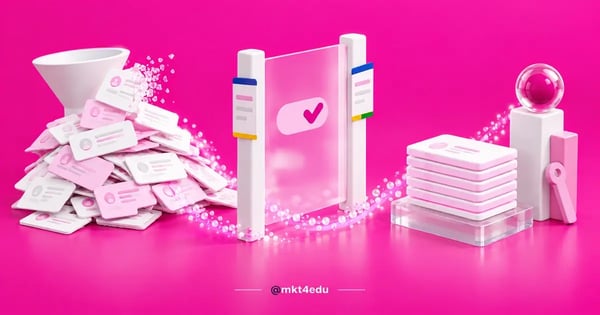 Caption: In privacy marketing, a smaller consented list pays off more than a large irregular one: what does not pass through consent cannot be used.
The difference between compliance and privacy marketing lies in when the decision is made. Compliance reviews what has already been done, while privacy marketing enters at campaign design, before the first form goes live.
Collecting less data and explaining the reason better is an editorial decision as much as a legal one. A short form, a purpose written in plain language and a visible opt-out tend to lift completion rates, because they reduce the hesitation that stops people midway.
Which privacy regulations are already in force today?
Four regulatory fronts now affect marketing directly: GDPR in the European Union, LGPD in Brazil, the block of state laws in the United States and the European artificial intelligence regulation. None of them is a bill under discussion, and all of them already create obligations for anyone collecting data from people in those territories.
Here is how those fronts are organised:
|
Rule |
Where it applies |
In force since |
What it asks of marketing teams |
|
GDPR |
European Union and anyone handling European data |
2018 |
Declared legal basis, right of access and right to erasure |
|
LGPD |
Brazil |
2020 |
Declared purpose, consent when that is the basis used, and right to deletion |
|
CCPA and CPRA |
California, in the United States |
In force |
Right to know, to delete and to opt out of the sale or sharing of personal data |
|
Comprehensive state laws |
20 American states, with a caveat about Florida |
Staggered through 2025 and 2026 |
Access, correction, deletion and opt-out of targeted advertising |
|
EU AI Act |
European Union |
1 August 2024 |
AI literacy, prohibition of certain systems and rules for general purpose models |
Table: Regulatory fronts affecting how data is collected and used in campaigns.
What have GDPR and LGPD already settled about data collection?
GDPR (General Data Protection Regulation, the European data protection regulation) and LGPD (Lei Geral de Proteção de Dados, Brazil's general data protection law) locked in three requirements that now work as a floor in any operation. They are a declared legal basis, a specific purpose, and the right of the data subject to access and erase their own records.
The right to erasure is the one that usually catches teams off guard. Meeting it means knowing how many systems hold the same contact, and what LGPD requires inside the CRM starts with exactly that inventory.
How many American states already have a privacy law in force?
According to a review by Transcend, a privacy compliance software vendor, twenty American states now have a comprehensive consumer privacy law in force. Transcend itself notes that this total depends on counting Florida, whose law has a narrower scope than the others.
That caveat matters because it changes the number circulating in the market. The figure is useful as a well documented picture of the trend, then, and not as an official count from a regulator.
The pace of entry into force explains the gap against the picture of a few years ago. In 2025 the laws of Delaware, Nebraska, New Hampshire and Iowa took effect on 1 January, followed by New Jersey on 15 January.
The sequence continued through the same year. Tennessee came into force on 1 July, Minnesota on 31 July and Maryland on 1 October.
On 1 January 2026, it was the turn of Indiana, Kentucky and Rhode Island. For anyone capturing leads abroad, the question is no longer whether California applies, but which state the contact sits in.
What does the EU AI Act already require from marketing teams using AI?
The EU AI Act, the European regulation on AI (artificial intelligence), is a rule in force in the European Union, not a forecast. It was published in the Official Journal on 12 July 2024 and has been in force since 1 August 2024, with obligations that have landed in stages since then.
In the timeline maintained by the Future of Life Institute, which tracks the regulation and does not replace the official text, the prohibitions on certain AI systems and the AI literacy requirement have applied since 2 February 2025.
Rules for general purpose AI models, known as GPAI, together with governance and part of the penalties, have applied since 2 August 2025. The rest of the regulation has applied since 2 August 2026, and the next date on the timeline is 2 December 2026.
One transition exception tends to go unnoticed. GPAI models placed on the market before 2 August 2025 have until 2 August 2027 to comply.
For marketing, the practical effect is that using AI in segmentation, service and prospecting now sits inside the same documentation scope that already applied to personal data. The angle of prospecting with artificial intelligence under LGPD shows how that lands in a commercial team's routine.
The European bar for commercial communication tightened on more than one front in the same year. Since 27 September 2026, limits also apply to generic environmental claims in advertising, a theme developed in the article on integrating ecological practices into marketing.
What changes in marketing strategies with privacy marketing?
With privacy marketing, marketing strategies change at three concrete points: what the form asks for, what supports each segment, and what you can prove afterwards. The change is not about channels, it is about the order of decisions, because the legal basis is now defined before the creative work starts.
In digital marketing strategies, the first effect shows up in capture. A form asking for ten fields in exchange for a two page asset tends to convert less and to create records that do not hold up against a deletion request.
In inbound marketing strategies, this shifts the relative weight of the stages. The content that earns the first visit stays the same, but the moment of the data exchange has to explain, in one sentence, what the person gets back.
In inbound sales strategies, the impact falls on what the commercial team can use in an approach. Data collected to receive content does not by itself authorise a sales call, and that distinction has to be visible on the contact record.
Email marketing campaigns are where the difference becomes most measurable. An email marketing cadence built on recorded consent usually shows fewer spam complaints and better deliverability over time.
In media, the change is one of measurement method. Anyone running paid media needs a measurement design that does not depend solely on third party identifiers, a topic covered in remarketing without third party cookies.
How do you adapt CRM and tooling to privacy marketing?
Adapting the CRM to privacy marketing means turning consent into an auditable record inside the database itself. The CRM (Customer Relationship Management) has to store, for every contact, which legal basis supports the processing, when it was obtained and through which channel.
Three layers usually solve most of the operational problem. The first is capturing consent with a date, a source and the exact wording shown at the moment of acceptance.
The second layer is the data lifecycle. Setting a retention period per record type prevents the database that grows forever and is never cleaned.
The third layer is responding to the data subject. Meeting an access or deletion request on time depends on knowing where the same contact is duplicated, and that is the work organised by data governance in an educational CRM.
Inside the tool, much of this already exists as configuration. What to set up in practice for LGPD in HubSpot covers consent fields, subscription bases and the communication preference record.
Teams using HubSpot CRM save time by standardising properties before importing any list. A field created after the import tends to stay empty precisely on the oldest records, which are the ones with the least clear origin.
A shared definition of audiences across marketing, sales and service keeps each area from reading the same consent differently.
Video: Relationship management that defines, inside the CRM, what each data governance audience means (in Portuguese).
Consent management and anonymisation tools remain useful, as long as they feed the same central record. Two sources of truth about the same consent tend to produce conflicting answers on the first deletion request.
How do you apply privacy marketing in an educational institution?
In an educational institution, privacy marketing runs into a detail other sectors do not have: part of the audience is under age, and another part shares the decision with a guardian. That changes the legal basis, the wording of the form and the design of the acquisition journey.
A higher education institution deals with at least four subject profiles at once. They are the applicant, the enrolled student, the alumnus and the financial guarantor, each with a different expectation about what they agreed to.
What data does an education marketing strategy actually need?
An education marketing strategy rarely needs everything the enrolment form asks for. Name, contact details, programme of interest and city usually support most acquisition segmentation, while identity documents, income and health data belong to a later stage of the relationship.
Separating marketing data from enrolment data is the most productive adjustment. When both are collected in the same step, the institution carries sensitive information inside a database that will be used for campaign sends.
Data from minors calls for specific care in legal basis and in wording. A form that addresses the applicant and the guardian in the same sentence tends to produce ambiguous consent that is hard to defend later.
How do you adjust education marketing campaigns to consent?
Education marketing campaigns fit consent when every send can point to the origin of the contact. A careers fair, a scholarship form, a mock exam and a re-enrolment list create different expectations, and treating them as a single database usually raises unsubscribes.
In inbound marketing strategies aimed at education, career guidance content tends to be the most legitimate entry point. It justifies the data exchange clearly and supports a long cycle education marketing strategy, where the decision takes months.
In the inbound sales strategies of admissions, the limit has to be explicit on the record. An applicant who agreed to receive scholarship material has not, by that act, agreed to a phone call about enrolment.
What benefits does privacy marketing bring to a brand?
The benefits of privacy marketing show up on three fronts: lower regulatory risk, a cleaner contact database and a brand claim that holds up. Reputation is the most quoted gain, but the fastest effect tends to be operational, because a database with recorded origin is far easier to segment.
Risk reduction is the direct, measurable benefit. It translates into less exposure to sanctions and less rework when a data subject asks for access or deletion.
Database quality is the benefit that shows in reports. In general, lists built on explicit consent show better open and reply rates, because the contact remembers where the authorisation came from.
Brand differentiation is the slowest benefit and the least guaranteed. It tends to emerge when the practice is visible in the product and in customer service, not only in a privacy policy published in the footer.
It is worth separating expectation from fact. Compliance avoids penalties, which is objective, while the gain in consumer trust is a market reading and varies by sector and by brand history.
Frequently asked questions about privacy marketing

What should you prioritise first in privacy marketing?
The first priority in privacy marketing is the inventory: knowing what data the operation collects, through which form, under which legal basis and across how many systems it lives. Without that map, every other decision is guesswork, because there is no way to estimate the effort of meeting a deletion request.
The second priority is standardising the consent record in the CRM. A date, a source and the wording shown at acceptance resolve most of the questions that surface months later.
The third priority is the inherited list. It is usually the largest liability and the most postponed item, precisely because re-confirmation shrinks the list in the short term.
The fourth priority is measurement. Anyone who depends on a third party identifier to prove results gains from designing an in-house measurement path, grounded in data with a recorded origin.
If your operation still lacks that map, an outside read of the current collection design is a sensible place to begin. The mkt4edu team can review your acquisition design and your CRM and point out where consent is fragile before the next campaign cycle.












 Portugal