


Every time technology changes how people consume information, marketing has to reorganize itself. It happened with television, with social media and with data-driven personalization. Now, with AI filtering what each person sees, reads and buys, the new turn has a name: Marketing 7.0.
The proposal from Philip Kotler and his co-authors is to shift the focus from optimizing ads to understanding how the customer's mind works. That changes how you plan brand, content, sales and marketing campaigns, including in highly competitive markets such as education.
Below you will find the full evolution of marketing, the models in the book and a practical path to apply the concept in your own strategy.
What is Marketing 7.0?
Marketing 7.0 is the stage in the evolution of marketing where cognitive science and cognitive technology become the engine of strategy. Instead of only asking which ad performs best, the brand starts asking how the customer processes information, forms memory and makes decisions, and builds its actions from that answer.
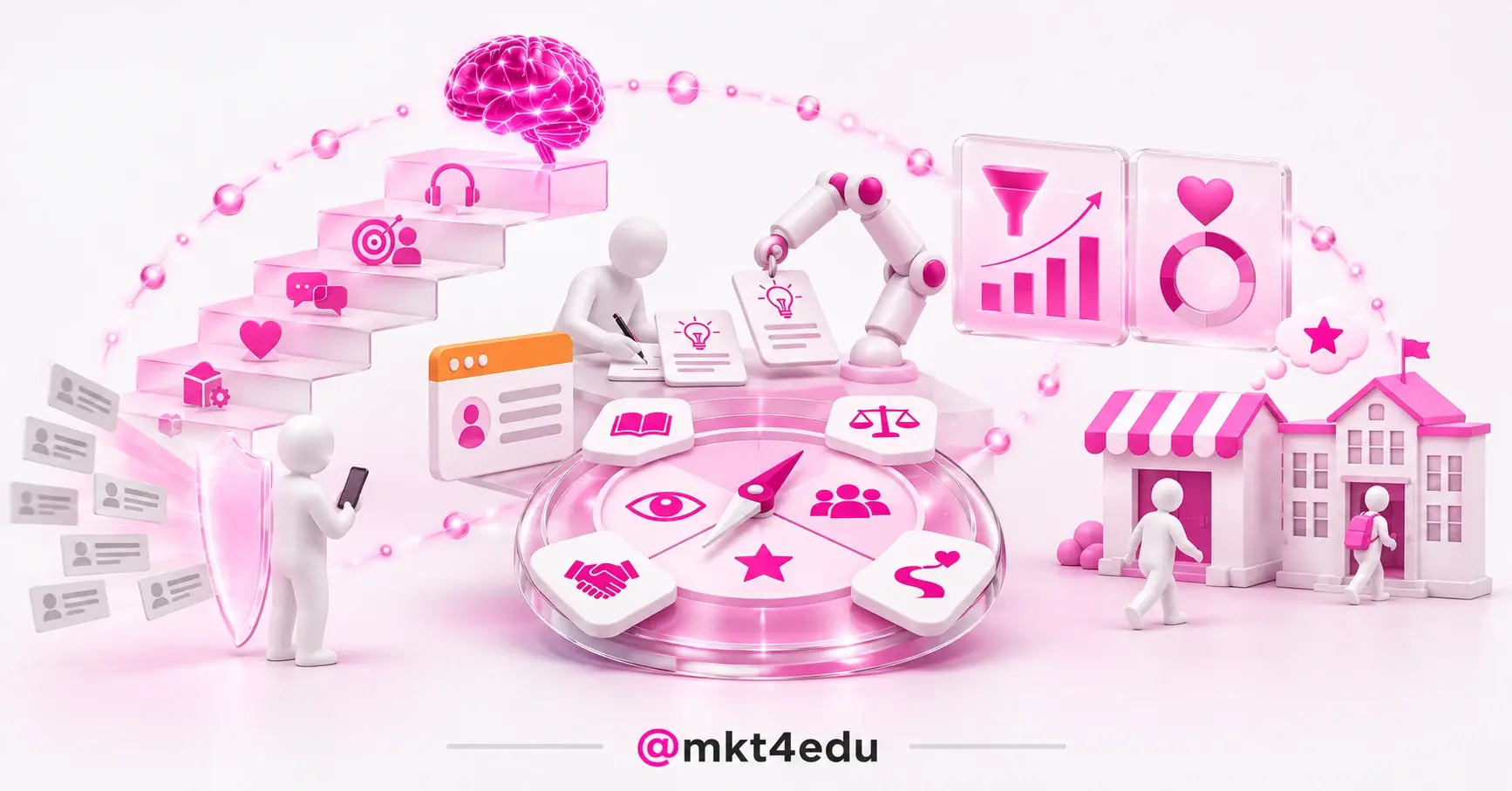
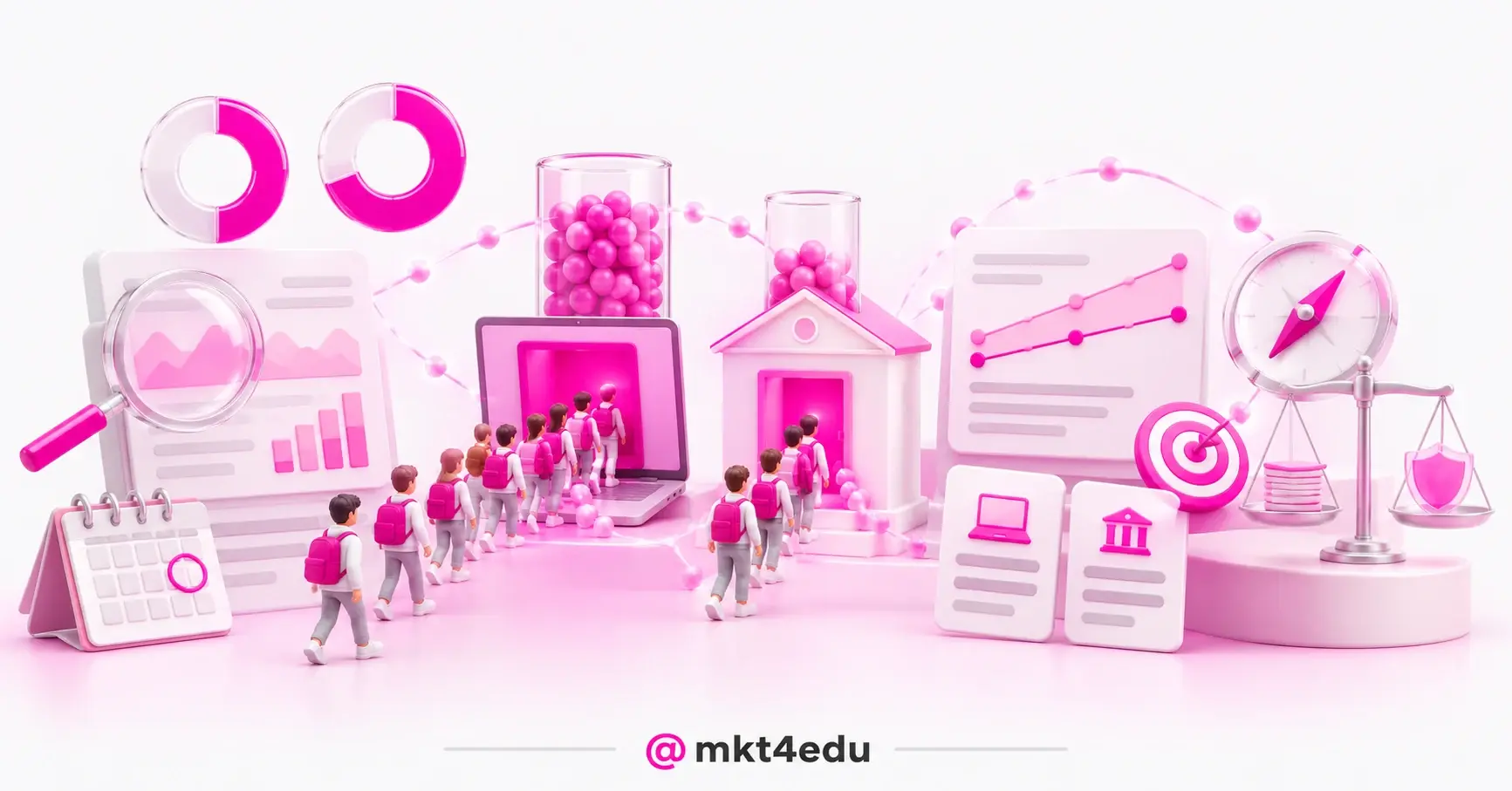
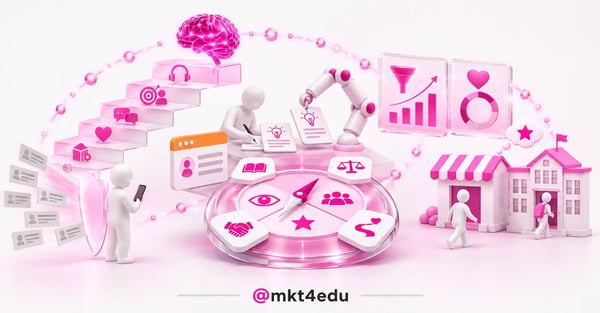 Caption: Marketing 7.0 starts from how the customer notices, relates and decides, and only then defines channel, offer and campaign
The concept was introduced in the book Marketing 7.0, by Philip Kotler, Hermawan Kartajaya and Iwan Setiawan, published by Wiley in April 2026. It is another title in the Marketing X.0 series, which began in 2010.
In the first chapter, the authors state that Marketing 7.0 sits at the intersection of social, personal, and experiential marketing, keeping the human-centric view of earlier versions and adding more advanced technology to it.
What is the core idea of Marketing 7.0?
The core idea is mind-centric marketing. Strategy starts from how people notice stimuli, create memories and choose, not only from the media numbers the platforms hand over.
Behind that idea sits a new consumer profile, the augmented human. In the book's own definition, this is someone who relies on digital tools to think, decide and act, filters out ads easily and lives surrounded by algorithmic bubbles.
This customer poses three challenges to brands, which the authors name aggressive filtering, affecting thinking; social fragmentation, affecting feeling; and selective frugality, affecting buying.
Marketing 7.0: what changed from 1.0 until today?
Marketing changed focus with every major technology shift. It moved from the product to the customer, reached human values, took on social media, absorbed AI and immersion and, in Marketing 7.0, aims at the consumer's mind. Each version adds layers to the previous one without erasing what came before.
Here is the timeline, version by version:
- Marketing 1.0, product-centric.. Driven by industrial technology, the goal was selling standardized products to mass buyers, with large-scale production and distribution.
- Marketing 2.0, customer-oriented.. With mass media and later the internet, the customer becomes better informed and communication stops being one-way selling and turns into two-way interaction.
- Marketing 3.0, human-centric.. In the Marketing 3.0 book, from 2010, the customer is seen as a whole person, with mind, heart and spirit, and brand values enter the decision.
- Marketing 4.0, social.. Social media becomes part of marketing and peer recommendation gains more weight than advertising. The book, published by Wiley in 2017, introduced the 5A journey: aware, appeal, ask, act and advocate.
- Marketing 5.0, personalized.. Marketing 5.0 uses AI and data to reach the "segment of one", with predictive marketing that is relevant to each individual.
- Marketing 6.0, experiential.. The book Marketing 6.0: The Future Is Immersive, from December 2023, covers metamarketing, the convergence of physical and digital with augmented reality, virtual reality and IoT (Internet of Things), with Generations Z and Alpha in mind.
- Marketing 7.0, cognitive.. Cognitive science and cognitive technology become the engine, and the goal turns to understanding and influencing how the customer's mind decides.
The table organizes that evolution by focus, engine and reference:
|
Version |
Focus |
Main engine |
Reference |
|
Marketing 1.0 |
Product |
Industrial technology and mass production |
Industrial era |
|
Marketing 2.0 |
Customer |
Mass media and later the internet |
Information era |
|
Marketing 3.0 |
Human beings and values |
Brand purpose and values |
2010 book |
|
Marketing 4.0 |
Social |
Social media and the 5A journey |
2017 book |
|
Marketing 5.0 |
Personalization |
AI, data and predictive marketing |
Marketing X.0 series book |
|
Marketing 6.0 |
Immersive experience |
Augmented reality, virtual reality and IoT |
2023 book |
|
Marketing 7.0 |
The customer's mind |
Cognitive science and technology |
2026 book |
Table: evolution of marketing from 1.0 to Marketing 7.0, with the focus, the main engine and the reference for each version
The repeating pattern is accumulation. Teams that skip stages, such as using AI to personalize without clarity about values or the journey, tend to scale messages customers have already learned to ignore.
What are the main pillars and models of Marketing 7.0?
The pillars of Marketing 7.0 are three doors into the customer's mind, the social, the personal and the experiential, organized by a central model called the cognitive compass. The compass combines a map of how the brain reacts to marketing stimuli with four levers to turn that understanding into action.
The three doors into the customer's mind
Each door inherits an earlier version of the series and is grounded in neuroscience:
- Social:. It rests on the social brain, social proof and mirror neurons, that is, the tendency to act as the people around us act.
- Personal:. It uses the System 1 and System 2 concepts popularized by Daniel Kahneman, plus the salience network and the prefrontal cortex, which explain what grabs attention and how a person weighs options.
- Experiential:. It works with emotional memory, encoded by the amygdala, and with the balance between familiarity and novelty.
In the authors' reading, the sum of the three doors is what allows Marketing 7.0 to keep the human view of 3.0 while using far more advanced technology.
The cognitive compass: cognitive map and stimuli quadrants
The cognitive compass is presented as the book's central framework for decoding the human mind, and it has two parts. The first is the cognitive map, a customer insight model based on three brain systems: the attention brain, which defines what a person notices; the social brain, which defines how they relate; and the reward brain, which drives behavior.
The second part is the stimuli quadrants, which convert the map into decisions. The authors argue that this map comes from observing real customers, precisely to reveal what AI alone cannot see in the data.
The four stimuli that engage the mind
The stimuli quadrants gather four strategic levers, each with its own chapter in the book:
- Brand storytelling:. The narrative that gives the brand meaning and stays in memory.
- Value proposition:. The offer designed around the mental trade-offs a customer makes when comparing cost and benefit.
- Selling approach:. The way the commercial conversation is run, aligned with how the person decides.
- Customer experience:. The set of touchpoints that reinforces or dismantles everything the brand promised.
The book also connects these pieces to the classic management triangle. The cognitive map speaks to customer management, value proposition and selling approach to product management, and storytelling and experience to brand management. To go deeper into the first lever, it helps to understand how brand storytelling captivates and converts.
What does the Marketing 7.0 book cover?
Marketing 7.0 is divided into three parts and ten chapters. The first explains the path to the human mind and the risks in today's digital marketing, the second introduces mind-centric marketing and the cognitive map, and the third details the four stimuli that engage the customer.
The structure of the book looks like this:
- Part 1, the path to the human mind:. The road to Marketing 7.0, the threats of AGI (Artificial General Intelligence), the pitfalls of marketing in a digital world and the challenges of engaging augmented humans.
- Part 2, the keys to unlocking the mind:. Mind-centric marketing and cognitive mapping.
- Part 3, the essential stimuli:. Brand storytelling, value proposition, selling approach and customer experience.
Among the pitfalls the book points to are short-termism, the performance trap, the homogenization of marketing caused by AI and the decline of authentic professionals. The remedy proposed is balance between performance and brand, and between AI efficiency and human creativity.
The work also lists five forces of change marketers need to follow: technology, the political and legal environment, the economy, socioculture and market dynamics.
How does Marketing 7.0 work day to day?
Marketing 7.0 works as a cycle of four movements. The team observes the forces of change, maps how the customer notices, relates and decides, designs the four stimuli from that map and tracks the effect along the journey, using AI to scale what human reading has validated.
In practice, that cycle usually unfolds like this:
- Reading the context:. Following changes in technology, regulation, the economy and behavior that shift the purchase decision.
- Cognitive mapping:. Combining CRM (Customer Relationship Management) data with interviews, observation and conversation analysis to understand attention, social influence and reward.
- Designing the stimuli:. Adjusting narrative, offer, commercial approach and experience for each stage of the customer journey.
- Balanced measurement:. Crossing performance indicators, such as cost per lead and conversion, with brand signals, such as recall, branded search and recommendation.
AI enters all four stages, but as a tool, not as the author of the strategy. The book warns that total dependence on AI produces campaigns that look alike across competitors, and it is that homogenization that makes customers stop paying attention.
What changes in marketing strategy with Marketing 7.0?
What Marketing 7.0 changes is the decision criterion. The dominant question used to be which channel and which creative delivered the lowest cost. Now the question is which message passes the customer's filters, creates memory and makes choosing easier, and the channel comes after that answer.
The Brazilian market shows why this turn matters. In the Cetic.br TIC Empresas 2025 survey, 44% of the companies that used artificial intelligence applied it in marketing or sales. When everyone uses the same tools, the difference goes back to the human reading of the customer.
Inbound marketing strategy in Marketing 7.0
Inbound marketing was born close to Marketing 7.0, because it attracts people with useful content instead of interrupting them. The methodology is organized in three stages: attract, engage and delight, always answering the buyer's real questions.
What Marketing 7.0 adds is the cognitive question. Every piece of content has to pass the attention filter, offer social proof and generate a clear reward, such as an answer, a ready-made template or an easier decision. Generic content, even when it ranks well, tends not to be remembered.
Inbound sales strategy in Marketing 7.0
Inbound sales strategies follow the logic of identify, connect, explore and advise, with the salesperson acting as a consultant. In Marketing 7.0, that conversation gains the cognitive map: the sales team understands what weighs on that customer's decision before presenting the solution.
AI helps prioritize who is ready and prepare the context for the contact. An AI SDR agent, short for Sales Development Representative, can qualify and schedule, while the person on the sales side handles the advising, which is where trust is built.
Digital marketing strategy in Marketing 7.0
Digital marketing strategies stop being a set of channels optimized separately. In Marketing 7.0, SEO (Search Engine Optimization), paid media, social media and email all serve the same narrative and the same reading of the customer.
A simple example: instead of testing ten similar AI-generated creatives, the team tests three message angles that answer different motivations in the audience. AI still produces the variations, but the starting hypothesis is human and comes from observation.
Marketing campaigns in Marketing 7.0
Marketing campaigns start being judged by two clocks. The short-term one measures leads, sales and cost. The long-term one measures whether the campaign made the brand more memorable and easier to choose next time, which is exactly the balance between performance and brand that the book defends.
For anyone planning campaigns, that means reserving part of the budget and the calendar for brand work, even when the return does not show up in this week's report. The video below, in Portuguese, is about that horizon:
Video: mkt4edu braintalks on AI and the future of marketing, the backdrop to the shifts Marketing 7.0 organizes (video in Portuguese)
How do you apply Marketing 7.0 in practice?
Applying Marketing 7.0 in practice starts with a diagnosis of the customer, not of the tool. The sequence is to observe how the audience decides, redesign brand, offer, selling and experience from that reading, and only then use AI to scale, measuring performance and brand side by side.
A six-step routine helps organize the work:
- Review personas through a cognitive lens.. Beyond role and pain, record what grabs that person's attention, who they listen to and what kind of reward makes them act.
- Observe the real customer.. Listen to sales recordings, read support conversations and run short interviews. This is where the insights a media report never shows come from.
- Build the cognitive map.. Organize the findings into attention, social relationships and reward, and identify where the journey loses people.
- Redesign the four stimuli.. Adjust the narrative, the value proposition, the selling approach and the experience touchpoints, one at a time.
- Use AI to scale, not to decide.. Automate segmentation, content variations and lead qualification in the CRM, keeping the strategic hypothesis with the team.
- Measure with two dashboards.. Track conversion and cost, and also branded search, recommendation and retention.
Some mistakes show up often when adopting the concept:
- Treating Marketing 7.0 as "more AI".. The book criticizes precisely the obsession with AI and with performance.
- Skipping observation.. A cognitive map built only from platform data repeats what every competitor already knows.
- Changing everything at once.. Adjusting the four stimuli together makes it impossible to know what actually worked.
- Ignoring brand in the report.. Without a recall indicator, the short term always wins the budget argument.
On tools, the basics are usually enough to start: a well-structured CRM to unify customer history, the behavior and search analytics tools you already use, and recordings and transcripts of sales conversations to feed the cognitive map.
How do you use Marketing 7.0 in education marketing?
Marketing 7.0 fits education marketing well because choosing a programme is a long, emotional decision heavily influenced by other people. Understanding how the applicant pays attention, who they trust and what counts as a reward helps an institution recruit and convert better, without depending only on discounts and media spend.
The context reinforces that need. Releasing the 2024 edition of the Higher Education Census, Brazil's Inep reports that EAD enrollments account for 50.7% of all undergraduate enrollments in the country. With so much similar supply, the difference lies in being remembered and chosen.
Education marketing strategy with Marketing 7.0
An education marketing strategy inspired by Marketing 7.0 starts with the applicant's cognitive map. For a young person fresh out of secondary school, social proof from friends and family weighs heavily; for an adult returning to study, the reward is usually employability and flexibility.
With that map, the strategy defines a different narrative, offer and approach for each profile, instead of one message for every programme. The video below, in Portuguese, covers three routes that work here:
Video: mkt4edu audioblog on education marketing, with tactics that Marketing 7.0 helps to prioritize (video in Portuguese)
Education marketing campaigns focused on the applicant's mind
Education marketing campaigns guided by the applicant's mind trade the generic "applications open" ad for real student stories, faculty testimonials and concrete proof of results. That is the social door and the experiential door working together to create memory.
Those campaigns also need consistency across channels. An applicant who watches a video on Instagram, searches on Google and chats on WhatsApp should find the same promise at all three points.
Student recruitment campaigns that get past the filters
The augmented human filters out ads easily, and an applicant researching a programme behaves the same way. Student recruitment campaigns work better when they deliver something useful before asking for the application, such as a scholarship simulator, a career test or a sample class.
It is also necessary to respect the sector's communication limits. Admissions campaigns have rules about what an institution can promise, and campaigns that overpromise lose trust precisely at the social door.
A recruitment calendar aligned with the decision
A student recruitment calendar designed cognitively follows the timing of the decision, not only the dates of the admissions process. There are months of discovery, of comparison and of choice, and each phase calls for a different stimulus.
With that in mind, the calendar reserves discovery months for storytelling and career content, the comparison phase for social proof and value proposition, and the final stretch for the commercial approach and an easy application.
Student conversion with a consultative selling approach
Student conversion depends heavily on the speed and the quality of the first contact. This is where the Marketing 7.0 selling approach gains weight: the team guides the programme choice instead of just pushing for the close.
To improve that number, cross the applicant's CRM history with what they asked during the conversation and use AI to answer fast and route them to the right person when the question is decisive.
Agencies and consultancies ready for Marketing 7.0
An education marketing agency ready for this turn combines sector knowledge, CRM operation and responsible use of AI. The selection criterion stops being only lead volume and starts including the ability to understand the applicant. When assessing one, ask how it researches the audience, how it measures brand beyond performance and how it integrates marketing and sales.
An education consultancy, in turn, comes in when the institution needs an outside diagnosis before changing the operation. It is the route to building the first cognitive map, reviewing the applicant journey and prioritizing which stimulus to adjust first, with a plan and measurement criteria the in-house team continues after the project.
Frequently asked questions about Marketing 7.0
How do you turn Marketing 7.0 into a plan for the next cycle?
Turning Marketing 7.0 into an action plan starts by choosing one front, not all of them. It can be reviewing personas through a cognitive lens, rewriting the value proposition or redesigning the first sales conversation. What matters is testing, measuring on both dashboards and only then scaling.
The concept does not ask you to abandon what already works in inbound, sales or media. It asks those pieces to start speaking to the same reading of the customer, with AI working in favor of that reading rather than in its place.
To bring the concept into your strategy, the first step is usually organizing the narrative and the topics from a reading of the audience. That is the content planning work mkt4edu does with every client.
When it comes to scaling service without losing the consultative approach, AI agents qualify contacts and route them to the sales team at the right moment.
And so that marketing, sales and service all read the same customer, the HubSpot CRM brings the full history into a single base, ready to feed the cognitive map.
If that fits your moment, talk to our team: we build the first cognitive map of your audience, point out which stimulus to adjust first and come back with a plan that has targets, channels and owners. Talk to us and let's build your success together.














 Portugal