






Every educational institution knows the feeling of a good campaign with a weak result. The media report shows leads on target, the registrar's office works all day, and the class opens with fewer students than planned.
In most cases, the problem is not attraction. Lead loss in the enrollment funnel happens afterwards, in stretches nobody measures because they are spread across marketing, student service and the registrar's office.
As long as the funnel is not measured stage by stage, any correction is guesswork. Increasing the student recruitment budget with a leaking funnel only increases the volume lost in the same place.
What are the stages of the recruitment and enrollment funnel?
The recruitment and enrollment funnel has five stages: visit, lead, registrant, approved and enrolled. Each handoff between them has a different owner inside the institution, and it is precisely in those changes of hands that most applicants disappear.
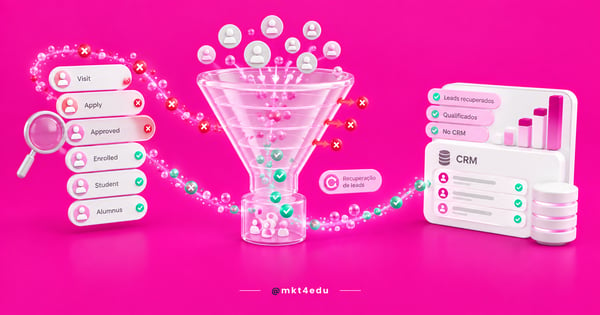 Caption: lead loss in the enrollment funnel happens in the handoffs between marketing, the registrar's office and finance
The first stage belongs to marketing. A visit becomes a lead when someone fills in a form, responds to an ad or starts a conversation on a service channel.
The second handoff depends on speed. A lead becomes a registrant when the applicant completes the admissions process, and that decision usually happens on the same day they searched.
From registration onwards, the process leaves marketing. Approval, documentation and payment go through the registrar's office and finance, areas that rarely appear in the campaign report.
The last stretch is the quietest. An approved applicant who does not submit a document triggers no alert anywhere, and disappears without anyone recording the reason.
Where does the biggest lead loss in the enrollment funnel happen?
The biggest lead loss in the enrollment funnel happens between registration and the payment of the first tuition installment. Since signing up is free and immediate, it is common, in the operations mkt4edu works with, for the same applicant to register at several institutions and choose later, based on who answered first and resolved their questions.
Each stage, however, has its own bottleneck. Recognizing them avoids treating the whole funnel with the same recipe.
The size of the entry funnel helps put the loss in perspective. The results of the Higher Education Census, published by Brazil's Inep, show the distance between the volume of entrants and of graduates in the sector.
Here is how the causes spread along the path:
|
Handoff |
Typical bottleneck |
Correction |
|
Visit to lead |
Long form and a page with no course information |
Cut fields and complete the course page |
|
Lead to registrant |
Delay in the first contact |
Immediate automated reply and a prioritized queue |
|
Registrant to approved |
The applicant does not finish the test or submit a grade |
Reminder with the deadline and a direct support channel |
|
Approved to enrolled |
Documents, financial doubt and comparison with another institution |
Enrollment cadence and a payment alternative |
Table: The most common bottlenecks at each handoff in an educational institution's enrollment funnel.
Notice that only the first bottleneck is a marketing problem in the traditional sense. The others are about process, deadlines and service.
That is why new campaigns rarely fix a low enrollment rate. They push more people into a path that was already losing applicants before.
How does HubSpot CRM make lead loss visible?
HubSpot CRM makes lead loss visible by recording each applicant at a lifecycle stage and showing how many move from one stage to the next. With that, the institution stops discussing total volume and starts discussing the pass-through rate between specific stages.
The first step is mapping the institution's real funnel inside the CRM. A generic sales pipeline does not describe an admissions process with a test, an approval and an enrollment.
With the right stages, the report changes in nature. Instead of "a thousand leads this month", it shows the loss by stage, as in the hypothetical example of 40% of registrants who never reach approval, which is a concrete and addressable problem.
The CRM also reveals the origin of each loss. When the entry channel is recorded on the contact, it becomes possible to see that a given ad generates many registrants and few enrollments, a sign of misaligned expectations.
None of this works without discipline in recording. A CRM applied to student recruitment only shows reality if the registrar's conversation and finance's reply land in the same database.
Improving the education sales funnel starts there, because it is impossible to fix what appears in no report.
Which sales automation recovers applicants before they give up?
The sales automation that recovers the most applicants is the enrollment cadence: a short sequence, triggered right after registration, that gets ahead of documentation, deadlines and payment method. It works because it attacks forgetfulness and doubt, the two most common causes of abandonment at that stage.
The basic design fits into three contacts. Confirmation on the same day, a reminder of what is pending two days later and a follow-up before the deadline closes.
The channel changes the result as much as the copy. The Super Panorama by Mobile Time/Opinion Box puts WhatsApp on the home screen of 64.8% of Brazilian smartphones, which helps explain why WhatsApp applied to student recruitment usually outperforms email at this stage.
The message structure follows the same logic as a communication cadence built for conversion, with the difference that here the goal is to unblock a pending item, not to introduce the institution.
It is also worth automating what happens before the lead exists. A well-built form in HubSpot reduces abandonment on the page itself and improves the quality of the contact entering the funnel.
In high-volume operations, a pre-sales agent integrated with the CRM guarantees an immediate response outside business hours, which is when much of the registration happens. mkt4edu runs that layer with voice and service AI agents.
The automation has to stop when the applicant replies. Keeping the sequence running after a reply turns a recovery effort into an annoyance, and usually costs the enrollment that was nearly closed.
It is worth separating those who stopped out of doubt from those who stopped over money. The first situation is resolved with objective information, while the second depends on a scholarship, financing or installments, and requires routing to whoever has the authority.
Well configured, this layer gives the team its time back. Student service stops chasing everyone and starts working the list of those who showed real interest, which is the practical beginning of any sales funnel improvement.
How do you fix the handoff between marketing and the registrar's office?
The handoff between marketing and the registrar's office is fixed with three definitions: who takes over the applicant at each stage, within how long that contact has to happen and where the outcome is recorded. Without those three rules, the lead sits in no man's land and the loss becomes routine.
The classic symptom of that failure is the repeated question. The applicant explains their situation to marketing, then explains it again to the registrar's office, and concludes the institution is disorganized.
The deadline has to be explicit and measured. The Harvard Business Review study cited above links contact within the first hour to an almost seven times greater chance of qualifying the lead. A target of first contact within fifteen minutes only exists once the report shows how long the institution actually takes.
Recording the outcome closes the loop. Knowing whether the applicant gave up over money, over documents or because they chose another institution is what makes it possible to fix the cause in the next cycle.
Defining owners is one of the educational marketing strategies with the best ratio of effort to return, because it does not depend on new budget.
It is worth extending the agreement beyond enrollment. When the same design covers re-enrollment, the institution starts treating student recruitment and retention as a single process, rather than two teams competing for priority.
That unification is the point where losing an applicant and losing a student stop being separate subjects. Student retention depends on the same record and the same clarity of ownership that recruitment requires at the entrance.
An educational consultancy usually starts its work with exactly that map of responsibilities, because it reveals within weeks where the institution is losing without noticing.
Much of educational marketing strategy fails here, and not in the creative work. The campaign does its job of bringing interested people in, but the internal path does not hold the volume it delivers.
Which indicators measure the conversion of registrants into enrolled students?
Four indicators measure the conversion of registrants into enrolled students: the pass-through rate between stages, average time to first contact, total funnel time and cost per enrollment by course. Together, they show whether the problem is attracting, responding or completing the process.
The pass-through rate is the main indicator. It turns the feeling of "we lose a lot of people" into a number per stage, which can be compared between courses and between terms.
Time to first contact is usually the easiest to improve. It is also the one that responds fastest, because it depends on organizing a queue and not on investment.
Cost per enrollment by course closes the financial reading. It shows which courses sustain the operation and which consume budget without delivering a full class.
Institutions that have already built a measurement plan tied to revenue operations manage to track those four numbers without manual work before every meeting.
Improving commercial processes in education depends on that base. Without an indicator per stage, any change becomes an opinion, and the discussion goes back to lead volume.
It is also worth tracking the outcome of those who did not enroll. A reason for withdrawal recorded in HubSpot CRM turns a loss into information, and shows whether the obstacle was price, deadline, documentation or competition.
Those reasons tend to repeat by course. When three out of four withdrawals from the same course cite payment terms, the fix stops being a marketing matter and becomes commercial policy.
Reading by cohort closes the improvement cycle of the education sales funnel. Comparing the same stage across two terms shows whether the change worked or merely moved the bottleneck to the next stage.
Institutions that sustain that routine manage to forecast the class before the admissions process ends, which changes the conversation about opening classes and allocating teachers.
Frequently asked questions about lead loss in the enrollment funnel
What should you prioritize first to reduce lead loss?
Prioritize the stretch between registration and enrollment. That is where the most interested people are, where the loss is largest and where the fix does not depend on new budget, only on cadence, deadlines and a defined owner.
Second, measure the time to first contact. That number usually reveals a bottleneck nobody suspected and responds quickly to simple changes in organization.
Leave the campaign review for last. As long as the funnel does not hold the applicant who already arrived, more traffic simply means more loss at the same point.
If your institution wants to see the funnel stage by stage and recover the enrollments lost halfway through today, the mkt4edu team can structure the process with HubSpot CRM applied to education. Talk to our team to map where your biggest loss sits.



























 Portugal