


A quiet change on Instagram can interfere directly with secondary school recruitment at any institution that uses DMs (direct messages) as a prospecting channel. Since November 2026 the Instagram age restriction has applied globally, and the platform can classify a profile as a teenager even when the account was registered with an adult age.
Meta officially calls the feature age estimation, but people search for it as the Instagram age restriction, which is how the change shows up for most marketing teams.
For anyone running admissions campaigns with direct outreach on social media, this is a change to the rules of the game, not a cosmetic adjustment.
What is the Instagram age restriction and how does it work?
The Instagram age restriction is the set of protections the platform applies when its AI (Artificial Intelligence) age estimation calculates that a profile probably belongs to a teenager, based on behaviour, connections and usage patterns, not only on the date of birth entered at registration.
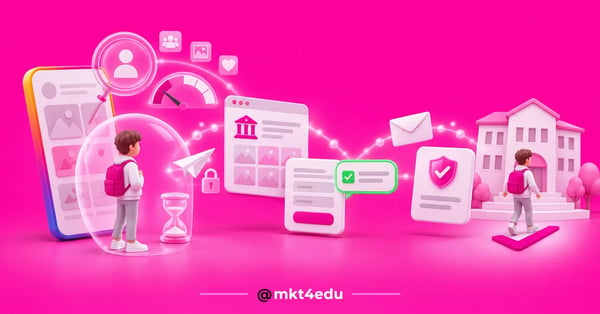 Caption: the Instagram age restriction acts before the first message, and changes the route by which a secondary school candidate reaches the institution
When that calculation points to a teenager, the platform automatically applies Teen Account restrictions, even if the user registered an adult age on purpose.
The feature does not rely on facial recognition and does not ask for a document at every check. The analysis looks at indirect signals: who the profile interacts with, what kind of content it consumes, which accounts it follows and how it behaves inside the app over time.
The 9 November 2026 change did not create the feature; it widened its reach. Meta describes the news by saying it is expanding its AI age-estimation technology globally, putting millions more teenagers under Teen Account protections, "no matter where you live".
The previous reach was already substantial. Al Jazeera records that the technology had already been rolled out in more than 20 countries before the announcement, which shows Instagram had been testing automatic classification for some time before taking it worldwide.
Why did Meta decide to expand age estimation worldwide?
Meta expanded age estimation worldwide after a run of court settlements and regulatory pressure over teenage safety on social media, amid accusations that platform age verification was insufficient. The announcement arrived alongside other measures aimed at under-18s.
The company cites in its own statement a recent settlement with 52 attorneys general from both parties in the United States. According to Al Jazeera, the suit was settled out of court in August, with Meta agreeing to pay up to $18bn and to make significant changes to protect minors, among them time limits, nighttime curfews and limits on filters that simulate cosmetic procedures.
The same report says part of the payment, about $5bn, is conditional on competitors adopting similar measures. AI age estimation sits inside that package, as the technical layer that holds the other restrictions up.
The company also says that later this year it will begin rolling out similar technology globally on Threads, and that it continues to implement the feature on Facebook. The strategy behind it is clear: make age classification automatic across Meta's whole app ecosystem, not just on Instagram.

Does the Instagram age restriction already apply to accounts in Brazil?
Yes. In its Portuguese-language statement, Meta says it is expanding globally a technology "already used on Instagram in Brazil". The November 2026 news, then, is taking the same feature to more countries, not launching it here.
The company does not publish a closed list of countries covered by the expansion, nor does it detail criteria country by country. The official position is global reach, and that the effort holds "no matter where you live", which includes Brazil by Meta's own direct confirmation.
For the marketing team at a Brazilian institution, that confirmation changes the weight of the news: this is not a feature that "might arrive one day", it is a feature already running over the institutional profile and over the profile of the candidate the team is trying to reach.
What happens when the AI identifies a teenager?
When the AI identifies a teenager, the account falls under Teen Account rules, which limit who can start contact, what kind of content appears and how much daily screen time is allowed. For an institution, the practical effect is that the institutional account may lose the ability to open a DM with that candidate.
The restrictions vary with the configuration and the country, but they follow a common pattern across the markets where the feature already runs:
|
Restriction |
What changes |
Effect on recruitment |
|
Who can make contact |
A direct message from a profile outside the teenager's network of contacts is restricted. |
The institutional account may not be able to open a DM. |
|
Content shown |
Recommendations and searches pass through a stricter age filter. |
Ads and organic posts reach that profile less often. |
|
Screen time |
Break reminders and a daily usage limit come into force. |
The window for contacting the candidate shrinks. |
Table: typical Teen Account restrictions under the Instagram age restriction and their practical effect on institutional prospecting
The time limit has published numbers in at least one market. In the United States, according to Al Jazeera, Meta will cap under-18s at two hours a day and apply a midnight-to-6am curfew. The company has not published equivalent parameters for Brazil.
The central point for recruitment is the first row of the table. An institution prospecting secondary school candidates by DM may simply be unable to start the conversation, because the platform treats the institutional account as a contact outside the teenager's network, which cuts student conversion through that channel.
Is Instagram's AI age estimation reliable?
The reliability of AI age estimation is questioned by researchers and regulators, and Meta does not publish the accuracy of its own model. Treating the feature as a finished, infallible solution is an editorial and strategic risk for anyone planning around it.
Sonia Livingstone, a researcher at the London School of Economics, points to the absence of clear evidence that the system stops young children from creating accounts or that every teenager is in fact moved into a Teen Account. In her view the feature poses a privacy risk to all users, not just children, because identifying who is a minor requires analysing everyone's behaviour.
There is also a precedent of limited effectiveness in an equivalent age ban. Australia's online safety regulator, eSafety, found that more than 80 percent of preteens and young teens were still using social media half a year after the country's under-16 ban, largely because age checks failed to stop them.
Livingstone's criticism and the eSafety data do not mean the feature has no effect at all. They mean an institution's recruitment cannot assume the AI identification is accurate, nor that every real secondary school candidate will show up in the system with the correct adult age.
How does the Instagram age restriction affect secondary school recruitment?
The Instagram age restriction affects secondary school recruitment directly, because much of that prospecting happens by DM, whether in an admissions campaign or in early outreach to final-year students. If the AI identifies the candidate as a teenager, even when they registered an adult age, the institutional account may not be able to send the first message.
The risk is not hypothetical. A secondary school candidate is usually between 15 and 18, exactly the band Teen Accounts protect, and exactly the band where registering an adult date of birth, by mistake or by choice, is common.
This is a point of analysis and recommendation from mkt4edu, not a fact published by Meta: teams that build their whole secondary school recruitment cadence around direct DMs on Instagram are betting on a channel that can close the door halfway through, with no warning and no control by the institution over when it happens.
That risk does not knock Instagram out as a recruitment channel, but it does knock out the bet of relying on it alone to open the first conversation with this specific audience, which strengthens the case for diversifying the student recruitment strategy for secondary school.
How do you adjust the digital marketing strategy around this restriction?
Adjusting the digital marketing strategy around this restriction means keeping the channel but no longer depending on it as the only door to direct contact with a secondary school candidate. mkt4edu's recommendation is to strengthen complementary channels that do not depend on the AI clearing the contact.
Three practical fronts help the team reduce that dependency:
- The form as the main entry point. A campaign landing page captures the lead before any DM attempt, and the first contact goes out through a channel the institution controls.
- WhatsApp with explicit opt-in. The candidate authorises contact on the form itself, which secures a direct channel that does not depend on Instagram's age classification.
- Email as the nurturing layer. It keeps the relationship alive between the first contact and enrolment, without depending on the institutional account sending a message inside the app.
Video: mkt4edu audioblog on landing pages, the entry point that does not depend on the Instagram age restriction
Diversifying channels does not mean abandoning the institution's social media management. Social media marketing for secondary school still needs an active presence on Instagram, because that is where the candidate researches, compares and decides whether to trust the brand before applying to any admissions process.
What changes is the channel's role inside the funnel. The institution's social media strategies start treating Instagram as a shop window and a discovery point, with the form, WhatsApp with opt-in and email as the channels that actually open and sustain the individual conversation with the candidate.
Working on SEO for social media on the institutional profile is still worth it, because it improves the chance of the candidate finding the institution on their own, through search inside and outside the platform, and that also feeds the volume of leads arriving through the form rather than through DMs.
Monitoring Meta's commercial terms belongs in the routine of any team that depends on the platform for paid media, because changes like this arrive first in an official statement and only later show up in campaign results.
Reviewing the secondary school student recruitment calendar alongside that routine helps redistribute the weight between channels before a drop in contact becomes a missed target.
What role does Brazil's ECA Digital play in this?
The ECA Digital is Law 15,211 of 17 September 2025, which governs the protection of children and teenagers in digital environments and is nicknamed the Digital Statute of the Child and Adolescent. Meta cites that law in its statement about the expansion, arguing that parental approval for app downloads and age verification should happen at the level of app stores and operating systems.
For an institution's recruitment, the point to watch is not legal but practical. The Instagram age restriction is a technical layer of the platform, while the ECA Digital is the legal layer that already requires different treatment for teenagers' data in the Brazilian online environment.
Both send the marketing team the same signal: handle contact with a minor with more care, documented consent and channels that allow explicit opt-in.
The same care also affects the institution's CRM (Customer Relationship Management) data, because a secondary school candidate arriving through a form or through WhatsApp with opt-in needs data handling aligned with data protection law, with the same attention already given to any sensitive data about a minor.
Frequently asked questions about the Instagram age restriction
Where should the recruitment team start with the Instagram age restriction?
The first step is mapping how much of the secondary school enrolment target depends today on DMs opened by the institutional account on Instagram. That number alone already shows the institution's real exposure to the Instagram age restriction, before any other adjustment.
With that number in hand, the priority is redesigning the top of the funnel so that the form and WhatsApp with opt-in take over the job of opening contact, leaving Instagram as a discovery and ongoing relationship channel.
That division of roles between channels is what sustains a marketing strategy resilient to platform changes the institution does not control. The article on educational marketing strategies gathers other channel adjustments for anyone facing this same kind of rule change.
Want help reviewing the secondary school recruitment cadence with this scenario in mind? mkt4edu's educational marketing agency and educational marketing consultancy help redesign the funnel with diversified channels, and the team is available to talk through a diagnosis of your own operation. Talk to us and let's build your success together.
















 Portugal