




Every lead generation team has been through the same scenario: a report full of new leads, celebrations at the end of the month, and—weeks later—a sales rep complaining that no one is responding or moving forward.
Understanding how to generate qualified leads resolves this disconnect precisely because it shifts the focus from the number of sign-ups to the actual intent of those who join the database. This applies to both educational institutions and companies in any industry.
High volume may seem like progress, but when most contacts have no concrete interest, the effort becomes a waste.
This article advocates a simple idea: fewer leads—as long as they’re warmer—generate more enrollments and more sales than a flood of cold leads. And the driving force behind this change is decision-making content—content that speaks to those who are already making a choice.
What does it mean to generate qualified leads?
Generating qualified leads means attracting contacts whose profile and intent align with what you offer—not just accumulating sign-ups.
A qualified lead shows genuine interest, fits the audience you serve, and demonstrates signs that they may move toward a purchase or enrollment decision.
The word “qualified” has two dimensions. The first is profile: the person is part of the audience served by the educational institution or company, in the right region, segment, or program category. The second is intent: through their behavior, they demonstrate that they are considering a choice.
A contact who downloaded free material out of curiosity fits the profile but may have no intention. On the other hand, someone who researched prices, compared options, and returned to the website three times has both.
The most common mistake is treating every registration as a lead. An email address in a spreadsheet is not an opportunity; it only becomes an opportunity when there is a match between what the person is looking for and what you offer.
That’s why understanding how to generate leads with a focus on quality begins before the lead generation process itself. It starts with defining who you want to attract and what signals indicate that it’s worth investing sales time in that person.
Why prioritize quality over volume?
Prioritizing quality over volume pays off because an inflated lead base is costly and yields little. Every cold contact consumes the sales team’s attention, skews metrics, and delays service for those who actually want to buy.
Fewer, but warmer, leads accelerate the sales funnel and improve the conversion rate for sign-ups or sales.
Volume has a strong psychological appeal. A large number looks like success, but the hidden cost becomes apparent later, when the sales team spends hours calling people who never intended to buy or enroll.
Think of time as a limited resource. If a consultant manages to speak with fifty people a week, it makes a huge difference whether those fifty are simply curious or whether they are prospects and customers seriously considering enrollment or a purchase.
A large pool can also skew the analysis. A low conversion rate is often interpreted as a failure on the salesperson’s part, when in fact the problem originated at the top—in attracting people who aren’t a good fit.
There’s also the impact on team morale. Calling dozens of contacts who don’t answer or say they just wanted the free material wears down any team. The consultant wastes energy on people who aren’t going to convert.
It’s worth remembering that investing in high-quality organic lead generation yields returns in the medium term. Those who understand why SEO pays off as a lead generation strategy knows that attracting the right person is worth more than attracting a lot of the wrong people.
The logic is the same as when fishing. There’s no point in pulling in a full net if most of the catch has to be thrown back into the sea. It’s better to cast the right bait in the right spot.
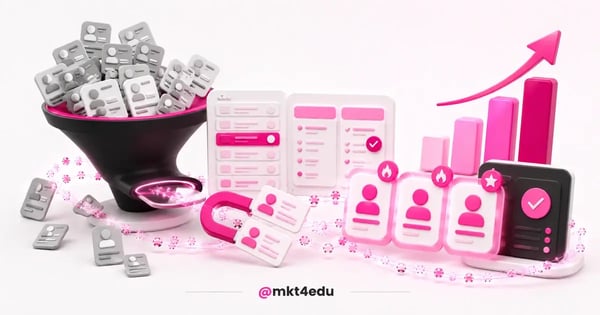 Caption: A full database isn’t a good database: decision-driven content filters out those who are just browsing and directs sales to those who are already making a choice.
What’s the difference between MQLs and SQLs in the sales funnel?
The difference lies in the stage of intent. An MQL (marketing-qualified lead) has shown interest but is still learning. An SQL (sales-qualified lead) is already showing clear signs that they want to buy.
The SQL is further along in the sales funnel and deserves priority sales follow-up.
Behavior reveals the stage. MQLs generally consume educational content, such as blog posts, guides, and webinars, while SQLs engage with bottom-of-the-funnel content, such as pricing pages, case studies, and demos, signaling a much stronger intent.
This insight changes the way we work. An MQL needs nurturing, more information, and time, whereas an SQL needs conversation, a quick response, and a clear path to making a decision.
Before comparing the two profiles in detail, it’s worth keeping the central idea in mind: the type of content a person seeks reveals how close they are to making a decision. Those who want to understand a topic read broad material, while those who want to make a decision look for pricing, comparisons, and terms.
|
Criteria |
Top-tier lead (Typical MQL) |
Decision-maker lead (on the path to SQL) |
|---|---|---|
|
Content Consumer |
Blogs, e-books, introductory webinars |
Product or course pages, pricing, comparisons, purchase or enrollment terms |
|
Questions they ask |
What is it, how does it work |
How much does it cost, when does it start, how do I sign up or enroll? |
|
Intent |
To learn, to research |
To choose, to sign up |
|
Ideal business action |
Provide information |
Act quickly and support the decision |
|
Level of urgency |
Low |
High |
Table: A single contact can move from the top of the funnel to the decision stage as the content they consume changes, so it’s important to track their history and not just their most recent action.
The table makes it clear why treating everyone the same wastes opportunities. Calling an MQL as if it were an SQL is off-putting. Nurturing an SQL as if it were an MQL causes you to miss the decision window.
When it comes to conversion, market benchmarks help set realistic expectations.
The conversion rate from MQL to SQL typically ranges from about 13% to 26%, and high-performing teams reach close to 39% to 40% when they apply behavior-based lead scoring — that is, scoring actions that indicate intent.
This figure reinforces the central argument of the text. If only a fraction of MQLs become SQLs, it makes sense to attract MQLs that are more likely to advance, rather than filling the database with contacts who are unlikely to move past the first stage.
How does decision-driven content generate hotter leads?
Decision-driven content generates hotter leads because it speaks to people who are already comparing options and about to make a choice. Product or course pages, comparisons, case studies, and explanations of pricing and terms attract people with concrete intent.
People who arrive via this type of content are much closer to making a purchase or enrolling.
Top-of-funnel content answers the question “what is it?” Decision-making content answers the question “which one should I choose and why?” This second question only arises in the minds of those who have already moved forward in the process.
That’s why the content at the bottom of the funnel acts as a natural filter. Anyone reading a page that compares service plans or course options isn’t just browsing—they’re making a decision.
This line of reasoning ties in with the logic of product-oriented SEO and the purchase decision, in which content is built around what the person is actually going to purchase, rather than just broad topics.
Some decision-making formats that attract hot leads:
- Detailed product or course pages, with specific scope, duration, and unique selling points.
- Honest comparisons between options, such as service plans or in-person, blended, and online learning formats.
- Clear explanations of pricing, scholarships, payment plans, and enrollment or admission procedures.
- Testimonials and stories from students or customers who’ve had the same concerns.
- Frequently asked questions that address the final objection before a purchase or enrollment.
The quality of this content matters just as much as the topic itself. Superficial material won’t convince decision-makers.
That’s why it’s worth investing in depth and credibility, applying the principles of experience, authority, and trust that underpin E-E-A-T, since reliable content at the decision-making stage alleviates the fear of making the wrong choice.
There’s a positive side effect. By producing decision-making content, you also educate the sales team, because the very objections the text addresses are the ones that come up in sales conversations.
Understanding how to generate hot leads, therefore, involves shifting part of the production effort from the top of the funnel to the decision-making stage. It’s not about abandoning the top of the funnel, but about striking a balance, ensuring there’s a clear path for those who are already ready.
How can you apply this concept to recruiting students and clients?
Applying this concept to student and client recruitment means organizing content around the purchase or enrollment decision and prioritizing those who demonstrate genuine intent.
Both educational institutions and businesses gain efficiency when they produce materials that address the questions of those who are already interested in signing up or studying, and direct their sales teams to focus on these prospects first.
In educational marketing, the customer journey has clear peaks of intent. College entrance exams, application deadlines, the start of the semester, and re-enrollment periods are when people are making decisions.
In businesses, these peaks occur at the end of the quarter, during product launches, and when contracts are renewed. At these times, decision-driven content yields much greater results.
A common mistake is to address all this high demand solely with general information about careers and the job market. Someone who searches for a product name along with the word “price,” or for a course name along with the word “tuition,” doesn’t want a generic article. They want specific figures, terms, and a clear path to signing up or enrolling.
It’s worth mapping out the questions that arise at the end of the customer journey and turning each one into content. How does the sign-up or enrollment process work? How much does it cost? When does it start? Are there any discounts or scholarships available? These answers attract exactly those who are close to making a purchase or enrolling.
After attracting leads, it’s time for execution. There’s no point in attracting hot leads if customer service takes too long. Structuring the sales process well—with the support of clear inbound sales processes focused on conversion—ensures that the ready-to-commit candidate or customer receives a quick response.
Qualification also requires criteria. Defining with the sales team which signals indicate a hot lead prevents consultants from wasting time on those who are merely browsing. Profile, course or product of interest, and actions on the website make up this set of signals.
Finally, content production must be continuous and planned. Consistent content marketing focused on lead generation supports both the top of the funnel—which feeds the base—and the decision-making stage, which generates the hottest opportunities throughout the year.
How to Use AI and SEO to Generate Qualified Leads?
AI and SEO help generate qualified leads by attracting the right people and quickly distinguishing those with purchase intent from those who are merely browsing.
SEO delivers decision-making content to those who are already looking for solutions, and AI speeds up the screening process, initial outreach, and behavioral scoring of leads.
SEO strategies attract the right audience at exactly the right moment. When someone searches for a product, a course, a service type, or a contract term, that search reveals intent.
Ranking for these terms puts your educational institution or company in front of those who have already decided to search.
However, it’s not enough to focus solely on traditional search engines. As more and more people ask AI assistants directly, optimizing for this scenario—by applying the logic of optimization for response engines ensures a presence where the decision is actually made.
When it comes to generating leads with AI in practice, the benefits lie in speed and filtering. An automated service can answer the first question immediately, gather information, and identify who is ready to speak with a consultant.
This is the role of an SDR agent equipped with artificial intelligence to perform the initial screening, qualify leads based on their behavior, and pass on to the human team only those contacts showing clear signs of intent.
This doesn’t replace the human touch at the right moment. The comparison between an AI SDR and a human SDR shows that the best approach combines both: the machine handles the volume and initial screening, and a person steps in when the conversation requires empathy and negotiation.
AI also improves lead scoring. By automatically assigning a score to each action—such as visiting the pricing page or opening three emails in a row—the system helps move the hottest leads to the top of the queue.
It’s this kind of behavioral analysis that brings teams closer to that conversion rate of nearly 40%.
The result is straightforward. SEO brings in the right people, AI quickly qualifies them, and the sales team focuses its energy on those most likely to enroll or make a purchase. Less wasted effort, more quality leads.
Frequently Asked Questions About Generating Qualified Leads
Ready to attract hotter leads to your acquisition efforts?
If your customer base is growing but enrollments or sales aren’t keeping pace, the problem is almost never a lack of leads—it’s an excess of cold leads.
Shifting from the race for volume to the pursuit of genuine intent is a game-changer, both for educational institutions and for businesses: fewer leads—but hotter ones—generate more enrollments and more sales.
This shift is what underpins effective inbound marketing strategies: decision-driven content to attract those who are already comparing options, and a conversion funnel that separates those who are ready from those who are just researching.
The next step is to make the conversion process itself a qualifying step. A form that only asks for an email address provides just a name, while a quiz or calculator gathers information on interest, budget, and stage of decision-making as the person answers.
Market research indicates that interactive content converts well in about 70% of cases, compared to 36% for static content. Structuring an interactive funnel with quizzes and calculators transforms the form into a screening step and provides the sales team with a lead that already comes with context.



.jpg)























 Portugal