


Between the last day of the exam and the release of the scores, millions of candidates sit and wait. Many universities stop too, waiting for the results to restart the campaign, and lose precisely the period when the ENEM score is on the mind of whoever is about to choose a course.
The 2026 edition marks that window out clearly. The papers were sat on 8 and 15 November, the answer keys were scheduled for 18 November and the results are set for 18 January 2027: two months of decision-making already under way.
Institutions that use that period to generate contacts, explain the routes of entry and prepare their service team reach January with a warm base. Those that wait for the results to start compete for the same candidate with the whole market, on the same day.
When do the ENEM results come out?
The ENEM 2026 results come out on 18 January 2027. The edition, run by Inep, Brazil's national institute for educational studies and research, drew 5.05 million registrations, papers on 8 and 15 November and answer keys on 18 November.
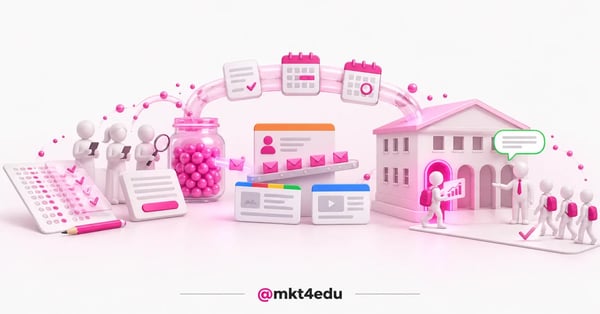 Caption: the ENEM score window runs from the answer key to enrolment, and each phase calls for a different move from the university's recruitment
For the university, that date splits the campaign in two phases: before 18 January, generate and warm up contacts; afterwards, convert the people who now know their own score.
The answer key already changes candidate behaviour. With the official answers in hand, they check their results and start researching courses and institutions, and the university that shows up at that moment with clear information makes the shortlist before the competition.
Other calendars remain open. Brazil's education ministry publishes the official timetables for Sisu, Prouni and Fies, the federal admissions and funding programmes, on the Portal Único de Acesso ao Ensino Superior, and up to 19 November 2026 no 2027 date appeared there or on the three programmes' own pages. Until that changes, no campaign asset should carry deadlines for those programmes.
How can a university use the ENEM score in its admissions process?
A university can use the ENEM score in its admissions process as a route of entry of its own, in which exam performance replaces the institution's paper. The admissions rules define everything: minimum score, the weight of the essay, which editions are accepted and the documents required. For the candidate, the advantage is making use of an effort they have already made.
An admissions process built on the ENEM score usually sits alongside other doors. An institution's own paper, scheduled or online, review of secondary school transcripts, transfers and second-degree entry serve different profiles, and the application page should keep every option visible.
Clarity in the rules is the most sensitive point: a candidate who cannot tell whether their score qualifies abandons the application, so the criteria need to be in plain language on the course page.
The admissions campaigns that work in this window treat the ENEM score as the argument, not as a footnote. The central message is direct: your score can be your application, with no new exam.
Is entry by ENEM score worth offering at a private university?
Offering entry by ENEM score is worth it because the route reduces friction at the application stage. The candidate does not have to book another exam or prepare all over again, which tends to speed up the decision and raise conversion among people already researching.
The care goes into the criterion. A minimum score set too high turns away candidates who would make good students, and a rule that is too loose can suggest that any performance will do, which weighs on how the course's quality is perceived.
The balance usually comes from combining routes. The ENEM score becomes the fastest path for whoever did well in the exam, while the institution's own paper welcomes those who did not sit it or want to improve on their result.
What should recruitment do before the ENEM results?
In recruitment before the ENEM results, the goal is turning interest into an identified contact. The moves that pay off most are opening pre-applications, offering routes of entry that do not depend on the new score, publishing content that answers the questions of the moment and preparing the service team for the January peak.
The pre-application is the centrepiece of this phase. The candidate registers interest in a course, receives the admissions information and gets priority when the score arrives, while the university gains a name, a contact and a course of interest in its database.
The application form has to be short at this stage. Name, contact, course and intended route of entry are enough, and every extra field reduces the chance of the candidate finishing the registration on a phone.
An enrolment system integrated with the CRM (Customer Relationship Management) stops those registrations from getting lost in spreadsheets. Every pre-applicant enters the database with a source, a course and a stage, ready to receive the right message at the right moment.
Here is how the moves spread across the window:
|
Phase |
What the candidate is doing |
What the university does |
|
Answer keys (from 18 Nov) |
Checks answers and starts researching courses |
Open pre-applications and publish the routes of entry |
|
December |
Compares institutions, prices and scholarships with family |
Nurture the base, offer the own-paper route and answer questions |
|
Weeks before 18 Jan |
Waits for the score and narrows the shortlist |
Explain how the score will be used and prepare the service team |
|
Results (18 Jan 2027) |
Looks up the score and decides where to apply |
Convert pre-applicants with a fast reply |
Table: phases of the window between the answer key and the ENEM score release in 2026, and the recruitment move that matches each one
December is the phase most often wasted: with the end-of-year holidays, many teams slow down, while the candidate has more time to research and talk it over with family. And part of the audience is still sitting the exam: Inep set the re-application of the papers for 15 and 16 December, for candidates who hit a logistical or health problem on the official days.
An automated lead nurturing flow covers much of that gap. In tools like HubSpot, each pre-applicant receives a sequence of emails about the course, the routes of entry and the payment terms, without depending on a full team being around.
How do you recruit students who sat ENEM?
To recruit students who sat ENEM, segment the base by each candidate's moment, present the score as a route of entry and reply quickly on every channel. The right message depends on where they are: researching courses, comparing institutions or ready to apply.
The best student recruitment strategies in this window combine three fronts. Paid media generates volume of contacts, content answers the questions of those still researching, and the service team turns interest into an application.
On media, paid media management in Google Ads and Meta Ads makes it possible to talk to people searching terms tied to ENEM and to the routes of entry. The budget goes further when it follows the calendar: a continuous presence from the answer keys and a push in the weeks around the results.
Enrolment remarketing brings back whoever visited the course page and left without registering. In this window it is especially useful, because the candidate goes back to researching several times until the score arrives.
On service, WhatsApp in student recruitment is usually the preferred channel for quick questions: whether the score qualifies, how much it costs, when classes start. A slow reply on that channel tends to become an application at a competitor.
Segmentation ties the three fronts together. A candidate who has not picked a course gets guidance content; one who has gets entry and pricing information; one with a funding question gets an explanation of the programmes and of the institution's own terms.
Media, content and service only work inside a student recruitment strategy with targets per course and per channel, which show in time whether the window is paying off.
Three simple adjustments already make a difference to recruitment in this phase:
Video: mkt4edu audioblog with three recruitment adjustments that hold during the ENEM score window
How do you use SEO to recruit students with the ENEM score?
To use SEO in recruitment around the ENEM score, a university needs pages that answer exactly what the candidate searches after the exam: whether the institution accepts the score, for which courses, with what minimum, which editions count and how to apply. A clear, up-to-date page shows up on Google and in AI answers.
SEO (Search Engine Optimization) has one advantage over paid media in this window: the page keeps working every day with no cost per click. Done well, it serves the November candidate and becomes the base for the cycles that follow.
How does a candidate search for a university using the ENEM score?
Candidates search in direct terms: universities that accept the ENEM score, scholarships with the ENEM score, admissions with the ENEM score, the score needed for medicine, or the course name followed by the city. Each of those intents calls for a specific answer, not a generic admissions page.
Before creating pages, it is worth checking how those searches already reach your site. Google Search Console shows the queries that already generate impressions, and a keyword research tool, such as Semrush, helps estimate the volume of the variations by course and by city.
How do you build the entry-by-ENEM-score page?
The entry page should answer, at the top and in plain language, the five questions that decide the application: which courses accept the score, what the minimum is, which editions of the exam count, which documents are required and until when it is possible to apply. All of it has to match the official admissions rules.
A few SEO practices help that page rank and convert:
- One page per intent: entry by ENEM score deserves its own page, separate from traditional admissions.
- A title built on the real search: the exam name, the university's name and, where it makes sense, the city.
- FAQs on the page itself: the candidate's questions answered in short blocks.
- A link to each course: the entry page leads to the course page, and the course links back to it.
- A short form at the end: whoever has read the rules is already ready to apply.
For universities with campuses in several cities, local SEO makes a difference. Candidates tend to search close to where they live, and a page that names the city, the address and that unit's courses tends to perform better on those queries.
How do you show up in AI answers about the ENEM score?
To show up in AI answers, the page has to be indexed and carry the information in an objective, verifiable form. Google states that there are no additional requirements to appear in AI Overviews or AI Mode, beyond the page being indexed and eligible to be shown with a snippet: the same SEO good practice applies.
In practice that favours pages with clear, dated facts: minimum score per course, editions accepted and the application deadline, each in a sentence that answers on its own. Assistants such as ChatGPT and Google's AI Mode tend to cite passages like that, and the detail is in the guide to SEO for AI.
Video: mkt4edu audioblog on SEO, AEO and GEO, the acronyms behind showing up in searches about the ENEM score
SEO does not pay off overnight, which is why the calendar matters. For this cycle, the sooner the page goes live, the more time it has to be indexed before the 18 January results; for the next ones, SEO work should start months before the exam. That planning is part of mkt4edu's SEO service.
How do you communicate Prouni and Fies in the campaign?
To communicate Prouni and Fies, explain what each programme is, whether the institution takes part and what the candidate needs to prepare, without citing dates before they are officially published. Up to 19 November 2026, no 2027 timetable for Sisu, Prouni or Fies appeared on the education ministry's official portal.
The first rule is accuracy: promoting Prouni or Fies only makes sense if the institution takes part in the programmes for the courses being advertised, and that has to be confirmed before it enters any asset.
The second rule is not to promise an outcome. Selection follows criteria set in each edition, so the communication can say the university takes part and explain the path, but never guarantee a scholarship or funding to the candidate.
The third rule is to keep the programmes apart in the messaging. Sisu selects candidates for public institutions, while Prouni and Fies are the federal programmes that reach private universities, and mixing the three confuses the candidate in the very first message.
While the dates are pending, the useful content is what prepares the candidate: explaining how the programmes work, reminding them that the ENEM score feeds the selection, and saying that the calendar will be communicated as soon as it is published.
The institution's own terms, such as its scholarships, discounts and instalment plans, can and should appear clearly. They are the immediate answer for a candidate worried about cost, while the federal programmes still have no calendar.
What does the recruitment calendar look like after ENEM?
The recruitment calendar after ENEM has two moments: up to 18 January, the campaign generates and warms up contacts; from the results onwards, it converts. The weeks following the release of the scores tend to concentrate the applications, and the service team has to be sized to reply the same day.
A good student recruitment calendar treats the results date as the campaign's turning point. The assets change from "get ready" to "use your score now", and media shifts to prioritising conversion.
On results day, the base of pre-applicants is the most valuable asset there is. An email and WhatsApp message saying the score can now be used in an application tends to convert more than any advert aimed at a cold audience, and the guide to converting applicants into enrolled students details the sequence of contacts that runs from approval to enrolment.
After the peak, the calendar carries on with the federal programmes' announcements, whenever they come, and with the later rounds of the admissions process that uses the ENEM score. Every new date is a fresh reason to talk again to whoever has not decided.
Splitting the campaign into phases is part of an educational marketing strategy that looks at the whole year: the ENEM window is the most intense one, but the phase logic holds for the cycle's other campaigns.
Which mistakes should you avoid in ENEM marketing campaigns?
The most common mistakes in educational marketing campaigns around ENEM are waiting for the results to start, promising dates for federal programmes that have not been published, hiding the entry rules and leaving the service team unprepared for January. All of them cost enrolments in the period of highest demand.
Each one has a simple correction:
- Pausing the campaign until the results. The candidate's research starts at the answer key, and whoever only shows up in January joins the race late.
- Jumping ahead of Sisu, Prouni and Fies dates. While the 2027 timetables are not published officially, no asset should carry deadlines for those programmes.
- Hiding the entry rules. The minimum score, the editions accepted and the documents must sit on the course page, in plain language.
- Promising a scholarship or funding. The university can explain the path, but approval depends on criteria it does not control.
- Under-sizing the service team. The January peak calls for a defined headcount, a script of answers and an agreed reply time.
Behind all of those mistakes sits a lack of early planning. The student recruitment strategies that work in this window are decided in October and November, not in the week of the results.
When the internal team cannot handle the volume, an educational marketing agency can take on the campaign's media, content and automation, leaving the institution to concentrate on service and enrolment.
Frequently asked questions about the ENEM score
Recruiting on the ENEM score: now, or can it wait for the results?
It is for now. The candidate's decision starts at the answer key, takes shape in December and settles in the weeks after 18 January, and the university that only appears at the results is competing for an audience that has already narrowed its shortlist.
Starting now does not mean spending everything now. It means opening pre-applications, publishing the routes of entry, building the nurturing flow and preparing the service team, leaving the bulk of the media spend for the weeks around the results.
Splitting the effort that way protects both the budget and the recruitment calendar for the rest of the cycle. The ENEM window stops being a last-minute scramble and becomes a sequence of phases with a target, a message and an owner.
If there are not enough hands internally to run every front at once, an educational marketing agency can organise the campaign inside a full-cycle educational marketing strategy, from the first advert to enrolment.
And one detail decides the whole window: how fast the reply comes.
Our student conversion study timed 305 applications at private universities and shows how long an institution takes to speak to someone who has just applied, on which channel, and what changes when that contact happens within the first hour.














 Portugal