


Next term's enrolment target is already set, the budget is smaller than leadership would like and every channel promises results. Creating educational marketing strategies in that scenario means deciding where to invest in a market where distance learning already accounts for most students at Brazil's higher education institutions.
Dropout consumes part of what recruitment brings in, and the candidate researches the university by talking to an AI (Artificial Intelligence) before opening the website. Without a plan that ties those fronts together, digital marketing for educational institutions becomes a pile of scattered campaigns, measured by leads that never become students.
The strategies themselves, such as SEO (Search Engine Optimization), paid media or WhatsApp, are the pieces. What is usually missing is the board: the sequence of eight decisions that makes the pieces work together, from the diagnosis to each cycle's review.
What are educational marketing strategies, and why did digital become the base?
Educational marketing strategies are the decisions that connect the institution's enrolment target to audience, positioning, channels, budget and measurement, each with a deadline and an owner. Together they form the educational marketing strategy of the year, the document that guides every campaign the institution runs.
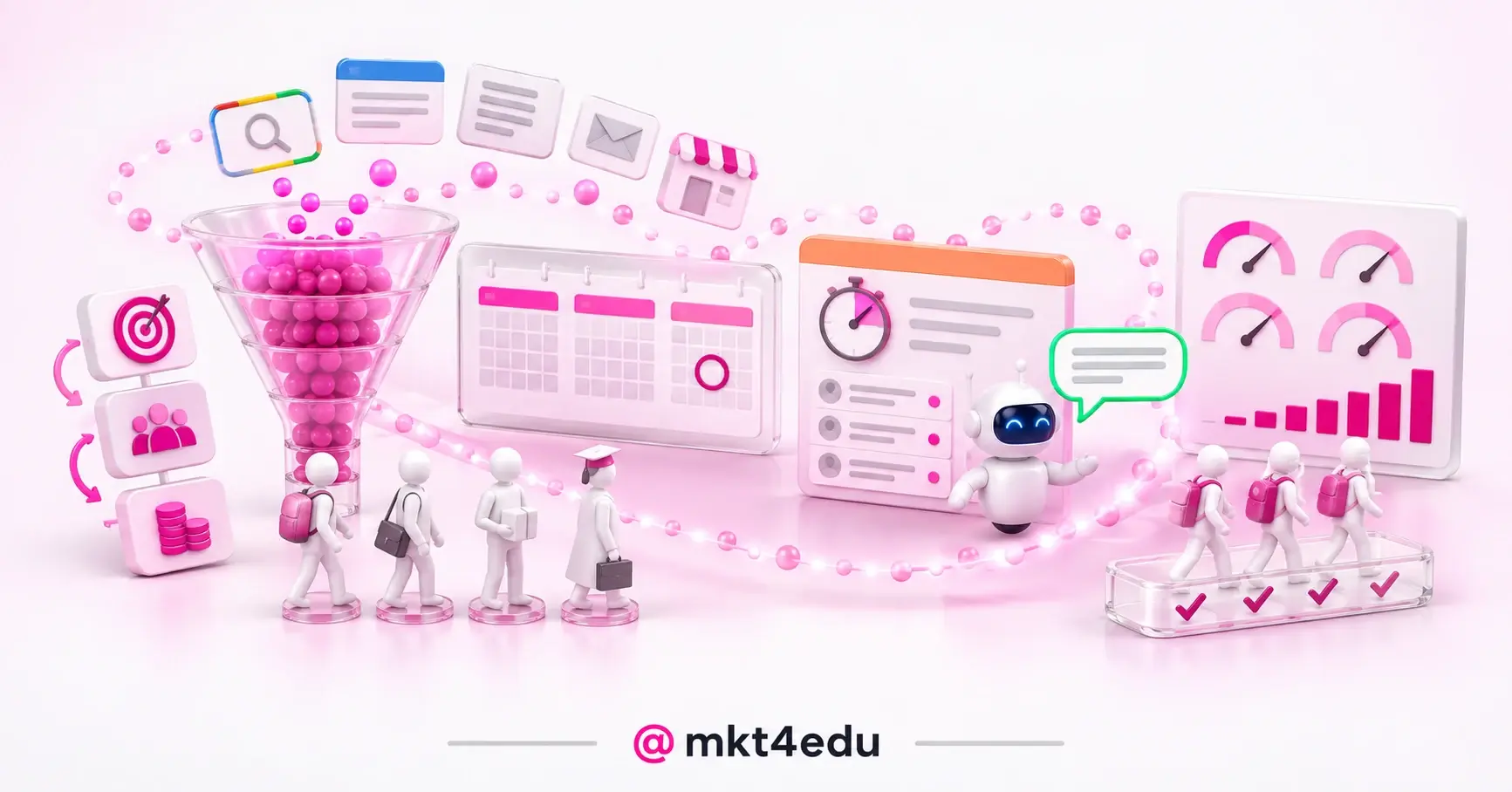
 Caption: how to create educational marketing strategies: it starts with the diagnosis and organises personas, channel mix, calendar and metrics by funnel stage
That plan exists so that every unit of budget invested in student recruitment and retention answers a named objective, rather than the impulse to repeat whatever a competitor did at the last entrance exam.
Educational marketing applies marketing strategies for education to schools, universities and courses. The most widely adopted base is inbound, the strategic method of growing an organization through lasting relationships with candidates, students and families instead of interruption.
Digital became the base for a numerical reason. Brazil's 16th Mapa do Ensino Superior, published by Semesp, shows that in 2024 distance learning reached 50.7% of the country's students, out of a total of 10.2 million enrolments in Inep's 2024 higher education census.
Research has changed too. HEPI's Student Generative AI Survey 2026, run by Savanta with 1,054 full-time UK undergraduates, reports that 95% of students report using AI in at least one way. The data is British, but it points the direction: the candidate consults an assistant before opening the website. Digital marketing for educational institutions has become the backbone of the plan.
What are the steps of educational marketing planning?
Complete educational marketing planning has eight steps: diagnosis, objectives, audience, positioning, channel mix, calendar and campaigns, measurement and optimisation. Diagnosis, positioning and calendar tend to be the steps that get skipped, and their absence is what makes strategies fail most often.
Step 1: how do you diagnose the institution before planning?
The diagnosis is the survey of where the institution stands on recruitment, retention, brand and channels, using data from the CRM (Customer Relationship Management), GA4 (Google Analytics 4) and SEO tools. All planning starts here: how many students come in, how many leave and through which doors they arrive.
Start with the CRM, software that centralizes all your customer information and interactions in one place. Export the last four terms and calculate lead-to-applicant and applicant-to-enrolment conversion, by course and by source channel.
Next, cross GA4 with Google Search Console and an SEO suite. A course page with traffic and few applications indicates a problem with the offer; a page with no traffic indicates a problem with SEO.
Then separate dropout by course and delivery mode. In Brazil's private network, 2024 dropout was 41.9% in distance learning and 26.6% on campus, according to the same Semesp report.
A mistake to avoid: diagnosing recruitment only. An institution that enrols a thousand students and loses four hundred in the first year has a student retention problem that marketing needs to see.
Step 2: how do you set objectives and enrolment targets in the strategy?
The plan's objectives split into three fronts: student recruitment, student retention and brand building. Each front gets numerical targets, with a deadline and an owner, derived from the diagnosis. The student recruitment strategy breaks down into enrolments per course, delivery mode and campus, never into a single number for the whole institution.
In retention the reasoning is the same: if first-year dropout sits at 30% in a course, the target may be 24% in the next cycle. Recruitment and retention belong to the same plan, because they share the same target of active students.
Every target follows the SMART rule: "enrol 250 students in on-campus Nursing at the summer entrance exam, with CAC (Customer Acquisition Cost) up to BRL 900", not "increase enrolments".
Step 3: how do you get to know the audience and build the institution's personas?
Getting to know the audience means turning CRM data, the sales team's conversations and student surveys into personas, profiles that represent the groups of candidates the institution wants to enrol. A persona is a semi-fictional representation of your ideal customer, and an institution usually needs three to five, one per major enrolment decision.
Besides the candidate and the student, the fee payer decides a large share of on-campus enrolments and needs a persona of their own. Each persona's journey gets a map: how they discover the institution, what they compare and what makes them decide. That map defines the content for each stage of the sales funnel.
AI search has changed the start of that journey. The candidate asks the assistant "which is the best Nursing university in this city" and gets three names. Whoever is absent from that answer never enters the comparison.
A mistake to avoid: creating personas from what leadership imagines. Personas are born of interviews with recently enrolled students, of leads that did not convert and of the WhatsApp advisers who hear the real objections.
Step 4: how do you define the institution's positioning and value proposition?
Positioning answers the question "why study here, and not at the competitor that costs the same?". The value proposition gathers the differentiators the institution can prove: official quality ratings, graduate employability, faculty, facilities, the flexibility of distance learning and student support. Educational branding organises those differentiators into a promise that holds across every channel.
Institutional authority is what sustains positioning in AI search. Assistants cite pages with verifiable facts and ignore adjectives: a course page with the official rating, the coordinator's name and graduate outcomes stands a better chance of being cited than one offering "academic excellence".
Step 5: how do you build the channel mix and the digital marketing strategies?
The channel mix is the combination of digital and offline marketing strategies that takes each persona from first contact to enrolment, with an objective and a metric per channel. Digital marketing strategies for institutions organise into two blocks: inbound marketing strategies, which attract and educate, and inbound sales strategies, which serve and convert.
Inbound marketing strategies start on the website and on each course page. SEO means helping search engines understand your content, and according to Google there are no additional requirements to appear in AI Overviews or AI Mode beyond the page being indexed and eligible to be shown with a snippet.
Content marketing maps each persona's questions and spreads articles and videos across the year. When there are not enough hands internally, mkt4edu's content planning service delivers the topic map for the team to execute.
Inbound sales strategies come in when the lead raises a hand. In inbound selling, the rep serves each lead individually, considering their specific pains and goals: a contact cadence in the CRM, an SDR (Sales Development Representative) to qualify and WhatsApp as the main channel.
Marketing automation connects the two blocks. It is software that handles routine marketing tasks without human action: it sends the prospectus, alerts the SDR when a candidate visits the pricing page and moves the lead from MQL (Marketing Qualified Lead) to SQL (Sales Qualified Lead).
Paid media accelerates what inbound builds: Google Ads captures whoever is already searching for the course and Meta Ads retargets whoever visited without applying. Here is how each channel is organised by objective:
|
Channel |
Main objective |
Journey stage |
The metric that matters |
|
SEO and blog |
Attract whoever researches courses and careers |
Discovery and consideration |
Organic leads per course page |
|
Course page and enrolment system |
Turn a visit into an application |
Decision |
Visit-to-applicant conversion rate |
|
Google Ads |
Capture searches with enrolment intent |
Consideration and decision |
Cost per applicant |
|
Meta Ads |
Generate demand and retarget |
Discovery and decision |
Cost per lead and recovery rate |
|
Email and automation |
Nurture the lead until the application |
Consideration |
Progression rate from marketing qualified lead to sales qualified lead |
|
WhatsApp and SDR |
Serve and convert the applicant |
Decision |
Applicant-to-enrolment rate |
|
Organic social media |
Build brand and community |
Discovery and post-enrolment |
Reach and branded search |
|
Events and school visits |
Generate qualified in-person leads |
Discovery and consideration |
Leads registered in the CRM per event |
Table: the channel mix behind how to create educational marketing strategies, with each channel's objective, journey stage and metric
Each channel comes in with a function and a metric, and the budget follows the function, not the fashion. The audioblog below shows three of those fronts applied to universities:
Video: mkt4edu audioblog with three fronts that enter the mix when you work out how to create educational marketing strategies
Step 6: how do you organise the calendar and the educational marketing campaigns?
The recruitment calendar spreads educational marketing campaigns across the year, with a start date, a budget, a target and an owner for each one, and it reserves the period between campaigns for brand and content building. This is where the plan stops being an intention and gains a budget and deadlines.
A university's student recruitment calendar revolves around the summer entrance exam, the national exam results, the winter entrance exam, transfers and re-enrolment. Each campaign gets a brief: objective, persona, offer, channels, budget, enrolment target and cut-off date. Without a cut-off date, the campaign becomes continuous spending with no assessment.
The marketing budget comes out of that brief: add up the leads each campaign needs, multiply by each channel's cost per lead and add the brand and content budget. Re-enrolment deserves a campaign of its own, and the student retention strategy has a method that talks to this calendar.
Step 7: how do you measure the results of the educational marketing strategy?
Measuring results means following, by channel and by campaign, the lead's path to enrolment, with a fixed set of educational marketing metrics reviewed every week. Measurement has to connect GA4, which shows behaviour on the site, with the CRM, which shows who applied and enrolled, because neither tells the whole story on its own.
Educational marketing metrics organise into four layers. The first is traffic and engagement: sessions per course page and engaged sessions, which in GA4 are the ones that last longer than 10 seconds, record a key event or reach two or more page views. The second, generation, gathers leads per channel and cost per lead.
The third, conversion, measures the lead-to-applicant rate, the applicant-to-enrolment rate and CAC per course. The fourth, retention, tracks dropout per term and retained revenue.
Leadership's KPIs (Key Performance Indicators) come from those last two layers; in HubSpot, lifecycle reports show how many contacts moved from lead to marketing qualified lead, sales qualified lead, opportunity and customer in the period.
A mistake to avoid: measuring only what paid media reports. Only the CRM shows whether the lead became a student. The full monitoring walkthrough is in the audioblog below:
Video: mkt4edu audioblog on monitoring performance once you know how to create educational marketing strategies
Step 8: how do you keep optimising educational marketing strategies?
Optimising continuously means reviewing educational marketing strategies in fixed cycles, based on the data from the previous step, and moving budget, content and effort from what does not work to what does. No plan is immutable, and the review works better when it has a calendar, controlled tests and AI support for reading the data.
The cycle has three rhythms. Every week, marketing adjusts bids and creative. Every month, marketing and sales review conversion by channel. Every term, leadership reviews targets, positioning and the marketing budget. Tests follow one rule, changing one variable at a time, and CRO (Conversion Rate Optimization) organises those tests on the course page.
AI comes in on two fronts. In analysis, predictive models in the CRM point to which leads have the highest chance of enrolling and which students are at risk of dropping out. In execution, AI agents answer first-level questions on WhatsApp, without replacing the SDR.
Which mistakes break the strategy, and when should you hire an educational marketing agency?
The mistakes that break an educational marketing strategy most often are: skipping the diagnosis, setting a single target without breaking it down by course, copying a competitor's digital marketing strategies, concentrating the budget on the entrance exam and judging everything by leads instead of enrolments. Each one leaves a visible symptom in the CRM.
Two other mistakes are splitting recruitment and retention across teams that do not talk to each other, and failing to integrate the tools. The marketing for universities that keeps CAC under control depends on the CRM, GA4 and WhatsApp sharing one base.
Hiring an educational marketing agency makes sense when the institution has no team to execute the eight steps, or when the team masters media but not the CRM and marketing automation.
The criteria for choosing an educational marketing agency are objective: cases with enrolment numbers, command of the institution's CRM and a proposal that starts with the diagnosis.
The educational marketing consultancy is the middle format, for institutions with an execution team that need a method. mkt4edu works in both formats, with services ranging from content planning to CRM and media operations.
Whatever the format, the diagnosis, the targets and the positioning belong to leadership, because they are what survives a change of supplier.
Frequently asked questions about how to create educational marketing strategies
How do you turn educational marketing strategies into enrolments next term?
Educational marketing strategies turn into enrolments when the eight steps stop being a document and become a routine: a diagnosis built on CRM data, targets per course, real personas, positioning the institution can prove, channels with a defined function, a calendar with a budget, weekly measurement and a review every cycle.
The sequence fits into four weeks: diagnosis and targets in the first, personas and positioning in the second, channels and calendar in the third, dashboard and first campaign in the fourth. Whoever follows the plan and reviews each cycle accumulates learning; whoever changes everything with each campaign starts from zero again.
If the next entrance exam already has a date, the mkt4edu team can assess your institution's diagnosis and channel mix in a conversation, and you leave it with the cycle's first decisions prioritised: which course to attack first, where to reallocate budget and what to measure every week. Talk to us and let's build your success together.














 Portugal