


The candidate for an online programme settles almost everything on the internet: researching the field, comparing institutions and reading reviews before filling in a form. So digital marketing for distance learning is not support for recruitment, it is the ground where the enrolment is decided.
Many institutions, though, carry the on-campus recipe over to distance learning, with advertising concentrated in the campaign and a rush to close. The result tends to be expensive leads and an enrolment team chasing cold contacts.
This guide organises the opposite path: inbound applied step by step to online programmes, from content-led attraction to the handover to sales, with tools, metrics and mistakes to avoid.
Why does digital marketing for distance learning have its own logic?
Digital marketing for distance learning has its own logic because students in that mode research, compare and apply without ever setting foot on campus. The competition is national, the journey is entirely digital and the whole funnel happens online, which makes digital marketing strategy the base of recruitment, not a complement to it.
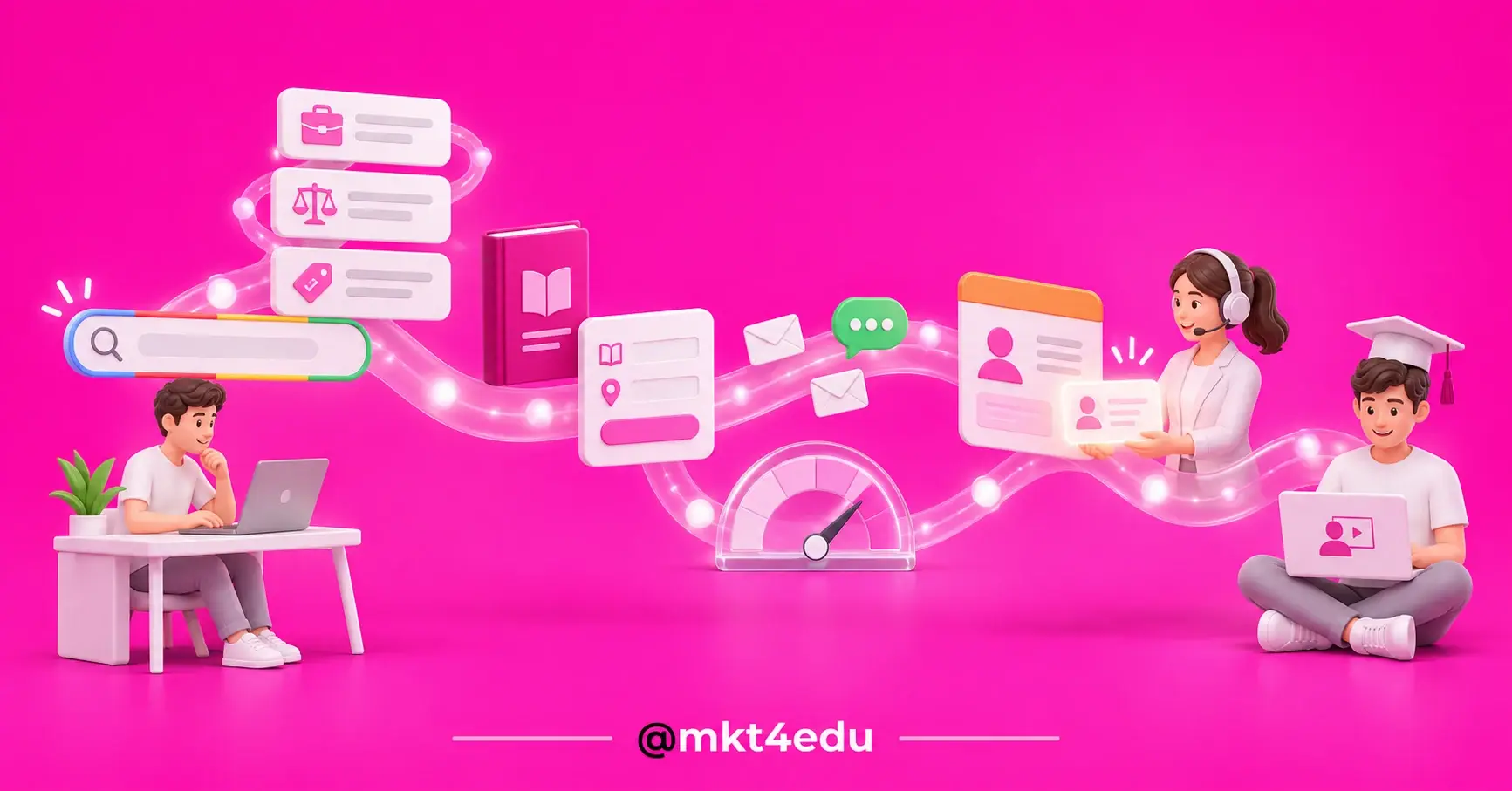
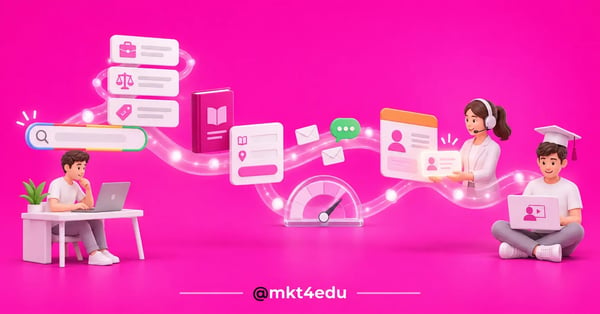 Caption: digital marketing for distance learning follows the candidate from the first search to enrolment, all online
The size of the segment explains the fight. Brazil's 2024 Higher Education Census, run by Inep, recorded distance learning at 50.7% of enrolments and 66.8% of new entrants in undergraduate education.
In practice, two in three first-year students now come in through distance learning, and each of them arrived through a Google search, a referral, social media or an advert, comparing offers from across the country.
That scenario changes the shape of marketing strategy: territory tactics, such as school visits and media around the campus, lose force when the competitor is national.
Online student recruitment calls for an educational marketing strategy designed for the full digital journey: attract through search, convert on the site, nurture with automation and measure every stage.
That is the design of inbound marketing applied to education: instead of interrupting the candidate, the institution publishes the content they are looking for and follows them through to enrolment.
Video: an audio post from the mkt4edu channel on fronts that sustain digital marketing for distance learning at an institution
How do you attract distance learning students with content marketing and SEO?
Attraction in inbound marketing for distance learning combines two fronts: content marketing, which produces the answers the candidate searches for, and SEO, which makes those answers appear in search engines. Together they build a source of visits that does not drop to zero when the media budget runs out.
SEO (Search Engine Optimization) is the work of helping search engines understand the site's content and connecting it to whoever is searching. In distance learning, that means showing up when someone types the programme name, the study mode or a career question.
Before producing anything, define who you are writing for. A buyer persona, which HubSpot describes as a semi-fictional representation of your ideal customer, guides tone and topics: the recent school leaver researches careers and entry scores, while the working adult researches flexibility and time to graduation.
With the persona defined, keyword research reveals what that audience types: Semrush shows search volume and competition for each term, and Google Search Console shows the queries already bringing visitors to the site.
That research feeds a student recruitment calendar that distributes topics across the application cycles, so the right content is live before the peak in demand.
When there is no in-house capacity to turn research into topics, structured content planning organises personas, keywords and calendar into a single editorial plan.
What does the distance learning student research before applying?
Before applying, the distance learning student researches the career, the comparison between study modes, the institution's reputation, official recognition of the programme, the study routine and, finally, fees, scholarships and the application process. Each stage of that journey calls for different content and a different offer.
Here is how the searches and the offers line up along the funnel:
|
Funnel stage |
What the online student researches |
Conversion offer |
|
Top (discovery) |
Whether studying online is worth it, online versus on campus, careers with the most opportunities |
Newsletter and an introductory career ebook |
|
Middle (consideration) |
Best online programmes in the field, official recognition, study routine and assessments |
Comparison guide of study modes and a webinar with the programme leader |
|
Bottom (decision) |
Fees, scholarships and discounts, entry routes, online admissions application |
Application to the admissions process and a conversation with an adviser |
Table: the research journey of the online student by funnel stage, with the conversion offer digital marketing for distance learning provides at each one
The right-hand column is what turns content marketing into lead generation. Without a conversion offer, the article informs, generates traffic and sends the visitor back to Google without leaving a contact.
SEO for online programmes: local or national search?
SEO for online programmes is, in most cases, a national contest: the student can study from any city, so the institution competes with the whole country for the field's terms. The exception is the model with physical study centres, where searches including a city name reactivate the local layer.
In practice the two layers coexist. Programme pages compete for national terms, while study centre pages answer local search, with an address and the calendar of in-person assessments.
It is also worth preparing the pages for AI-generated answers. SEO for AI structures content to be cited by assistants and AI-powered search engines, a growing channel for discovering online programmes.
Sustaining that front takes continuous work, and a dedicated SEO operation covers everything from the technical audit to optimising programme and study centre pages.
How do you generate leads for online programmes without paid media?
To generate leads for online programmes without paid media, turn organic traffic into sign-ups: offer rich materials tied to the study decision, place short forms in the most visited content and keep conversion pages fast. Organic lead generation grows with the content library, with no cost per click.
The principle is a value exchange. The candidate hands over a name, an email and the programme of interest when the material solves a real doubt, such as a careers guide or a comparison of study modes.
In projects run by mkt4edu, a minimum set of data travels with the lead from the moment of conversion: the programme and the campus of interest, captured through a form field, a hidden field or UTM parameters (the codes that identify source and campaign in the URL).
Without that link, only a contact is created, and the funnel reading breaks: nobody can say which content generates enrolments in which programme, and the nurturing that follows comes out generic.
How do you convert a blog visitor into an applicant?
To convert a blog visitor into an applicant, connect each article to an offer on the same theme and the same funnel stage: the careers post points to the professions guide, the comparison of study modes points to the programme page, and decision-stage content points to the application.
Calls to action convert poorly when they ignore the reader's moment: an invitation to apply inside a discovery article arrives too early, while downloading the career guide speaks to the doubt that brought the visit.
The tactics to improve student enrolment add up quickly here: headline, social proof, loading speed and where the offers sit inside the content.
That is how inbound marketing swaps cost per click for cost of production: every piece published becomes a permanent conversion point and keeps generating sign-ups through the following cycles.
Video: an audiobook from 4RevOps with the lead generation logic behind digital marketing for distance learning
How do you nurture distance learning leads and hand them to sales at the right time?
Nurturing turns a freshly converted lead into a candidate ready for the sales conversation. In distance learning it happens through email, WhatsApp and automation, with content moving from general interest to the specific programme, until clear intent signals release the handover to the enrolment team.
Marketing automation, which HubSpot describes as software that takes care of routine marketing tasks, runs that sequence at scale: it fires the right series for each profile, reacts to the lead's behaviour and records the full history, with no manual sending.
The design of the sequence matters more than the tool. A lead nurturing flow for online enrolments starts from the interest shown at conversion, from programme to campus, and gets more specific with each message.
The typical sequence runs from content about the chosen career to the programme's differentiators and student testimonials, closing with scholarships, entry conditions and an invitation to apply.
To decide the moment of handover, lead scoring in educational marketing scores profile and behaviour: a visit to the fees page, opening the last few emails, an application started. Above the cut-off score, the lead goes to sales.
That handover has to happen inside a CRM (Customer Relationship Management, the platform managing relationships with leads and students), where marketing and sales see the same funnel and the same origin for every contact.
In the sales contact, WhatsApp for student recruitment tends to be the fastest response channel for the Brazilian candidate, provided the approach arrives with context, naming the programme and the material consumed.
In projects run by mkt4edu, that circuit never debuts at full scale. The pilot starts with the lowest-volume segment, online undergraduate programmes in those projects, with a manual fallback to correct whatever the automation gets wrong before scaling.
Starting small also protects the educational marketing campaigns already running: the new sequence coexists with the current operation until the funnel is validated end to end.
How do you measure distance learning recruitment and which mistakes should you avoid?
Measuring distance learning recruitment follows the whole funnel: organic traffic and search positions in attraction, conversion rate on the pages, lead progression in nurturing and enrolments by channel at the close. Without that stage-by-stage reading, campaigns become bets rather than investment.
The tools split by stage: Google Search Console shows queries, impressions and clicks for each page, Semrush tracks positions against competitors, and the CRM delivers conversion rates by source.
The metric that closes the account is customer acquisition cost per enrolment, compared by channel: it is what shows when content beats paid media on efficiency and where to reallocate budget.
By the same rule, inbound marketing is judged on cost per enrolment, never on lead volume. A channel producing cheap contacts and expensive enrolments has to show up in the reading, not in the celebration.
A few mistakes come up often in that measurement:
- Measuring the lead alone: a submitted form is halfway there; without tracking conversion to enrolment, the funnel optimises the wrong indicator.
- Treating distance learning as one block: undergraduate, graduate and short courses have different journeys and ticket sizes, and campaigns segmented by offer read the result more precisely.
- Switching content off outside the application cycle: the candidate's research does not respect a calendar, and a library taken offline loses position before the peak.
- Separating recruitment and retention: an enrolment that drops out in the first term returns the acquisition cost without returning the revenue, and reading them separately hides that loss.
With those points fixed, digital marketing strategy gains what recruitment most lacks: funnel predictability from one cycle to the next.
Frequently asked questions about digital marketing for distance learning
Where should you start with digital marketing for distance learning?
Start with the base that holds everything else up: a defined persona, keyword research done and a realistic production calendar. With that in place, publish the first conversion offers, switch on nurturing and agree the handover rule with sales before chasing volume.
That order avoids the classic mistake of starting at the end: buying media, flooding sales with cold contacts and concluding that the internet does not produce enrolments. In inbound, each stage prepares the next.
It is also worth reviewing the marketing already running. Campaigns that today only generate clicks can start generating qualified leads with a conversion offer and a nurturing flow attached to them, with no new budget.
And once the enrolment is done, the calculation that decides the sustainability of distance learning begins: recruitment and retention as a single cycle. The ROI of student retention shows why holding on to whoever already enrolled multiplies the return on every enrolment won.










 Portugal