




Customer success was born in the software market, but the problem it solves is familiar to any education institution: the customer who comes in, pays for a while and leaves before reaching what they came for.
In education, that exit has a name and a price. Every student who abandons the programme takes future fees with them along with all the investment made to enrol them, and replacing that student is expensive in a competitive recruitment market.
This guide maps the crossing: what customer success is, how the concept translates to student retention, how to build the operation step by step, which mistakes to avoid and how to measure the retention team's result.
What is customer success and why is it proactive?
Customer success is the strategy that ensures the customer reaches the results they wanted from a product or service. The definition popularised by HubSpot frames it as what enables customers to achieve their desired outcomes, and marks the contrast with support: support is reactive and answers specific requests, while customer success is proactive.
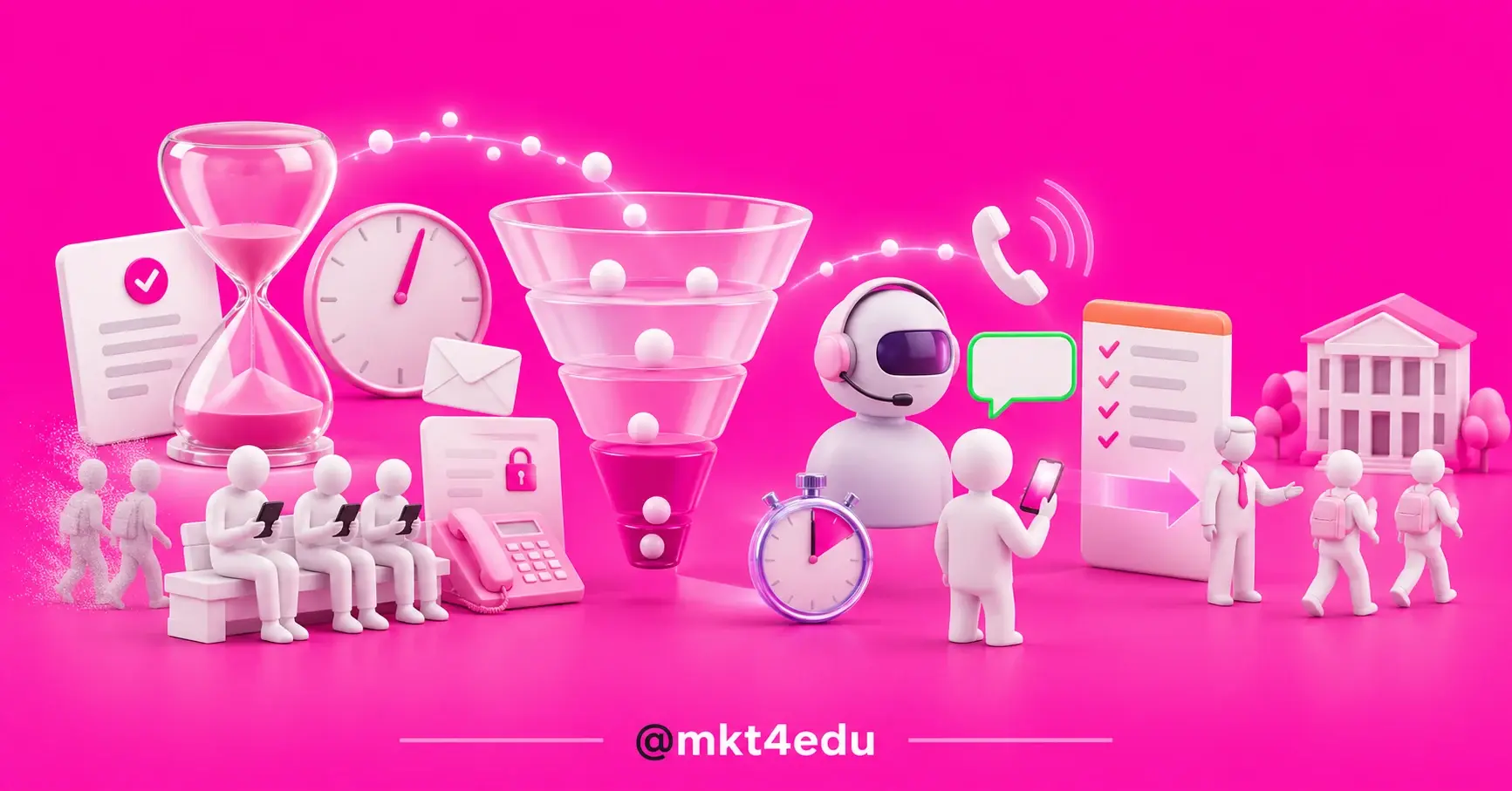
 Caption: customer success in education turns a risk signal into proactive action before the student drops out
The logic was born in subscription companies, where revenue depends on renewal. In that model, selling is only the start: profit appears when the customer stays, and loyalty becomes a growth engine rather than an after-sales action.
So customer success operates on data rather than on complaints. The team tracks product usage, identifies who is stuck and acts on its own initiative, with onboarding, training and contact at the right moment.
That difference in posture changes the company's arithmetic. Retention usually costs less than acquisition, and a successful customer renews, buys again and refers, which turns staying into a revenue strategy.
Why does dropout in higher education call for customer success?
Dropout in higher education is the educational equivalent of a cancellation: the student quits before the degree, and the institution loses the future revenue of an enrolment that cost a lot. The problem hits both on-campus and distance learning, and treating retention as customer success is the strategic answer to that loss.
The size of the problem has been measured. The 16th Higher Education Map, by Semesp, records for 2024 a total dropout rate of 41.6% in distance learning and 24.8% on campus.
The numbers change how the budget reads. In distance learning, more than four in ten students left their programme that year, and the commercial effort starts from zero to replace revenue that was already inside the house.
Preventing costs less than replacing. A student leaving requires new marketing budget, while the causes of dropout in higher education usually give a signal weeks in advance.
In the online mode the challenge is even more delicate, because the screen hides disengagement. The factors behind dropout in online learning show up first in the virtual learning environment, in logins that thin out and assignments that stop being submitted.
The reverse path is mapped too: the ROI of student retention shows that holding on to someone already studying costs less than recruiting a new student in their place.
So mature operations treat recruitment and retention as the same revenue strategy, not as targets belonging to separate departments.
Video: a video from the mkt4edu channel on retention and recruitment, the two ends customer success in education connects
How do you build the customer success operation step by step?
To build the customer success operation in education, follow four steps: map the risk signals that precede dropping out, consolidate those signals into a student health score, design a proactive action plan for each risk band, and appoint the team responsible for retention.
Each step has a concrete deliverable, and the order matters:
- Map the risk signals. Find where dropping out announces itself: frequency of access to the virtual learning environment, grades, late payments, support tickets and silence across the institution's channels.
- Build the student health score. Combine those signals into a single risk and engagement indicator, updated on a defined cycle, to order who needs action first.
- Design the proactive action plan. Define, for each signal and risk band, which action happens, through which channel, within what time and on whose initiative.
- Appoint the retention team. Give the operation an owner, a target and a routine, with clear roles across tutoring, programme leadership, the registrar and finance.
What is a student health score?
A student health score is the composite indicator that sums up, in a single number or band, each student's dropout risk and level of engagement. It combines signals such as frequency of access to the learning environment, performance in assessments, financial status and support history.
The value of the health score is in prioritisation, not decimal precision. It exists to answer one operational question: among hundreds or thousands of students, who needs contact this week?
Each institution defines its own criteria and bands, because the weight of each signal tends to vary with the programme, the mode and the student profile. The essential part is reviewing the model each cycle, comparing the score with the actual dropouts.
With the score ordering the queue, the action plan defines what happens in response to each signal. Here is how that design is organised:
|
Risk signal |
Proactive action |
Owner |
|
Drop in access to the virtual learning environment |
Supportive contact within 48 hours, offering help with the content |
Tutoring |
|
Below-average grades in consecutive assessments |
Invitation to tutoring sessions and an individual study plan |
Programme leadership |
|
First monthly fee overdue |
A consultative approach with a payment arrangement before the collection notice |
Finance |
|
A complaint logged without resolution |
Immediate escalation with a defined response deadline |
Retention team |
|
Silence across all of the institution's channels |
A re-engagement sequence by email and WhatsApp |
Retention team |
Table: the proactive action plan of customer success in education, with the risk signal, the institution's response and the owner of each move
The plan only works with a deadline and an owner, because a risk signal ages fast. The best practices for a student relationship sequence help calibrate frequency and tone so the communication supports rather than hounds.
At scale, that design does not hold up on manual work. Workflow automation with enrolment triggers, actions and delays makes each signal fire the right action on its own: the student enters the flow when the criterion is met, and the task reaches the owner without depending on a spreadsheet.
It is the combination behind student retention with CRM and automation: the data feeding the health score and the flows executing the plan live in the same place.
That place is the CRM (Customer Relationship Management), the platform that, as HubSpot describes it, centralises all customer information and interactions in one place. In education, an education CRM keeps the student's full history, from recruitment through to retention.
Who does customer success at a college?
Customer success at a college is done by a dedicated retention team that orchestrates tutoring, programme leadership, the registrar and finance around the same signals. The operation's owner monitors the health score, calls on each area according to the plan and answers for the retention target.
The classic mistake is diluting responsibility. When retention is everybody's job, it is nobody's target, and each area acts only within its own counter.
Team size varies with the operation, but the minimum design fits any structure: one person responsible for the monitoring routine and a light committee with the areas that carry out the actions.
In operations run by mkt4edu, the structure behind that team is built in HubSpot CRM, with two distinct pipelines: one for retention and one for cancellation. Automation moves the ticket from one to the other according to the outcome of the conversation with the student.
In that design, a resolution field closes the cycle: once filled in, it closes the ticket and sends an email and a WhatsApp message to the owner, who learns the outcome without having to watch the queue.
Integration with the ERP (Enterprise Resource Planning, the academic management system) happens only when the case opens and when it closes. That way the two systems talk at the moments that matter, without coupling the middle of the flow to every change of stage.
Building that structure is project work, and it usually goes faster on a prepared base: a CRM implementation designed for retention arrives with the pipelines, the automations and the fields already connected to the plan.
Which mistakes weaken customer success in education?
The mistakes that most weaken customer success in education are treating the operation as support with a new name, building a health score with no action plan, reducing retention to debt collection, leaving the team without an owner, and separating retention from recruitment. Each one empties the strategy from a different side.
It is worth looking closely at each trap, because they all seem reasonable while they are happening:
- Rebranding support: changing the sign on the help desk without changing the posture keeps the operation reactive, and contact still happens only after the student complains or disappears.
- Measuring without acting: a health score with no action plan becomes a pretty report, with the risk identified, documented and ignored, while the dropout follows the course it was already on.
- Confusing retention with collections: when the only proactive contact comes from finance, the student learns that the institution only calls when a payment is late.
- Operating without an owner: with no target and no one responsible, each area handles its own slice of the signal, and nobody sees the whole student.
- Separating the funnels: treating recruitment and retention as isolated operations makes marketing promise an experience nobody follows up on after enrolment.
There is a common thread in those mistakes: each one reduces loyalty to a procedure, when it is a change of posture. The student quickly notices the difference between an institution that follows their journey and one that only reacts to a protocol.
In the end, the rule that holds for any business holds for the campus: retention is the consequence of value delivered consistently, not of a discount offered at the exit.
How do you measure the retention team's result?
The retention team's result is measured by the dropout rate per term and per programme, by the re-enrolment rate, by the time between the risk signal and the first action, and by the revenue preserved in cases where the plan reversed an announced departure.
The dropout rate is the final indicator, but it reacts slowly. So the operation also tracks process indicators: how many at-risk students were contacted within the deadline and how many open cases reached a resolution.
Preserved revenue translates the operation into the language of the board. The cost of a lost enrolment gives the reference for what each departure would take away, and every documented reversal becomes a financial result for the team.
The fair comparison is always against your own base: same programme, same mode and same point in the previous cycle. External benchmarks tend to help less, because the student profile changes the number entirely.
With that measurement in place, the budget conversation changes tone. The retention team stops being seen as an administrative cost and starts showing, in revenue, what retention gives back each cycle.
Video: an audiobook from 4RevOps on retention metrics, the scale that measures customer success in education
Frequently asked questions about customer success
Where should you start with student retention through customer success?
Start with mapping the risk signals, because it uses data the institution already has and delivers a result before any new tool. Attendance, grades, payments and support already tell you who is heading for the exit; what is missing is organising the listening and defining who acts on each warning.
Next, consolidate the signals into a simple health score, design the proactive action plan with an owner and a deadline, and formalise the retention team. Sophistication comes with the cycles: the first term of operation teaches more about your own base than any external reference.
The gain shows up in two layers. In the short term, reversed departures and preserved revenue; in the long term, the reputation of an institution that follows its students, which feeds referrals and strengthens the next recruitment campaign.
And retention pays off even more when marketing works in its favour from the first class. The guide to educational marketing for student retention shows how to turn communication, content and relationships into retention tools.














 Portugal