




In today's world, where people ask you to be open and to own your part, joining a CRM (Customer Relationship Management) with corporate social responsibility practices is essential for building lasting, positive relationships with customers.
Aligning these two elements not only strengthens the company's image, but also brings value for both the business and society.
Let's discuss how this integration can be a competitive differentiator and a path to sustainable growth.
Understanding CRM and corporate social responsibility
Before we begin, it's key to remember the role of a CRM and its main functions.
Basically, Customer Relationship Management (CRM) is a tool that enables companies to manage their interactions with current and potential customers in a centralized and intuitive way.
CRM allows companies to better understand their customers' needs, offering more personalized and relevant experiences.
It also helps organize and automate processes such as sales and customer service, increasing efficiency and customer satisfaction.
Effective use of a CRM can result in greater loyalty, increased sales and a better understanding of the market.
On the other hand, corporate social responsibility refers to business practices that consider the social, environmental and economic impact of their operations.
More than just a trend, this practice is essential for building a solid reputation and ensuring long-term sustainability.
Companies that adopt social responsibility, such as running on renewable power, backing a cause, or building a workplace that takes all comers. Those do more than lift how customers see you. They leave the world around you better off.
Here is what works in practice: a recycling program, a hand to the neighborhood, and being open about how you run.
Aligning CRM with corporate social responsibility
Putting your values into a CRM is a strong way to hold a customer closer, and to line the business up with what social responsibility asks.
You do it by putting social responsibility straight into the way you hold a customer. Back a cause. Push for a lighter footprint. Or make sure what you sell reaches everyone and leaves nobody out.
One notable example is Patagonia, which uses its CRM to support sustainability and social engagement practices.
The company does more than sell a good product. It says plainly what it does for the planet, such as taking clothes back to recycle and giving part of what it earns to green causes.
In doing so, Patagonia creates an emotional bond with its customers, who find with its values and become brand advocates.
CRM can also be an effective tool for promoting and reinforcing ethical practices within your company.
By using CRM to track customer interactions and feedback, you can find areas where practices can be boosted, ensuring that all processes are aligned with the company's ethical values.
Being open is the heart of it. Tell your customers plainly how you work and what you stand by. It does more than build trust. It marks your brand off from the rest in a crowded market.
Aligning CRM with corporate social responsibility is not just a business strategy; it is a commitment to having a positive impact on the world.
By doing so, you not only boost your bottom line, but also build a customer base that shares and supports your values.
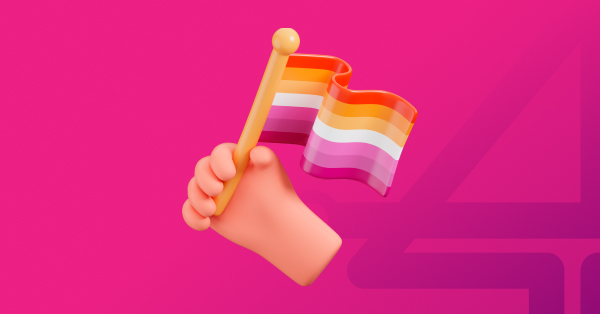
Caption: 3D illustration of a hand holding a flag in lesbian pride colors on a pink background.
Benefits of alignment for your marketing strategy
Put social responsibility inside the CRM and it shows. People can see you are open and that you mean it, and they trust you more.
This trust is the basis for building lasting relationships, generating loyalty that makes your brand stand out in the market.
After all, customers are increasingly aware of and attentive to the practices of the companies with which they interact.
CRM is a key tool for finding and engaging these customers who value social responsibility.
Use the CRM to say plainly what you do on social responsibility, and you draw that crowd in. You also build a bond that runs on feeling, so they stay, because what you stand for is what they stand for.
This integration can result in a big competitive advantage. Customers who perceive a company's social commitment tend to choose its products or services, even if it means paying a little more.
This alignment can raise the performance of your marketing strategy and lift what you earn. Doing right by people brings more customers in, and it builds a business that turns a profit and can keep going.
Best practices for alignment and business analysis
To begin with, it is essential to clearly define the social values your company wishes to promote and how they align with your business goals.
Then configure your CRM to reflect these values, targeting customers and campaigns that are in line with your social responsibility practices.
Finally, communicate these initiatives transparently, showing customers how they are contributing to key causes by choosing your company.
There are many platforms that can help this integration. We mainly recommend HubSpot, as it allows you to customize and automate CRM processes in line with social responsibility goals in a more assertive and intuitive way.
Tools like these help you track the impact of your social initiatives and create campaigns that highlight your social responsibility practices in an authentic and engaging way.
That said, there are real hurdles when you join a CRM to this work. Chief among them: people inside the company resist the change, and it is hard to prove what your efforts did.
To overcome these obstacles, it is essential to involve all levels of the company from the outset, ensuring that everyone grasps the benefits of this integration.
In addition, use specific business analysis metrics within CRM, such as customer satisfaction in relation to social practices, to judge and adjust your strategies as needed.
Lining those two up is work that never quite ends. But put the effort in with the right tools and your company can do two things at once: hold its customers better, and add something real to a world that needs it.
Increase your company's social responsibility and your bottom line
As we have seen, integrating social values into your CRM not only boosts your brand image, but also attracts and retains customers who value ethical and sustainable practices.
This alignment also strengthens the brand's reputation, as well as creating a genuine connection with customers by highlighting tangible values that resonate with them on a personal level.
This integration is an essential step for any company wishing to stand out in an increasingly conscious and competitive market.
Now, I encourage you to think about how social responsibility can be incorporated into your CRM strategies.
Small changes can bring big results, both for your company and for society.
If you're looking for ways to integrate CRM efficiently, check out our post on the importance of a HubSpot consultancy. It could be the next step in taking your strategy to the next level!

How to align CRM with corporate social responsibility
What does it mean to align CRM with corporate social responsibility?
It means putting ethics and a lighter footprint into the way you hold a customer. Joined up like that, a CRM does more than log a sale or a call. It carries what your company stands for, on people, on the planet, and on the money.
Why is it worth combining CRM and social responsibility?
Because today's consumers value companies with purpose. By showing that your brand cares about the impact it has on the world, you build stronger, longer-lasting relationships. This strengthens your reputation and helps you win the trust of more engaged audiences.
How can CRM support social responsibility initiatives?
A CRM lets you slice and shape a campaign around what you and your customers both hold dear. It also carries the word about what you did, whether that is a donation, a lighter footprint, or opening a door. And it lets you watch how people take it.
What are the marketing impacts of this integration?
This integration makes the marketing strategy more relevant and connected to what consumers expect. Actions gain more authenticity, the public tends to respond better to campaigns and the brand differentiates itself. This can bring more conversions and greater loyalty.
What results can a company expect from this practice?
Line your CRM up with social responsibility and your company can win more trust, pull more people in, draw a better crowd, and even hold a higher price on what it sells green. That is growth that lasts, and a brand that stands taller.
What are the best practices for implementing this alignment?
Define the social values the company wants to promote, configure the CRM to reflect these values and keep transparent communication with customers. It's also key to rely on platforms such as HubSpot, which help the automation and tracking of campaigns with this focus.
What are the challenges and how can they be overcome?
The hurdles: people inside resist the change, and the effect of what you did is hard to prove. To get past both, bring the whole team in from day one, show them what the tie-up gives, and follow the reads that matter, such as how customers see you and how they answer a campaign, right there in the CRM.

.jpg)
























 Portugal