





Student recruitment campaigns are long. An application window stretches over weeks, sometimes months, and targets an audience that does not grow at the same speed as the budget invested.
That is the scenario where creative fatigue shows up most strongly. The same ad repeatedly reaches the same people, and performance drops without anyone touching targeting, budget or offer.
The most common mistake in paid traffic when facing that drop is raising the bid or changing the audience. Both actions cost money and rarely solve anything, because they attack a symptom instead of the cause.
What is creative fatigue and why does it happen?
Creative fatigue is the wearing out of an ad through repeated exposure to the same audience. The asset remains technically correct, but loses its power to hold attention because people have already seen it several times, and the result appears as falling clicks and rising cost per result.
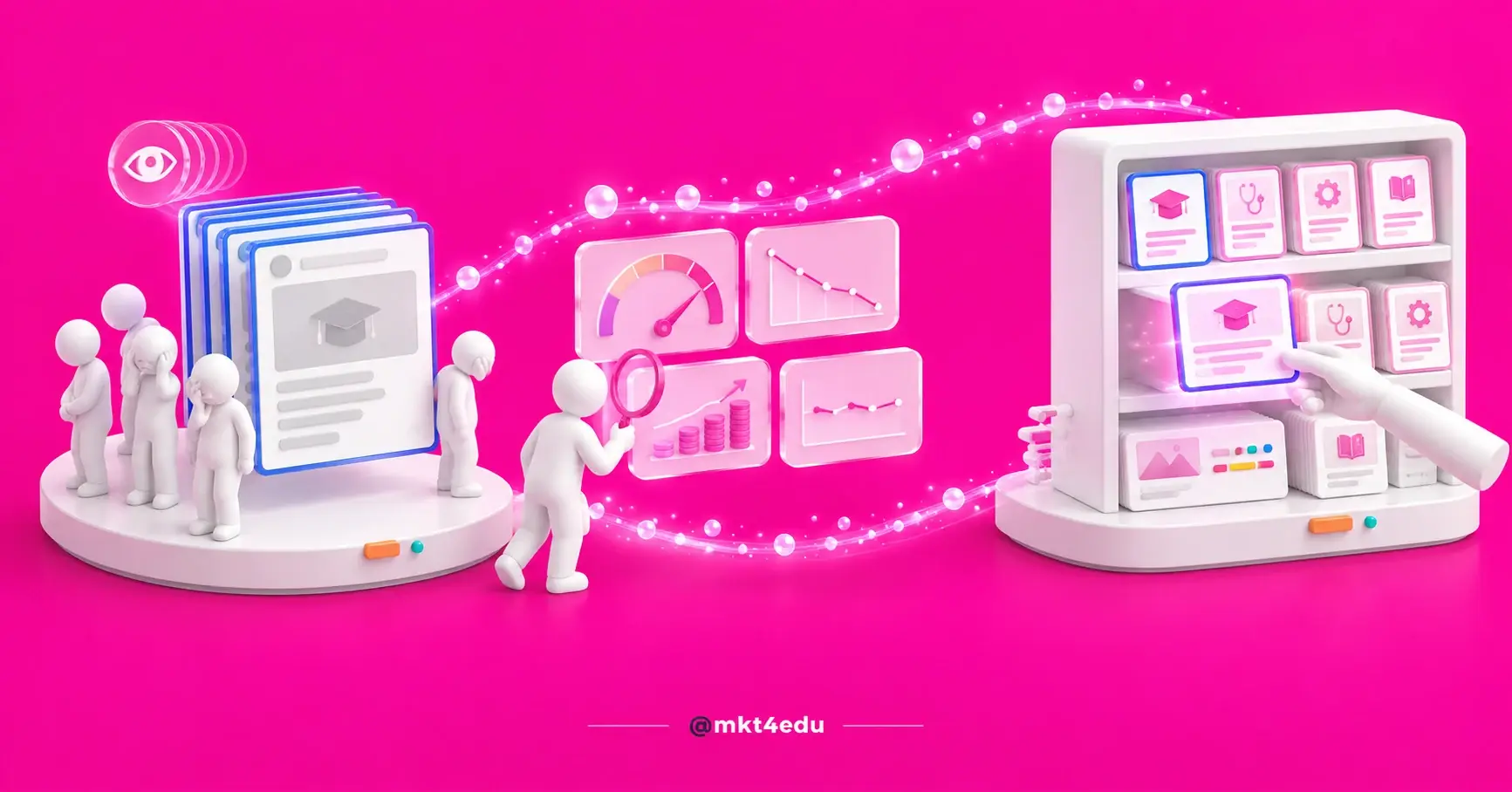
 Caption: creative fatigue appears when the same audience has seen the asset too many times and the bank of variations cannot keep up
The main cause is arithmetic. An audience of finite size receives continuous delivery, and the average number of impressions per person rises with every day of the campaign.
In student recruitment, two factors speed that process up. The audience is usually bounded geographically, and the application window concentrates the budget into a few weeks.
An institution with a campus in a mid-sized city competes for the attention of a small audience. With a constant daily budget, that audience reaches high frequencies within days.
There is also the seasonal factor. Admissions campaigns come back with the same look and the same discount promise every term, and anyone who saw the previous asset recognises the pattern before reading it.
It is worth separating fatigue from similar problems. If CPM rose because a strong competitor entered the auction, the drop in efficiency does not come from the creative and replacing the asset will not solve it.
The same goes for a change in offer. When a program loses its price or schedule advantage, the ad starts selling something less competitive, and no new format compensates for that.
In paid media management, fatigue is one of the few causes of decline that has a cheap and fast solution. Producing a new variation costs less than raising the bid or opening an audience that does not convert.
Which metrics expose creative fatigue?
Four metrics expose creative fatigue when read together: frequency, CTR, CPM and cost per lead. The characteristic pattern is frequency rising, CTR falling and cost per lead increasing, with CPM relatively stable. None of them alone proves the wear.
Frequency is the exposure indicator. It shows how many times, on average, each person in the audience saw the ad in the period analysed, which is exactly what the Google Ads frequency cap lets you restrict in display and video campaigns.
CTR is the reaction indicator. When the same asset starts generating fewer clicks on the same number of impressions, the audience is ignoring what used to draw attention.
CPM helps rule out the auction hypothesis. If cost per thousand impressions spiked alongside, competition increased and the reading changes completely.
Cost per lead closes the equation. It is the number leadership will ask about, but in isolation it does not distinguish fatigue from a drop in landing page conversion.
Video: how to use data analysis to separate creative fatigue from other causes of decline, on the mkt4edu channel (video in Portuguese)
See how to tell each diagnosis apart by the combination of numbers:
|
Signal observed |
Likely diagnosis |
Recommended action |
|
High frequency, falling CTR, stable CPM |
Creative fatigue |
Refresh the asset in the same ad set |
|
Rising CPM with stable CTR |
Auction pressure |
Review budget, period and audience |
|
Stable CTR and rising cost per lead |
Drop on the landing page |
Test the form and page load |
|
Flat reach with constant budget |
Audience exhausted |
Widen geography or interests |
Table: combined reading of metrics to separate creative fatigue from other causes of decline in the campaign
The comparison has to be made against the campaign's own history. A CTR of 1.2% can be excellent for one program and weak for another, so the useful benchmark is that asset's average over its first two weeks.
How much does creative fatigue add to the cost of student recruitment?
Creative fatigue makes student recruitment more expensive at two moments: first it raises cost per lead, then it reduces the quality of the leads that still arrive. The second effect is the costlier one, because it appears weeks later, already in cost per enrollment, when the cycle's budget has been spent.
The first effect is visible on the dashboard. With fewer clicks on the same investment, each contact starts costing more.
The second effect is silent. As the ad saturates those with genuine interest, the remaining volume tends to come from less decided people, who fill in the form and do not move on to apply.
That is why tracking cost per lead alone can mislead. A campaign with an acceptable cost per lead and a falling applicant-to-enrolled conversion is usually delivering increasingly cold contacts.
Reading it correctly requires connecting the ad to the enrollment. Without enrollment data flowing back into the platform, the algorithm keeps optimising for the completed form, and the creative's wear only shows up at the bottom of the funnel.
Structuring that reading is exactly the role of a measurement plan tied to revenue operations, which connects investment, lead and enrollment into a single data series.
How often should creatives be replaced in an admissions campaign?
There is no universal interval for refreshing creatives. The practical rule is to replace the asset when frequency passes the level at which that asset's CTR historically starts to fall, which, in our experience with admissions campaigns aimed at a local audience, happens within a few weeks of delivery.
The calendar helps plan production, not decide the change. Teams that produce in batches at the start of the cycle can refresh when the numbers call for it, without waiting for the next planning meeting.
Broad audiences last longer. A national distance-learning campaign spreads impressions across millions of people, and frequency rises slowly.
Local audiences saturate fast. A campus advertising to a city of two hundred thousand people with a steady daily budget reaches high frequency in days, not weeks.
Remarketing campaigns are the most sensitive case. Because the audience is small by definition, the asset wears out before any other, and it pays to keep variations ready from the start.
There is also the refresh by campaign stage. The message that works when applications open is not the one that works in the closing week, and that change of argument renews attention even with a similar format.
Campaigns tied to admissions exams have a predictable calendar, and sponsored links aimed at those periods require preparation before the search peak, while there is still time to produce variations.
How do you build a creative bank by program?
A creative bank is a set of assets produced in advance and organised by program, format and campaign stage. It exists so that refreshing becomes a ten-minute decision in the ads manager, and not an urgent request to the design team in the middle of the application peak.
The minimum organisation has three axes: program or field, delivery format and message angle. With five priority programs, three formats and three angles, the initial inventory already covers much of the cycle.
The angles can reuse structures that work. Social proof from alumni, ease of admission, schedule flexibility, employability and price cover most of the objections raised by someone choosing a degree.
Producing in batches reduces cost per asset. A single filming session on campus yields material for months, as long as the script plans variations of opening and call to action. That rhythm of creative production is what stocks the bank.
The minimum size of the bank has a benchmark from the platform itself. Google Ads' best practices guide for responsive display ads suggests three to four ads per group and five to ten images per aspect ratio, which gives the order of magnitude for the inventory.
File naming also needs a standard. Without a convention that identifies program, angle and date, the bank turns into a folder where nobody finds the right version when they need it.
One precaution that avoids rework: program names, tuition figures and deadlines tend to change between cycles. Assets that keep perishable information out of the video and concentrate that data in the caption last longer.
The formats that sustain a recruitment campaign vary by channel, and social media marketing applied to admissions campaigns helps define what to produce for each stage of the funnel.
How do you adapt creatives to each generation?
Adapting creatives by generation means adjusting format, pace and language to the repertoire of whoever is watching. A seventeen-year-old applicant and a thirty-five-year-old professional returning to study consume video in different ways, and the same asset rarely serves both well.
Young audiences live on platforms used daily. Among Brazilian teenagers aged 15 to 17, WhatsApp and Instagram lead in usage frequency, at 91% and 81%, and YouTube is accessed at least almost every day by 66% of children and adolescents, according to ICT Kids Online Brazil 2024.
In practice, that favours short, vertical video with the information in the first seconds. What we have observed about generation Z and video changes what works as an opening, and a slow institutional piece loses attention before the argument lands.
Adult distance-learning audiences tolerate longer duration when the content answers a concrete doubt. Course load, degree recognition and compatibility with work hold attention better than campus imagery.
That difference also changes the pace of fatigue. Short, recognisable assets saturate faster, while explanatory formats withstand a slightly higher frequency before wearing out.
The following cohorts are already on institutions' radar. Understanding how generation alpha and the ones after it relate to media helps plan the medium-term creative bank.
In educational marketing strategies, that segmentation by language usually pays off more than fine demographic segmentation. Speaking the right language lowers cost per result before any audience adjustment in the ads manager.
How do you test without losing the campaign's learning?
Testing without losing learning means changing one variable at a time and keeping the history in the same place. Meta's documentation on the learning phase records that significant edits send the ad set back into learning, so it pays to replace ads inside existing sets and give the reading time.
The most frequent mistake is creating a new campaign for every idea. The budget fragments, each set receives few conversion events and none of them stabilises.
The second mistake is ending the test too early. Differences of one or two percentage points over a few days are usually noise, and deciding on them swaps a good asset for an identical one.
The third is testing everything at once. When image, copy and call to action change together, the result does not say which element made the difference and the learning does not accumulate.
A simple routine solves most cases:
- Keep one reference asset running throughout the test.
- Introduce one variation at a time, changing a single element.
- Define in advance which metric decides and which minimum volume ends the test.
- Record the result in a document that survives a change of team.
The last item is the one most often missing. Without a record, every recruitment cycle starts from scratch and the institution tests again what it already knew a year ago.
Paid traffic improves with that accumulation. A bank of learnings about which angles work for each program is worth more than any one-off bid adjustment.
Frequently asked questions about creative fatigue
What should you prioritise first to contain creative fatigue?
Prioritise the reading before production. Without tracking frequency, CTR and cost per lead on the same screen, the team replaces creatives by intuition and finds out too late that the problem was something else.
Then solve batch production. A small bank, with a few variations per program, eliminates most of the late refreshes that erode results during the application peak.
That bank serves student recruitment and retention at the same time. The same assets feed admission campaigns and re-enrollment communication, with an adjustment of argument instead of new production.
Only then refine the testing process. With reliable data and assets available, testing stops being a gamble and starts feeding the institution's repertoire cycle after cycle.
It is worth remembering that creative is only one of the levers in educational marketing strategies. Student recruitment and retention also depend on the program page, response speed and the distribution of budget across the programs that actually convert.
The ad's promise also reaches retention. When the creative sells a program different from what the student finds after enrolling, retention falls in the first term and gives back part of the budget invested in recruitment.
That is why it pays to review the creative bank together with whoever tracks student retention at the institution. Ask them to refresh the argument too, and not only the artwork, when the reason for withdrawal points to a misaligned expectation.
A refreshed creative only pays off if the landing page keeps up. Reviewing what happens on the other side of the click, before blaming the asset for the result, is part of the same work.

























 Portugal