


Consulting for colleges is hired to solve the same pain every time: the institution invests in advertising, has a dedicated team and still does not see enrolments grow at the pace the budget promised.
The first reaction is usually to change the campaign, the channel or the budget. In many cases, though, the bottleneck is not the advert but the process: leads with no fast response, a funnel with no owner, data scattered across spreadsheets that do not talk to each other.
This guide organises the decision. You will see what a consultancy really delivers, how it differs from an agency, when to hire, how it is priced, how to measure the return and what to require from the routine after signing.
What does consulting for colleges do?
Consulting for colleges examines how the institution attracts, converts and enrols students, locates the bottlenecks in that journey and redesigns processes, targets and routines for the in-house team to execute better. The work combines diagnosis, funnel design, team training and continuous data reading, always measured by enrolment rather than by scattered deliverables.
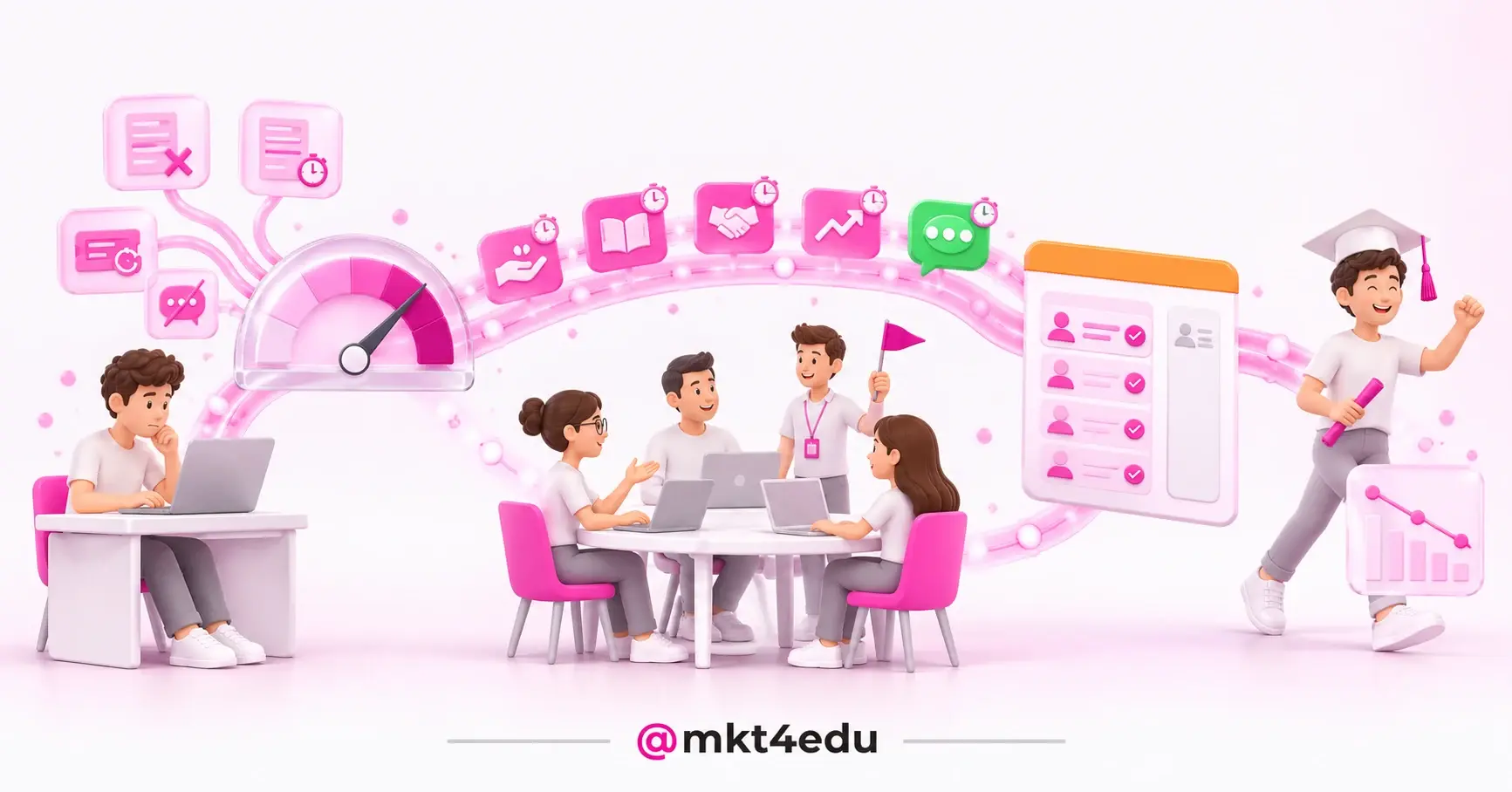
 Caption: consulting for colleges starts with a funnel diagnosis and ends with the in-house team running the method
In practice, the scope is organised into five deliverables:
- Diagnosis: an audit of the funnel, the channels, the CRM and the historical data, with the real numbers for each stage.
- Funnel design: stages, owners, response deadlines and handover criteria between marketing and sales.
- Processes: documented routines for lead response, nurturing, chasing pending items and re-enrolment.
- Team training: preparing the in-house team to run the method without depending on the consultant forever.
- Data reading: indicators per stage and per channel, reviewed on a fixed routine, so the budget follows what works.
That package exists because the market became harder to read. Brazil's 2024 Higher Education Census, run by Inep, recorded distance learning at 50.7% of enrolments and 66.8% of new entrants in undergraduate education.
Retention pushes from the other side. The 16th Higher Education Map, by Semesp, the body representing private institutions, records for 2024 a total dropout rate of 41.6% in distance learning and 24.8% on campus.
Together, the two numbers change the size of the challenge: competition became national with distance learning, and every enrolment won runs a real risk of being lost. An educational marketing strategy that ignores that double pressure tends to buy expensive volume and give it back as dropout.
So serious consultancies treat recruitment and retention as the same calculation. Working to improve student enrolment without holding on to whoever already came in is filling a leaking bucket, and the diagnosis has to look at both sides from day one.
Consulting or an educational marketing agency: which should you hire?
Hire a consultancy when the problem is method and an agency when the problem is continuous execution capacity. The consultancy diagnoses, designs processes and trains the team to operate on its own; the agency runs campaigns, content and media every month. Both models can coexist in the same project, each with its own role.
The confusion is understandable, because the boundaries overlap. A mature educational marketing agency also diagnoses before executing, and an educational marketing consultancy usually follows the execution to make sure the method leaves the page.
The deciding criterion is where the knowledge ends up. If the institution wants to internalise the operation, the consultancy transfers the method and steps aside; if it wants to outsource execution indefinitely, the agency takes on the campaigns as routine.
In the HubSpot ecosystem, both roles live with the same supplier. HubSpot's official solutions partner directory organises companies into Gold, Platinum, Diamond and Elite tiers, according to sourced, influenced and managed revenue points on the platform.
The tier works as an evaluation shortcut: the higher it is, the more clients and certifications sustain the partner agency's position. It is worth cross-referencing it with the criteria for choosing the right HubSpot partner for your project, because a high tier in another segment does not guarantee experience with education institutions.
There is a third route for anyone starting on the platform: HubSpot's official onboarding, run by the company itself. It covers the initial configuration; a HubSpot consultancy comes in when the institution needs funnel design, integrations and recruitment-specific processes.
Video: what changes with a specialist HubSpot partner alongside, a role consulting for colleges usually takes on
When should you hire enrolment consulting?
Hire enrolment consulting when the signs that the current model is exhausted pile up: cost per enrolment has been rising for more than a cycle, budget decisions are made on intuition, the funnel depends on one or two people, and targets are met, or missed, with no clear explanation.
Timing matters too. Redesigning a process at the peak of the admissions campaign disrupts the campaign itself, so the ideal is to hire between cycles, with the student recruitment calendar on the table, so the new method debuts alongside the following term.
Here is how the most common situations are organised:
|
Institution's situation |
What to hire |
Sign of return |
|
A funnel with no reliable data |
Diagnosis and process consulting |
Budget decisions backed by an indicator, not by intuition |
|
A lean, overloaded team |
Method consulting with an agency executing in parallel |
Campaigns live while the processes are redesigned |
|
An underused or non-existent CRM |
HubSpot consulting with implementation and integrations |
The funnel visible from campaign to enrolment, in one place |
|
Stable recruitment and high dropout |
Consulting focused on recruitment and retention |
Revenue per student growing over the course |
|
Cost per enrolment rising |
Student recruitment consulting with targets per channel |
Acquisition cost falling cycle by cycle |
Table: common situations at education institutions, the type of consulting for colleges to hire and the sign that the investment is paying back
The table does not replace the diagnosis, but it avoids the most expensive mistake: hiring execution when the problem is process, or hiring method when what is missing is capacity.
The same reasoning applies to organic. Inbound marketing only pays off once the funnel has an owner, a deadline and a defined handover criterion, and that foundation is exactly what the consultancy builds first.
How much does educational consulting cost?
The cost of educational consulting depends on the charging model: a fixed project, with defined scope and deadline; a monthly fee, for continuous support; or scope by front, where the institution buys separate blocks such as diagnosis, funnel or CRM. There is no single market price list, and it is worth being wary of anyone offering one.
The fixed project works well for bounded deliverables, such as a diagnosis with an action plan. The monthly fee makes sense when the consultancy follows the operation across whole cycles, and scope by front lets you start small and expand as the return shows up.
Five factors move the price in any model: the size of the institution, the number of fronts contracted, the maturity of the data, the seniority of the consulting team and the length of the engagement. An institution with a tidy CRM pays less for the same result, because the diagnosis moves faster.
The most honest evaluation parameter is not the absolute price but the cost compared with the problem. Knowing how much it costs to recruit a student in the current operation turns the proposal into simple arithmetic: if the consultancy cuts the waste in the funnel, it pays for itself within the cycle.
Before requesting a proposal, it is also worth looking at how the supplier designs its service fronts: modular scopes, from SEO to commercial processes, make the comparison fairer. A consultancy that details scope by front makes it easier to cut what is not a priority right now.
Video: a video from the mkt4edu channel on choosing the platform, a decision consulting for colleges helps support with data
How do you measure the return of recruitment consulting?
The return of recruitment consulting is measured by comparing funnel indicators before and after the project: cost per enrolment, conversion per stage, lead response time and revenue per student. The baseline is set in the diagnosis, and each front of the scope gets its own success indicator.
The first number on that scale is customer acquisition cost: if the method works, winning each student gets cheaper, or the same investment produces more enrolments. The reading is per channel and per programme, because the overall average hides where the gain happened.
The second reading is retention, measured in ROI (Return on Investment). The ROI of student retention completes the recruitment calculation: a process that enrols more but does not improve arrival at the second term has solved half the problem.
Training and process also belong on the scale, with indirect indicators: lead response time falling, campaigns launched on schedule and decisions documented on a fixed routine. A method that does not become team behaviour is an expensive report.
Ask for evidence of return in similar projects too. The mkt4edu case studies show the shape that proof should take: the institution's context, what was done and the number that changed, over a defined period.
On organic fronts, the reading period is longer. Inbound marketing matures over months, so the contract has to separate short-term indicators, such as process and conversion, from long-term ones, such as traffic and organic cost per lead.
What should you require from the day-to-day of consulting for colleges?
Require from consulting for colleges a short accountability routine, evidence for every deliverable, a written record of decisions, visibility of risks and scope discipline. Method is proven in the management of the project itself: a consultancy disorganised in its own routine is unlikely to organise anyone's recruitment.
In projects run by mkt4edu, an Elite-tier HubSpot partner agency that also works as a student recruitment consultancy for education institutions, that routine has five fixed practices:
- A 15-minute fortnightly status report: the meeting opens with the funnel KPIs (Key Performance Indicators) and with the project's margin consumption, so nobody discovers an hours overrun at the end of the contract.
- No task closed without evidence: nothing is marked complete without a screenshot or a link to what was delivered, which removes the almost ready from meetings.
- Minutes on the same day: the record goes out while the conversation is fresh and works as a living contract; that habit has already settled a scope dispute by checking what was agreed weeks earlier.
- A risk dashboard at the steering committee: project risks go up to the decision-making body with a colour and a response plan, instead of living in the consultant's head.
- A clear scope rule: the principle that an exception stays an exception governs requests outside the agreement, which are judged one by one rather than becoming a silent routine that erodes the project.
That routine counts double when the scope involves technology. A CRM implementation for education carries dozens of configuration decisions, and each one needs an owner, a deadline and evidence, or the system goes live different from what was designed.
The same rigour protects the institution's marketing strategy: a plan with no accountability routine becomes a pretty presentation, and the difference between the two outcomes shows up precisely in those management rituals.
What should you ask for in a consultancy's diagnosis?
Ask the diagnosis for four deliverables: the funnel map with the real numbers for each stage, the audit of channels and CRM, the list of bottlenecks prioritised by impact and effort, and an action plan with owners and deadlines. A diagnosis that ends in generic observations, with no numbers and no priority, guides no decision at all.
Require the document to state what could not be verified, and why. That honesty separates a serious diagnosis from a sales piece in disguise, and it previews how the consultancy will handle its own limitations during the project.
Frequently asked questions about consulting for colleges
Is hiring consulting for colleges something for now or can it wait?
Hiring consulting for colleges is for now when the institution recognises the signs in this guide: cost per enrolment rising, decisions without data and a funnel dependent on a few people. Waiting only makes sense when a method is working and measured, and the bottleneck is purely execution capacity.
The decision criterion fits in one question: will the next cycle repeat the mistakes of the current one? If the answer is yes, every term of waiting costs enrolments, and the educational marketing strategy stays hostage to intuition and urgency.
If you do decide to hire, use this guide's criteria in the selection: clear deliverables, a diagnosis with numbers, a transparent charging model, return indicators in the contract and a management routine with evidence. Strategy only leaves the page when someone holds the page to account every week.
And since much of the return is born in the handover from marketing to sales, it is worth preparing the sales team to receive the method: the guide to inbound sales for educational institutions shows how to structure the commercial funnel that turns a lead into an enrolment.













 Portugal