






Every institution knows the math: an enrollment lost mid-term costs far more than a new lead. Even so, most of the investment and attention stays at the top of the funnel, while the exit has no clear owner.
Student dropout rarely starts with a definitive decision. It starts with an unanswered question, an invoice nobody explained, a complaint that got no reply and the feeling that the institution is not paying attention.
That gap is exactly where artificial intelligence earns its place. It covers the distance between the moment a student shows discomfort and the moment someone from the team can talk to them.
Why does student dropout remain so high?
Student dropout stays high because it combines financial pressure, academic difficulty and a relationship failure, and institutions usually address only the first. Sector data points to a structural problem, not an isolated bad term.
The 15th Map of Higher Education, produced by Instituto Semesp with data from Inep, reports 61.3% cumulative withdrawal in Brazil's private network over the 2019 to 2023 cycle.
Distance learning shows the most critical picture. In private network online courses, withdrawal reaches 64.1%, and in online Business Administration the figure climbs to 70.7%.
In on-campus private courses the variation by field is also wide: Engineering records 65.2% and Law 57.3%. Institution size matters, and at large private institutions withdrawal hits 64.6%.
Numbers in that range leave little room to treat retention as a finance department matter. It is a relationship front, with data, channels and an owner, structured at the same level as an integrated student recruitment and retention operation.
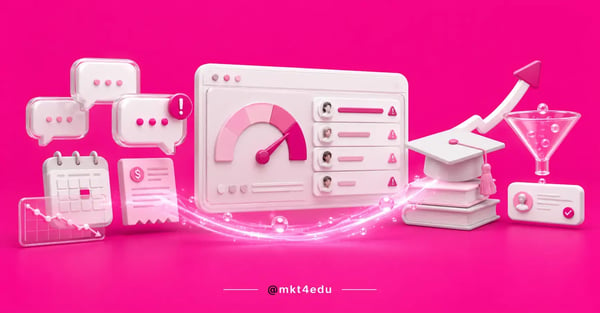 Caption: The signal shows up before the withdrawal: predictive AI orders the risk queue and gives the team time to act.
Which signals appear before a student withdraws?
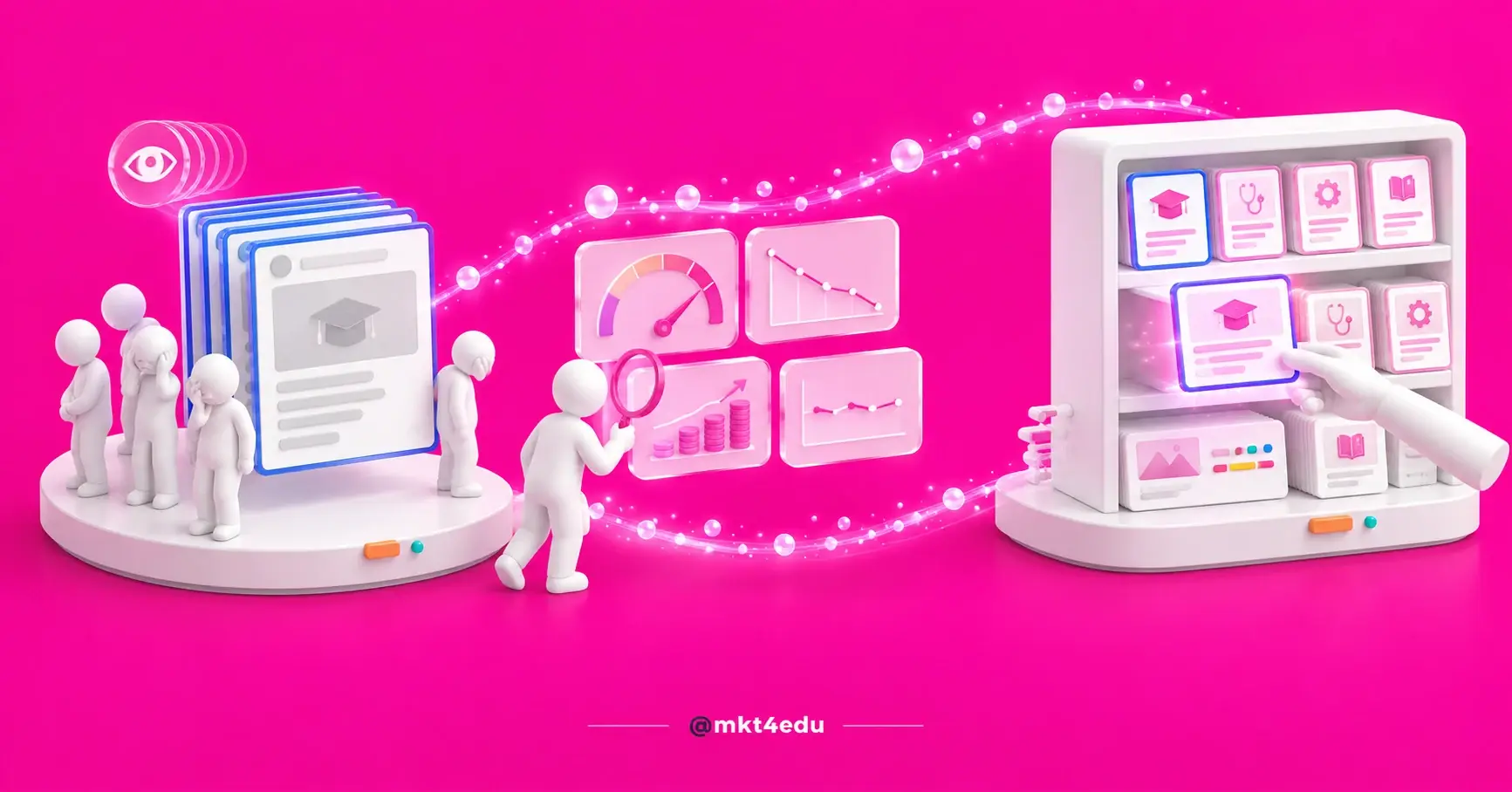
A student at risk of dropping out emits observable signals weeks before the withdrawal request: falling access to the virtual environment, late payments, unanswered messages, repeated complaints and absence from assessments. Each signal already exists in some institutional system, almost always without cross-referencing.
The first group of signals is behavioral. Falling attendance, decreasing platform logins and late assignment delivery indicate disengagement before any conversation about leaving.
The second group is financial. Recurring delays, renegotiation requests and questions about tuition amounts signal pressure the institution can address with clear information about alternatives.
The third group is the most ignored: the relational one. A question asked across three different channels without a consistent answer is a request for attention, and it usually precedes departure.
The practical difficulty is not recognizing those signals in one student. It is recognizing them in twenty thousand students at once, every day, without depending on someone watching a spreadsheet.
How does artificial intelligence identify dropout risk?
Artificial intelligence identifies dropout risk by cross-referencing behavior, payment and interaction history to estimate each student's probability of leaving. The output is a priority queue: who needs contact today, who enters an automated flow and who is stable.
The input is the database the institution already has. Enrollment, access, service, billing and conversation history feed the model, and record quality determines prediction quality.
The logic mirrors what happens at the top of the funnel. Just as predictive AI estimates a lead's chance of enrolling, it also estimates an enrolled student's chance of withdrawing.
The output has to be operational, not a pretty report. A risk score only earns its keep when it triggers a task for a person, entry into a communication flow or an alert to course coordination.
It is worth calibrating expectations: the model indicates probability, not certainty. It makes mistakes, which is why human judgment stays in the process, now with an ordered queue instead of an entire database to serve.
Which questions does AI answer and which need a person?
AI handles objective, repetitive, single-answer questions well: deadlines, amounts, procedures and where to find information. Conversations involving exceptions, negotiation, dissatisfaction and personal decisions need a person, with the conversation history at hand.
That split is not an aesthetic preference, it is what service data shows. Gartner research with 5,728 consumers, released in 2024, found that only 14% of customer service issues are fully resolved in self-service, although 73% of customers use that channel at some point.
The same study points to the two most frequent sources of frustration: 45% felt the company did not understand their need and 43% could not find content relevant to their problem. Translated into institutional routine, it is the difference between a bot trained on real student questions and a generic one.
In practice, triage works like this:
| Type of student contact | Who resolves it | Expected time |
|---|---|---|
| Re-enrollment deadline, calendar, documents | AI, no escalation | Immediate |
| Duplicate invoice, platform access, password | AI integrated with systems | Immediate |
| Renegotiation and discount requests | AI qualifies, person negotiates | Same day |
| Intention to suspend or cancel | Person, with conversation context | Within 2 hours |
| Complaints and declared dissatisfaction | Person, recorded as a ticket | Within 2 hours |
Table: Triage model between automated and human service across the most common retention questions.
The times in the last column are an operating reference, not a market standard. Each institution adjusts them to real team capacity, but keeping them explicit prevents a sensitive case from sitting idle.
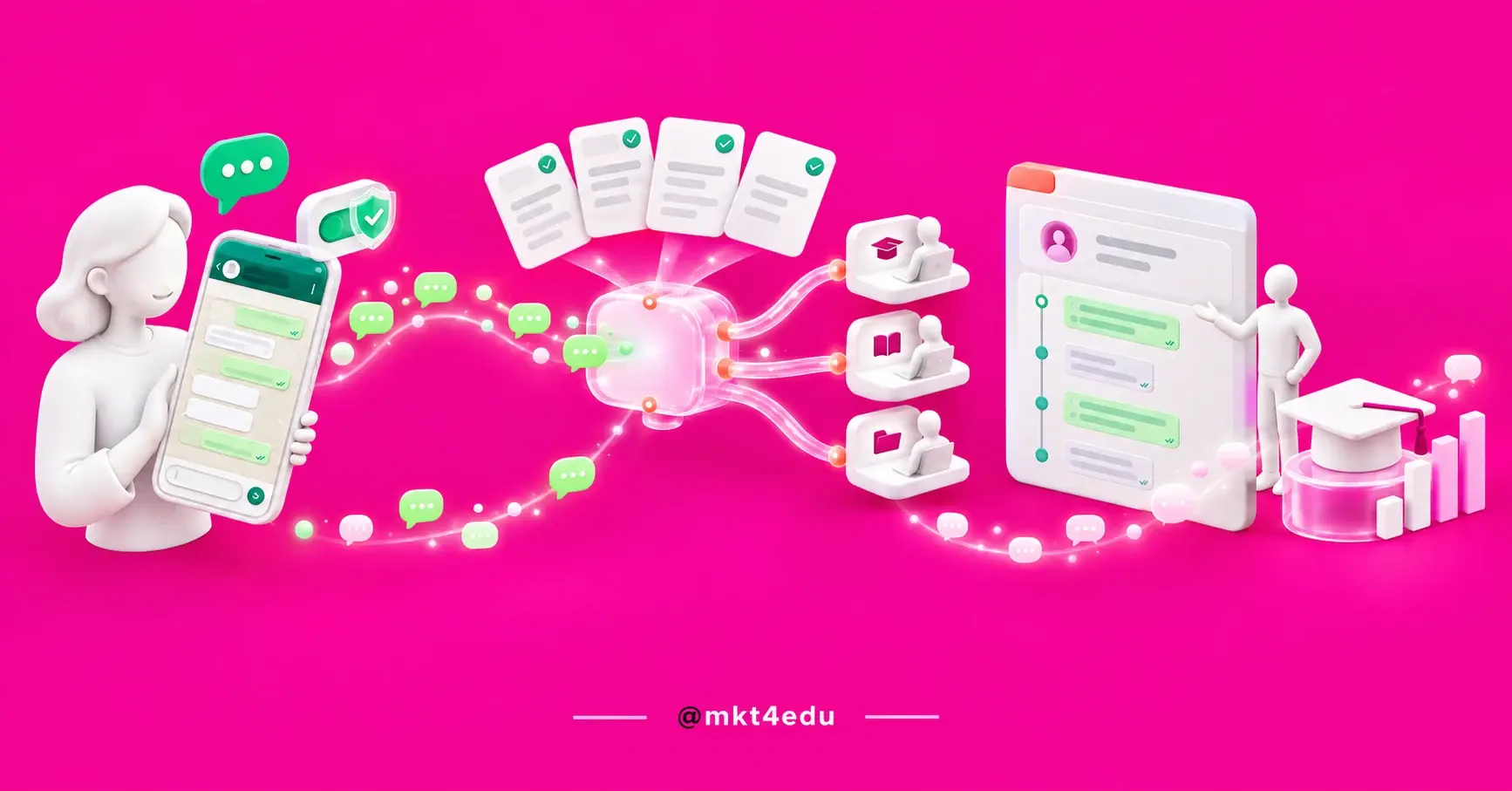
The detail that holds triage together is the handoff. When a person takes over without the history of what the student already asked the bot, the experience gets worse than having no automation at all. A chatbot properly integrated with the retention strategy delivers that context along with the conversation.
How do you deploy AI in retention without losing the human tone?
Deploying artificial intelligence in retention starts with data, not tooling: an organized database, accessible history and a definition of who answers what. Then come training on real student questions, the institution's tone of voice and the escalation rules.
The first step is the database. Without an educational CRM centralizing enrollment, service and history, AI answers into a void and the student notices.
The second step is the repertoire. The questions automation needs to master are already in the service records of recent terms, not in a generic list of college FAQs.
The third step is tone. The institution writes the way it speaks: no jargon, no promise it cannot keep, and clear disclosure that the service is automated.
AI agents run that path end to end when connected to the CRM: they read the history, prioritize who is at risk, send the right message and hand the case to the team with the context recorded.
The fourth step is legal and reputational. Student data is personal data, and the rules for processing, consent and retention need designing before the first message goes out, as covered in the material on data privacy in the CRM.
How do you measure AI's effect on student dropout?
AI's effect on student dropout is measured through four indicators: resolution rate without human intervention, time to first contact with an at-risk student, re-enrollment rate in the group served and the volume of sensitive cases identified in time.
Resolution rate shows whether automation is genuinely absorbing demand. A low number here indicates an insufficient repertoire, not bad technology.
Time to first contact is the indicator most closely tied to retention. A student who signaled an intention to leave and got a reply within two hours has a real chance of reconsidering.
Comparing re-enrollment requires a control group. Without comparing the served group against a similar unserved group, any variation could be seasonality.
Track what AI failed to resolve as well. The list of questions without a satisfactory answer is the best improvement agenda available, and it renews itself every term.
Frequently asked questions about student dropout
So, is AI worth the investment against student dropout?
Investing in AI against student dropout makes sense when the institution has a contact volume the team cannot absorb and enough data to predict risk. With a small base and service under control, the gain is marginal.
The starting point is rarely the technology. It is knowing how many students asked for information last term, how many went unanswered and how many of those left.
With that number in hand, the decision becomes objective. Automation gets a clear absorption target and the team gets a prioritized queue instead of an entire database.
If you want to understand where artificial intelligence fits in your recruitment and retention operation, that is what mkt4edu's artificial intelligence work is about.
Talk to our team for a diagnosis of your database and your student service flow.
Acting before the withdrawal happens means watching signals continuously, which is what AI agents for education do.

























 Portugal