






Every educational institution that adopted AI and a CRM in recent years went through the same doubt: what, exactly, should each one do? In many cases, AI was switched on before the process was designed, the CRM became an expensive contact list and the team kept putting out fires.
This article treats AI in educational management as a boundary problem, not a tooling problem. For each process, from student recruitment to alumni relations, you will see where AI fits, where the CRM fits, where each one leaves the stage and what remains people's work, whether by nature or by law.
The starting point is a figure that changes the conversation. According to Salesforce's State of Service research, published in May 2026 with 3,075 service professionals, 66% of operations already use AI agents, against 39% in 2025. Adoption stopped being the question, and the division of labor became the question.
What changes in educational management when AI and a CRM enter the routine?
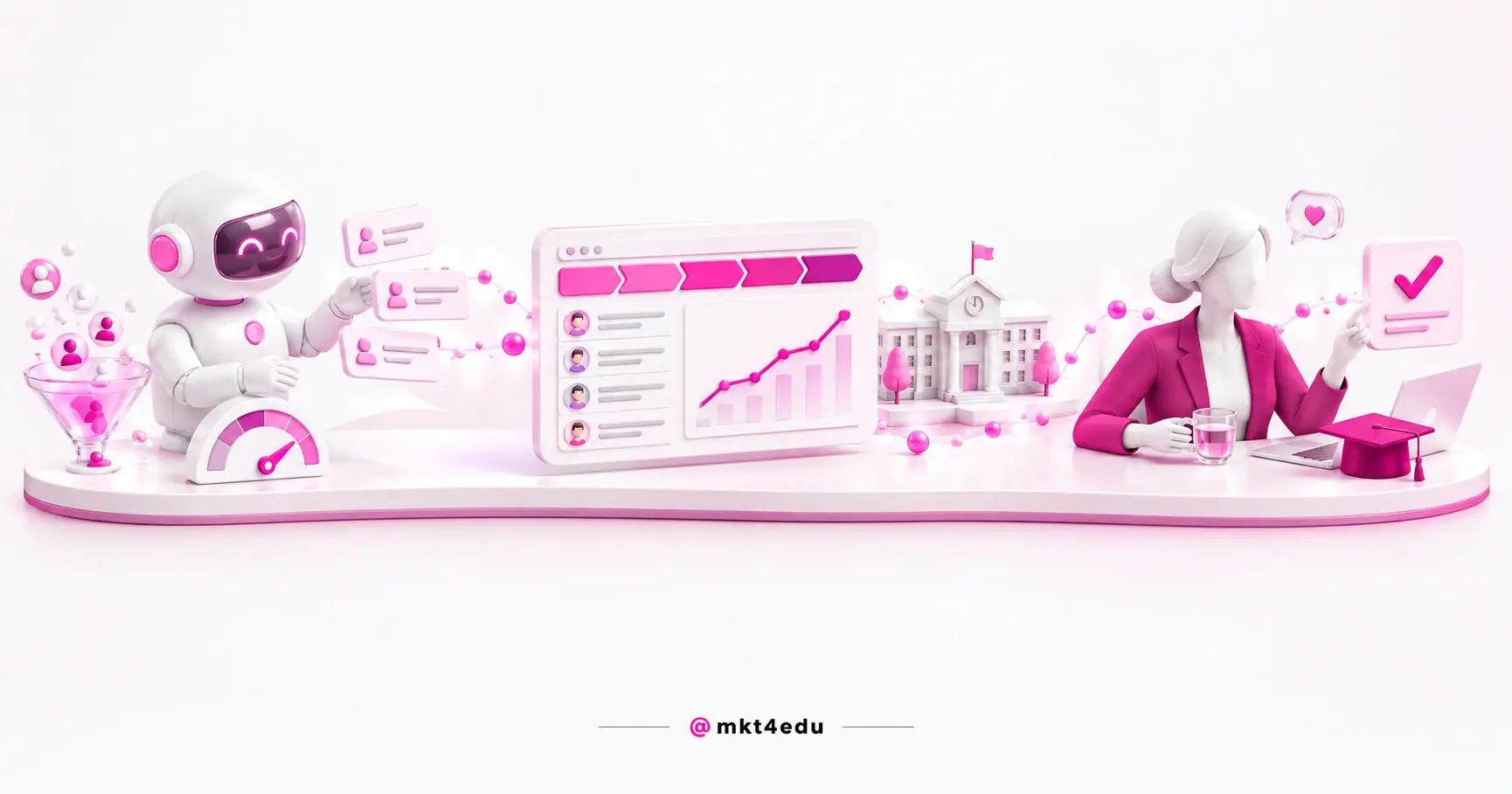
AI in educational management changes the nature of the team's work, not the number of people needed. Repetitive tasks, triage and first responses migrate to AI agents, the CRM becomes the institution's single memory, and people concentrate their time on decisions, negotiation and conversations that require listening. Each layer does only what belongs to it.
 Caption: in AI in educational management, automation covers the scale, the CRM holds the history and the team decides what requires judgment
This change has an order. First the process is designed, then the CRM records the process, and only then does AI operate on top of that record.
When the order is reversed, the institution switches on an AI agent that answers without history and feeds a database nobody consults.
The scale of the problem helps explain the urgency. The 16th Semesp Higher Education Map, based on 2024, records 10.2 million enrollments, 79.8% of them in private institutions. Annual dropout reaches 41.6% in distance learning and 24.8% on campus.
At that volume, no team follows every student by hand. AI covers the scale, the CRM makes sure nothing gets lost between departments, and the team acts where personal contact changes the outcome.
Where does AI fit into student recruitment and where does it stop?
In student recruitment, AI handles the first response to the lead, qualification through questions, prioritization of who is most likely to enroll and the drafting of follow-up messages. It stops when the applicant asks for special terms, shares a personal situation or hesitates between courses. At that point, the conversation moves to someone on the team.
The AI SDR (Sales Development Representative) agent is the clearest example of that boundary. It answers in seconds, at any hour, and asks about the course, the shift and the admission route.
The comparison between an AI SDR and a human SDR shows that the gain lies in coverage, not in replacement. The agent absorbs the volume, and the team receives conversations that already carry context.
Prediction is also AI territory. Predictive AI in student recruitment models cross the lead's source, the course of interest and message behavior to estimate the chance of enrollment. The team receives a list ordered by priority, instead of a chronological queue.
There are three situations in which AI has to leave the stage in student recruitment:
- The applicant asks about scholarships, discounts or payment terms outside the standard table.
- The applicant reports financial, family or health difficulties that affect the decision.
- The applicant is undecided between courses or formats and wants an opinion.
In those three cases, the AI agent records the context in the CRM and transfers the conversation with a summary. The person taking over does not start from scratch, and the applicant does not repeat their story. That design makes student recruitment feel continuous to the person on the other side.
What does the CRM do in educational management that AI does not replace?
The CRM does three things no AI replaces in educational management: it records the student's entire journey in one place, automates the contact cadence according to the stage and delivers reliable data for management decisions. AI consumes that record and returns the action, but it is not the record. Without a CRM, every conversation is born without a past.
The CRM works as the institution's memory. The applicant who talked to the AI agent in January, visited the campus in February and enrolled in March has to appear as a single person, with a single timeline. That single timeline is what makes it possible to measure conversion by stage.
Automation is the second function. In the HubSpot CRM, for example, a stage change triggers an email, a task for the advisor and a WhatsApp message with no manual intervention.
HubSpot's own Breeze AI agents operate inside that same record. This avoids the duplicate databases that usually appear when AI is contracted separately.
The third function is data for decisions. A well-configured CRM answers how much each enrollment cost per channel, how many students are at risk per course and which advisor converts best.
Education CRM implementation starts from that question: what decision does management need to make, and what data does it require? Configuration comes after the answer.
A CRM without adoption, however, is an expensive spreadsheet. If the team does not record, the data does not exist, and AI starts working with incomplete information. That is why training the team is part of the implementation, and not an extra that comes later.
Which educational management decisions remain human work?
What remains human work in educational management are the decisions involving strategy, negotiation, pedagogical judgment, conversations with people in vulnerable situations and legal responsibility over personal data. AI can prepare each of them with a summary, a prediction and options, but the final decision, the signature and the answer for the outcome stay with someone at the institution.
Strategy comes first. Deciding which courses to open, which audience to prioritize, how much to invest per channel and how to position the institution are business choices.
Educational marketing strategies are born of context, history and appetite for risk. AI comes in afterwards, to execute and measure.
Negotiation is second. Scholarships, discounts and tuition renegotiation involve institutional rules, margin and a reading of the situation. An AI agent can state the current policy, but granting an exception is a manager's decision, recorded in the CRM with a name and a date.
The pedagogical decision is third. Approval, curriculum adaptation and support for a struggling student are acts of coordination and teaching. AI flags the pattern in grades and attendance, and the academic coordination decides what to do about it.
Responsibility over personal data is fourth, and here the law is explicit. Brazil's LGPD (General Data Protection Law, Law 13.709/2018) assigns to the controller, that is, to the institution, the duty to account for the processing (art. 6, item X) and to honor the data subject's rights (art. 18).
Article 20 of the LGPD gives the data subject the right to request a review of decisions taken solely on the basis of automated processing that affect their interests, including those that define a personal, professional, consumer or credit profile. A student denied a scholarship by an AI score can ask for a person to review the decision.
Paragraph 1 of the same article requires the controller to provide clear information about the criteria and procedures behind the automated decision. A model nobody at the institution can explain is therefore a legal problem, not only a technical one.
This division becomes easier to see process by process. Here is how the boundaries are organized:
|
Process |
What AI does |
What the CRM does |
What stays with the person |
|
Recruitment |
First response, qualification, enrollment score, message draft |
Lead record, source, funnel stage, automatic cadence |
Negotiation, indecision between courses, the applicant's personal situation |
|
Enrollment |
Document checking, pending-item reminders, process questions |
Enrollment status, integration with the academic system |
Scholarships, discounts, deadline exceptions, contracts |
|
Service |
First level, frequent questions, triage by subject, conversation summary |
Ticket history, deadlines, owner, satisfaction |
Sensitive complaints, conflict, cases outside the standard |
|
Academic follow-up and retention |
Dropout risk prediction, alerts from grade and access patterns |
Risk list, contact cadence, record of each intervention |
Conversation with the at-risk student, pedagogical decision, renegotiation |
|
Alumni relations |
Segmentation by interest, suggestion of follow-on courses |
Alumni database, history, re-entry campaigns |
Personal invitation, partnership, referral, mentoring program |
|
Team management |
Performance summary, next-action suggestion, report draft |
Targets, dashboards, lead and task distribution |
Strategy, feedback, hiring, decisions about personal data |
Table: Map of boundaries by educational management process: what AI executes, what the CRM records and automates, and what remains a team decision.
The right-hand column is what defines the quality of the operation. When it is left empty, because everything was delegated, the institution loses human contact exactly at the moments that decide the enrollment or the student staying.
How do you divide AI, the CRM and the team in student retention?
In student retention, AI identifies who is at risk, the CRM organizes the list, the contact cadence and the record of each intervention, and the team holds the conversation that makes the student stay. Prediction without conversation retains nobody, and conversation without prediction arrives late. The design works when the three act in sequence.
It all starts with prediction. AI for predicting student dropout models cross access frequency in the virtual learning environment, grades, late tuition payments and interactions with the institution.
The result is a score per student, updated frequently, that points to who deserves attention now.
The CRM comes next. The risk list becomes a work queue with an owner, a deadline and history. If the student replied to an automated message saying they lost their job, that context sits in the record before the advisor calls.
The person closes the loop. A student at high risk for financial reasons needs someone with the autonomy to propose a renegotiation, and a student with an academic reason needs the academic coordination.
AI can suggest the referral, but the conversation is human, and its outcome goes back into the CRM.
Semesp's figures make the urgency clear. Cumulative dropout for the cohort that entered in 2020 and was tracked through 2024 reached 64.7% in private institutions and 68.1% in private distance learning. In that scenario, the division of labor between AI, the CRM and the team is what makes it possible to act before the student leaves.
The separation between student recruitment and retention also needs to fall. When the same CRM holds the journey from first contact, the retention team knows why the student chose the course and what they expected.
That integration between student recruitment and retention turns data into persistence. A student who arrives with their expectations on record is a student the institution can actually follow.
How does an educational consultancy organize this division of labor?
An educational consultancy organizes the division between AI, the CRM and the team in four movements: a diagnosis of each process as it runs today, the design of the boundaries, the configuration of the CRM and the AI agents according to that design, and training the team on the new flow. The value lies in the design, because a tool without a process reproduces the chaos faster.
The diagnosis maps who does what. At many institutions, the same applicant question is answered by three departments with three different answers.
The educational consultancy documents that real flow, measures response time and conversion per stage, and shows where AI and the CRM solve the problem and where only the process does.
Designing the boundaries is the decision stage. Here management defines, process by process, what AI answers on its own, what it transfers and what never passes through it.
It is a business meeting, not a technology meeting. Educational marketing strategies come out of it with clear escalation rules, which later become configuration.
Configuration comes next, and that is where the platform choice matters. A HubSpot CRM with native AI agents lets the record, the automation and first-level service live in the same place.
Anyone contracting a HubSpot CRM implementation should require that the boundaries designed become configured transfer rules, and not stay only in the document.
Training closes the loop. The team needs to know what AI already did before taking over the conversation, how to record the decision in the CRM and when to hand the case back to automation.
An educational marketing consultancy that does not train the team delivers technology, not results.
What risks come from delegating too much to AI in educational management?
Delegating too much to AI in educational management creates four concrete risks: automated decisions affecting the student without human review, personal data with no clear owner, service with no way out to a person, and the team losing its capacity to judge. None of them prevents the use of AI, but all of them require a limit designed before the agent is switched on.
The first risk is legal. A score that denies a scholarship, blocks re-enrollment or classifies a student as "low potential" is an automated decision affecting their interests, and article 20 of the LGPD gives the data subject the right to request a review.
Without a human flow for that review, the institution breaks the law without noticing.
Data without an owner is the second risk. When the AI agent is contracted separately from the CRM, the conversations sit in a database nobody audits.
The accountability principle in article 6 of the LGPD requires the institution to demonstrate the measures it adopted. That is only possible with a single record and controlled access.
The third risk is service with no escape hatch. Gartner's forecast talks about 80% of common customer service issues being resolved by agentic AI by 2029. The word that matters is "common", because the other 20% are the cases that define the institution's reputation.
Team atrophy is the fourth risk. When every triage, every summary and every suggestion comes from AI, the team stops exercising the judgment the boundary requires. Keeping people in the decisions guarantees there is someone capable of noticing when AI gets it wrong.
Mitigating these risks usually comes down to three simple rules:
- Every automated decision affecting the student has a human review path, documented and accessible.
- Every AI conversation is recorded in the CRM, with the same access control as the rest of the database.
- Every AI agent has a transfer trigger to a person, and that person receives the context.
With those rules, AI in educational management stops being a risk to control and becomes a layer of scale with defined responsibility.
Frequently asked questions about AI in educational management
Where do you start with AI in educational management?
Start with the process that loses the most students today, and design its boundary before signing any contract. If student recruitment is slow to respond, the first AI agent goes there, with the CRM recording every conversation and the team taking on the negotiation. If dropout is the problem, risk prediction goes first, with a mandatory human conversation.
Next, write the "what stays with the person" column for each process and present that document to the team before configuring any tool. The technology will reproduce whatever is on that page, and whatever is not designed will be decided on the fly.
Finally, measure the boundary, not only the outcome. The rate of transfers from AI to a person, the time to the first human response and the record of automated decision reviews show whether the division is healthy. To choose those numbers, the read on educational marketing metrics organizes the dashboard by journey stage.



.jpg)






















 Portugal