






Keeping a student enrolled costs far less than winning a new one, and even so most of the effort at institutions still goes to student recruitment.
An AI agent for student retention changes that logic by looking after persistence continuously, understanding each student's context and talking on the channel they already use every day.
In practice, persistence gains the same weight as recruitment inside the institution's educational marketing.
The challenge is large. According to the 14th Higher Education Map in Brazil, by Instituto Semesp, the dropout rate in the country reaches 57.2%. Every enrollment lost halfway through is revenue that came in the door and slipped out the window.
The good news is that much of the dropout comes from simple, predictable problems: a late tuition payment, an unanswered question, a forgotten re-enrollment deadline.
That is exactly where a well-designed AI agent makes a difference. In the next sections, you will see how.
What is an AI agent for student retention?
An AI agent for student retention is an intelligent assistant that talks with the student throughout the whole academic journey to keep them from quitting.
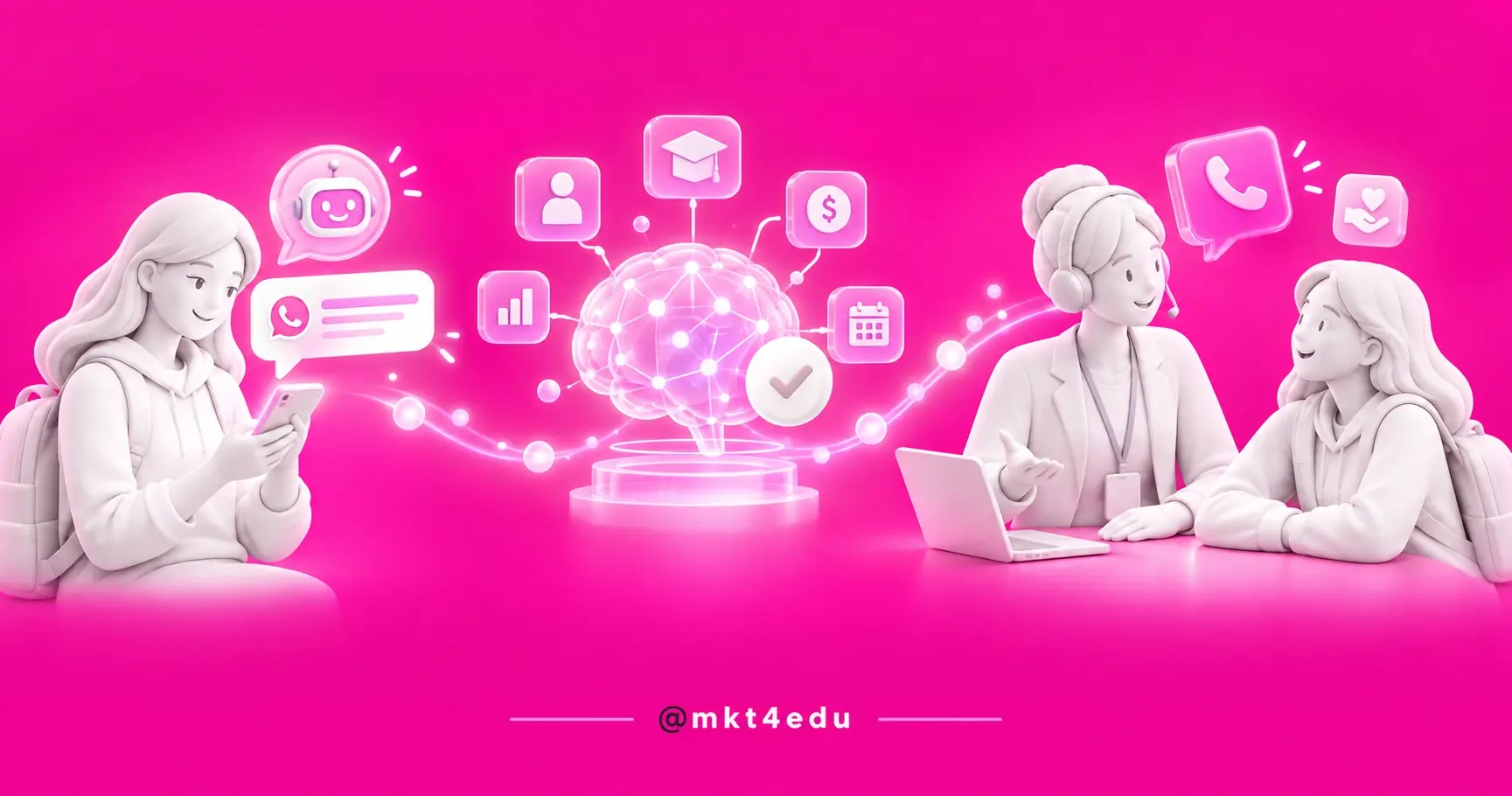
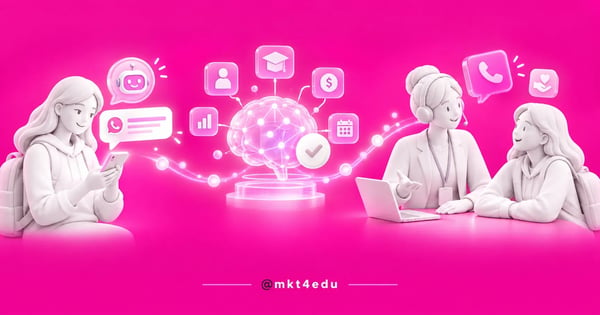 Caption: the AI agent for student retention talks on WhatsApp, reads the institution's data and brings in a person when the conversation calls for it
It understands the context, answers in natural language, accesses the institution's data and decides the best action: reminding of a deadline, negotiating a pending payment or calling in a person.
The central difference is the objective. The focus is not converting a lead, it is holding on to a student who is already enrolled. That changes the tone, the triggers and the timing of the conversations.
This agent lives on the channels the student already uses, WhatsApp above all, and also works by voice on outbound calls. It cross-references financial situation, attendance and enrollment status to personalize every approach.
The logic resembles that of an SDR agent, which qualifies and runs conversations at scale. The difference is the stage: the SDR works recruitment, in pre-sales, while the retention agent looks after those already inside. It is the same technology applied to different moments in the funnel.
That distinction is worth keeping. The SDR agent and the student success agent share the same AI engine, but they solve opposite problems: one attracts, the other retains.
What are AI agents?
AI agents are artificial intelligence systems that understand a request in natural language, decide what to do and carry out actions on their own to reach an objective.
Unlike a scripted chatbot, the agent does not follow a fixed route: it interprets the context, consults data and chooses the next step.
In practice, an agent combines three capabilities. It understands the conversation, reasons about what the student needs and acts, whether by sending a link, querying the system or handing the case to a person.
This shift is not hype. Deloitte points out, in the State of AI in the Enterprise 2026 report, that 95% of Brazilian companies plan to adopt agentic AI in the next two years, a sign that the technology is leaving the pilot stage and entering scale.
The same study shows that 44% of Brazilian organizations already point to customer relationships as one of the areas most impacted by AI. Student retention is, in the end, relationship management at scale.
For education, the message is direct. The AI agent stops being a distant promise and becomes a concrete tool for following thousands of students at the same time, with a level of personalization a human team alone cannot reach.
What is the difference between a retention chatbot and an AI agent?
The difference is one of intelligence and reach. The classic retention chatbot was a menu of questions and answers, where the student picked an option and received a canned text.
The AI agent understands what the person wrote, interprets the intent, finds the right data and answers the way a trained agent would.
The scripted chatbot broke easily. The student only had to step off the script to fall into a loop of "I did not understand, press 1". The frustration pushed away exactly the people the bot was supposed to keep.
The AI agent resolves that blind spot, because it handles off-pattern questions, keeps the thread of the conversation and knows when to bring in a person. That turns the student experience from an automated reply into a real dialogue.
There is also the leap in channels. The old bot lived trapped in a chat window, while the AI agent works on WhatsApp, in the portal and by voice, with the same brain behind all of them.
No wonder the preference for messaging is now settled. According to Meta's research on business messaging, 73.3% of consumers prefer to communicate with companies by message, and most already see value in receiving an AI response.
Calling this evolution a "chatbot" still works as a market term, but what resolves dropout today is an agent that reasons, not a menu that repeats itself.
Why does student retention need an AI agent?
Retention needs an AI agent because dropout is massive, silent and happens at the speed of daily life. No human team follows thousands of students one by one and notices, in time, who is about to quit.
The agent, on the other hand, keeps that watch going continuously and acts at the right instant, without cooling off.
The numbers explain the urgency. Beyond the 57.2% dropout reported by Semesp, late payments in Brazilian private higher education reached 9.33% in the first half of 2024, according to research by Instituto Semesp with Principia.
Late tuition and dropout go hand in hand. The student who stops paying is often the same one who, months later, does not re-enroll. Acting early on the financial side is acting early on retention.
The problem is one of scale and response time. A question without a quick answer becomes frustration, and frustration becomes withdrawal. The agent guarantees an immediate response, at any hour, every day.
The gains from an AI approach to relationships already show up in research. McKinsey, in the Next best experience study, shows that applying AI to customer experience can raise satisfaction by 15 to 20%, reduce service costs by 20 to 30% and, in the cases cited, cut the intent to leave among high-value customers.
The choice, in practice, is not between a robot and a person. It is between following every student with AI support or continuing to lose students for lack of hands to monitor each one.
That is why good educational marketing strategies already treat retention as part of the funnel, and not as a problem that belongs only to the registrar's office.
How does the AI agent for WhatsApp and voice work on persistence?
The AI agent works on persistence by running conversations at the moments where the student is most likely to slip, on the channel they already use.
On WhatsApp, it resolves day-to-day matters by text. By voice, it makes outbound calls for cases that need closer contact, such as a stalled re-enrollment or a dropout risk.
An AI agent for WhatsApp covers the four critical points of retention. It runs re-enrollment, handles friendly collections, answers academic questions and re-engages those who disappeared, all in a private, personalized conversation.
How does the agent run re-enrollment without forgetting anyone?
The agent announces that the window has opened, reminds of deadlines, sends the direct link, clears up questions about documents and prices and confirms the renewal. Whoever did not reply receives a follow-up in the right tone, without depending on the team's memory.
Re-enrollment is one of the biggest dropout bottlenecks because it depends on the student acting on a specific date. A reminder at the right moment, on WhatsApp, keeps inertia from turning into withdrawal.
How does the friendly collection handled by the agent work?
The agent reminds of tuition before the due date, flags late payments with empathy, offers negotiation options and sends the invoice or the link on the spot. When the conversation requires a more complex arrangement, it routes the case to finance with the full history.
Automated collection reduces late payments without wearing down the relationship. The student resolves the pending item with autonomy and without embarrassment.
How does the agent re-engage a student who has drifted away?
The agent cross-references risk signals, such as absences, prolonged silence and late payments, and reaches back out to those who have gone quiet. It reminds of classes and exams, flags low attendance and suggests support services before the distance turns into abandonment.
Here the boundary between recruiting and retaining appears. While an SDR agent on WhatsApp works to bring the applicant in from outside, the retention agent looks after those already inside. Same technology, opposite objectives in the funnel.
And the human touch is not lost. As in the comparison between an AI SDR and a human SDR, AI extends the reach and the person steps in where empathy decides. The agent resolves the repetitive work and hands the team, with context, only the cases that require listening and delicate negotiation.
How do you build an AI agent for student retention?
Building an AI agent for student retention starts by mapping the dropout points, connecting the student data and designing the conversations by objective.
Then come the handover rules to the human team, the use of the official WhatsApp API and a constant cycle of measurement and adjustment.
The steps below organize that path without turning the project into something endless.
First, map the risk moments. Re-enrollment, tuition due dates, falling attendance and recurring questions are the triggers the agent will monitor. Start with the ones that weigh most on your dropout.
Second, integrate the data sources. The agent needs to talk to the academic system, finance and the CRM to know who it is talking to and in what situation. Integrations such as artificial intelligence with HubSpot show how that data connects to generate action.
Third, design the conversations by objective. Each flow has a clear goal: confirm the re-enrollment, settle the payment, resolve the question, re-engage. Also define the tone, welcoming and direct, with the institution's own character.
Fourth, define the handover. Set explicit rules for when the agent brings in a person: complex negotiation, emotional signals, dissatisfaction, anything outside the scope. The student must never be stuck in a loop.
Fifth, choose the channels. Start with WhatsApp, through the official WhatsApp Business API, which ensures compliance and the sending of outbound messages with opt-in. Voice comes next, for the calls that need closer contact.
Sixth, unify the student record. A Revenue Operations approach aligns educational marketing, the registrar's office and finance around the same information. Without that base, the agent sees only half the story and loses its power to anticipate.
Seventh, measure and adjust constantly. No agent is born finished. Track the results, listen to what students ask and refine the flows month by month.
For institutions that do not want to build everything from scratch, working with a partner makes sense. The mkt4edu AI agents service already delivers that structure, designed for the reality of educational institutions.
Which metrics prove the result of an AI agent?
The metrics that prove the result of a retention AI agent measure persistence and efficiency: dropout rate, re-enrollment rate, late payments, response time, volume of cases resolved without a human and re-engagement rate.
Together, they show whether the agent is holding on to students and relieving the team.
Before any number, define the baseline. Without knowing today's dropout and late payments, it is impossible to prove tomorrow's improvement.
Here are the main metrics to track and what each one reveals.
|
Metric |
What it shows |
|
Dropout rate |
Whether fewer students are abandoning the course term by term |
|
Re-enrollment rate |
How many eligible students actually renewed their enrollment |
|
Late payment rate |
Whether friendly collection is reducing overdue payments |
|
Average response time |
The speed the agent brought to student service |
|
Cases resolved without a human |
The volume the agent absorbs and how much it frees the team |
|
Re-engagement rate |
How many distanced students went back to interacting |
Table: Main metrics for an AI agent for student retention and what each one reveals.
Tracking these metrics on the same dashboard connects the agent's effort to the institution's financial result.
The return shows up on both sides of the ledger. On one side, the revenue preserved by every student who stayed. On the other, the time saved by the team, which shifts to the higher-value cases instead of answering the same question a hundred times.
One important warning: do not chase the number of messages sent. What matters is the impact on persistence and on financial health, not the volume of outbound messages. A vanity metric does not pay the payroll.
Frequently asked questions about an AI agent for student retention
Is it worth investing in an AI agent for retention?
It is, and the calculation is direct. With dropout near 57% and late payments rising in Brazilian private higher education, every student who stays represents revenue preserved across several terms.
An AI agent for student retention attacks exactly the avoidable causes of that loss, on the channel the student uses most.
The gain is not only financial. It is strategic. While the agent handles the repetitive work, your team gets back time for the conversations that genuinely require sensitivity, the ones where a person changes the student's mind.
The difference between an agent that retains and a bot that irritates lies in the project: integrated data, well-written flows, human handover at the right moment. That is the work of Educational marketing specialists, and this is where mkt4edu/4RevOps experience shortens the path.
What remains is the part that usually stalls the approval, which is the price. A retention agent is not a software subscription and nothing else: the cost splits between the platform, integration with the institution's systems, flow design and ongoing maintenance.
Since the engine is the same on both sides of the funnel, so is the cost structure. Understanding how much an AI SDR costs gives you the investment reference before taking the retention project to the approval table, with the same components and the same logic of return per student.
























 Portugal