
 RevOps
What are the types of SEO and what does each one solve?
Technical, on-page, content, SXO, local, off-page, mobile, images and video, e-commerce, international, GEO and AEO, with the sign that each one is missing.
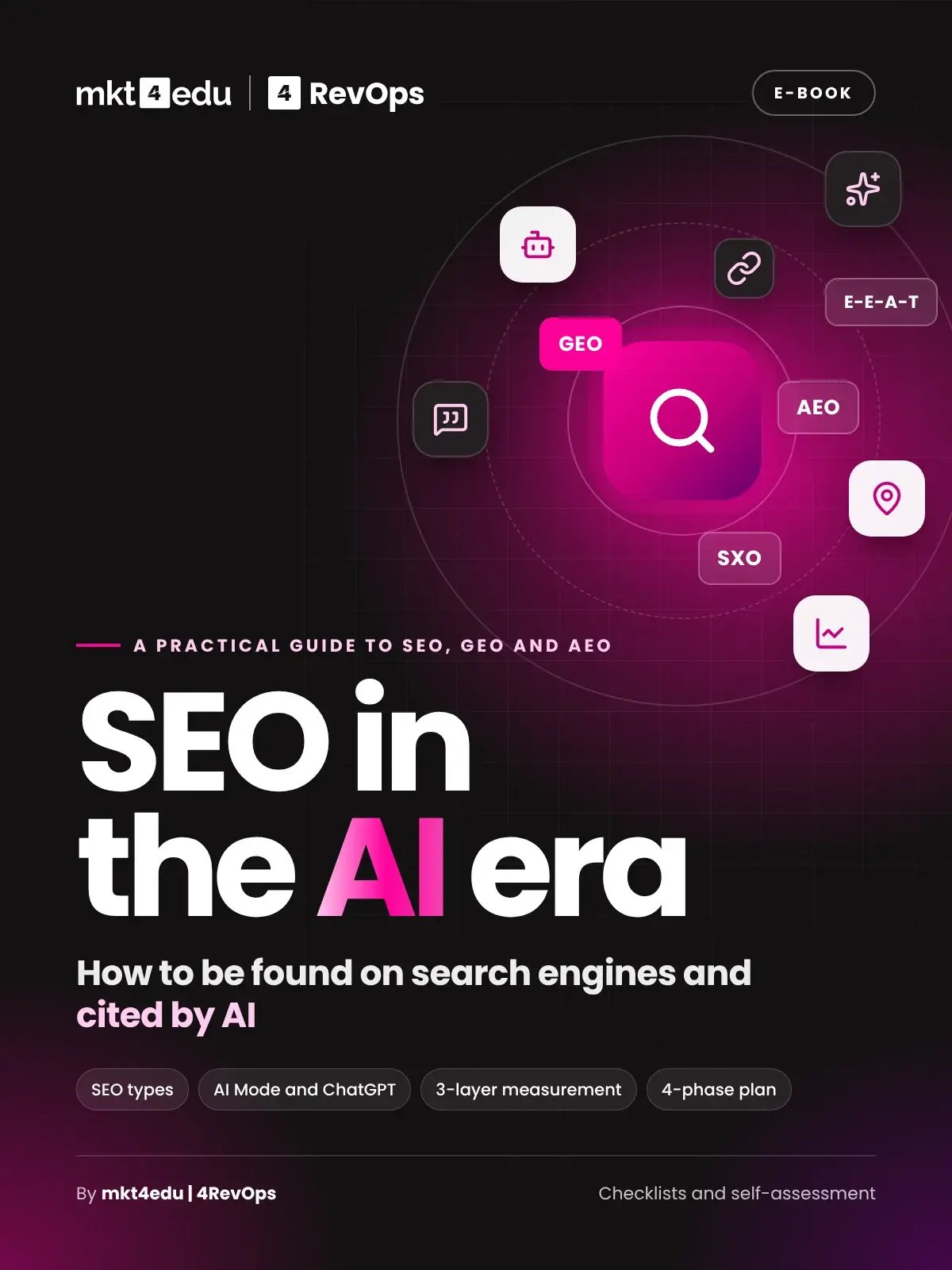
The mkt4edu | 4RevOps e-book brings together the SEO (Search Engine Optimization) techniques that work now: technical, on-page, content, SXO, local, off-page, GEO and AEO. It is a practical guide for your brand to show up on Google, in AI Mode and on ChatGPT, and to reach the buying decision.
Get the free e-book
Fill in the fields and open the interactive version right away.
What changed is where the answer appears, how many clicks it generates and how to measure the result. The foundation is still the same: a site that Google can crawl and understand, pages that answer exactly what the customer asks and clear signals that the brand is trustworthy.
Before, the goal was to reach Google's first page and wait for the click. Now, the same question can be answered by an Artificial Intelligence (AI) summary at the top of the search, by AI Mode, by a map with three companies or by ChatGPT, in an answer that cites only a few sources.
That is why GEO (Generative Engine Optimization) and AEO (Answer Engine Optimization) are, in practice, well-executed SEO with a different measure of success. The e-book shows how to combine the right types of SEO for each business and how to track, beyond ranking and clicks, impressions in AI features, citations and the quality of the lead that reaches the CRM (Customer Relationship Management).
What died was SEO measured only by clicks on generic content.
From the "Myths and truths" chapter, on the claim "SEO died with AI"You will learn the types of SEO, how Google and AI tools choose their sources, how to measure results and how to implement everything in four phases. There are twenty chapters organized as real questions, with a direct answer at the start of each section and official sources linked.
Technical, on-page, content, SXO, local, off-page, mobile, images and video, e-commerce, international, GEO and AEO, with the sign that each one is missing.
Crawling, indexing and serving, AI Mode's "query fan-out" and the weight of zero-click search.
What each acronym aims for, what the study that coined the term GEO says and why all three depend on the same pages.
Technical and mobile SEO, offer pages, SXO, content, local SEO, authority and E-E-A-T, and GEO, with the right profile and a market view.
Which bots to allow in robots.txt, how to avoid blocking them without knowing and why consistent information matters.
Title, meta description, headings, images and the markup still worth using, including the end of the FAQ rich result.
Visibility, traffic and business with Search Console, GA4 (Google Analytics 4) and CRM, including the generative AI report.
From a ready site and measurement to authority and presence in AI answers, with a checklist for each phase.
What is a myth about SEO and AI, and the questions to compare agencies or build an in-house team.
There is no official list of types of SEO: the market usually starts from three pillars (technical, on-page and off-page) and derives the rest from them. For this guide, the work was organized into eleven fronts, each tackling a different bottleneck. No company needs all of them with the same intensity: an e-commerce store lives on product SEO, a clinic on local SEO, a B2B company on content and authority. The e-book helps you choose the order of attack.
You read it in the browser, on mobile or desktop, and apply it as you read: you check off checklists, take a self-assessment and watch the videos without leaving the page.
The four implementation phases become lists you check off as you move forward.
Check what applies to your company and see whether SEO and GEO are already a priority.
AudioBlogs (in Portuguese) from the mkt4edu | 4RevOps YouTube channel complement the chapters.
Data from Google, Statcounter, Pew Research Center, Cetic.br, Inep and other sources, with links to check them.
Source: Google Search Central, guide to optimizing for AI features in Search
In education, SEO only pays off when it is part of an educational marketing strategy that connects search, campaigns, customer service and enrollment, with its own calendar and regulation. The e-book dedicates a chapter to it.
How to plan content about programs, scholarships and admission options so it is indexed weeks before the peak of admissions and ENEM (Brazil's National High School Exam).
Everything prospective students ask before applying, and what changed with Brazil's new distance learning framework, Decree 12,456/2025.
How SEO complements student recruitment campaigns, with the same messages, landing pages and offer data.
Criteria for evaluating an educational marketing agency and when it makes sense to hire a consultancy.
For people who decide on marketing, sales or communication in companies of any size and depend on being found by people who research before buying, hiring or enrolling.
mkt4edu is an educational marketing and Revenue Operations (RevOps) agency, the discipline that brings marketing, sales and customer relationships together around revenue. 4RevOps, its sister brand, takes the same data, CRM and automation methodology to B2B, healthcare, finance, industry and service businesses.
The e-book was written by Renan Andrade, SEO, GEO and content planning coordinator.
We are a 100% online agency, with operations in five countries: Brazil, Mexico, the United States, Portugal and the United Arab Emirates.
SEO in the AI era is about answers.
Being the clearest, most complete and most trustworthy source about your brand, wherever the question is asked.
It is the work of making a brand found on search engines and cited in AI-generated answers, such as AI Overviews, AI Mode and ChatGPT. The foundation is still the same: a site that Google can crawl and understand, pages that answer exactly what the customer asks and clear signals that the brand is trustworthy. The e-book shows what changed: where the answer appears, how many clicks it generates and how to measure the result.
They are different focuses of the same work. SEO optimizes to appear and get clicks in search; AEO, to be the direct answer in answer engines; GEO, to be found and cited by generative AI tools. For Google Search, the line is even thinner, because its AI features rely on the same ranking and quality systems. The e-book explains why all three approaches depend on the same pages.
For Google Search, no: there is no need to create text files for AI, special markup or Markdown versions. The e-book explains what llms.txt is and why it is still debated, and shows which bots to allow in robots.txt to appear in ChatGPT and Perplexity search.
There is no official list of types of SEO: the market usually starts from three pillars (technical, on-page and off-page) and derives the rest from them. The e-book organizes the work into eleven fronts: technical, on-page, content, SXO, local, off-page and link building, mobile, images and video, e-commerce and product, international, and GEO and AEO. For each one, it shows what it solves, where it works and the sign that it is missing.
Yes. It organizes measurement in three layers: visibility in Google Search Console, which since August 2026 has a generative AI performance report; traffic and key events in GA4; and leads, opportunities and sales in the CRM. It also includes a table of indicators showing where to measure each one.
Yes. There is a chapter on SEO within an educational marketing strategy and student recruitment, covering the student recruitment calendar, what a program page needs after Brazil's Decree 12,456/2025, how SEO adds to educational marketing campaigns and criteria for evaluating an agency or consultancy.
For people who decide on marketing, sales or communication in companies of any size: B2B companies, B2C brands, service providers, retail and e-commerce, healthcare and education.
Fill in the form on this page. You will then open the interactive version, which runs in the browser on desktop and mobile. Inside it, the Download PDF button creates a version through your browser to save or print.