
 RevOps
Which website experience fronts weigh most on conversion?
Information architecture, program and product pages, mobile-first, Core Web Vitals, accessibility, forms, chat and AI agents, and social proof.
The mkt4edu | 4RevOps e-book brings together the best practices to build websites and landing pages that are found on Google and in AI answers, persuade visitors and turn visits into leads, sales and enrollments, on HubSpot, WordPress or other platforms.
Get the free e-book
Fill in the fields and open the interactive version right away.
A website that converts takes visitors from the click to the decision without friction: it loads fast, works on mobile, answers the purchase questions, has a short form and responds quickly. What has changed is that visitors arrive further along in their decision, on their phones and often after an AI answer.
UX (User Experience) studies where people get stuck; CRO (Conversion Rate Optimization) tests changes and measures their effect; SEO (Search Engine Optimization) and AI search optimization make the website found on Google and cited in answers generated by Artificial Intelligence (AI).
In the United States, 68.01% of Google searches ended without a click between January and April 2026, and in Brazil Google's AI Mode has worked in Portuguese since September 2025. Those who reach the website tend to be closer to a decision, and a generic page wastes precisely that visitor.
At no point did they find the website ugly. They found it hard.
From the e-book's introduction, about the applicant who gives up at the sixth form fieldMuch longer than an hour, in most cases. In the Radar de Resposta, a study by mkt4edu itself, a researcher tried to apply as a prospective student at 504 private Brazilian higher education institutions (HEIs) between October 21 and November 10, 2026. Only 8.5% of the 305 that completed the application made direct contact within the first hour.
A study by mkt4edu itself, with one application per institution. Full method and results in Student conversion: the Radar de Resposta.
You will learn which fronts weigh most on conversion, how to test without Google Optimize, how to handle privacy, SEO and AI search, how to measure with Search Console and GA4 and how to implement everything in phases. There are 29 chapters organized as real questions, with a direct answer at the start and linked sources.
Information architecture, program and product pages, mobile-first, Core Web Vitals, accessibility, forms, chat and AI agents, and social proof.
What changed with the end of Google Optimize on September 30, 2023, how to build a hypothesis and what to do when traffic is small.
Rage clicks, dead clicks, scroll depth and the exact field where visitors give up on the form.
What the cookie guidance from Brazil's data protection authority (ANPD) recommends for the banner and how to record conversions even when visitors refuse.
Technical, on-page, content and authority SEO, and how to write so that AI-generated answers understand, trust and cite the page.
The elements that make a difference and one landing page for each goal: acquisition, bottom of funnel, retention, expansion and win-back.
Installation, key events, 14-month retention, BigQuery export, consent mode and Search Console's generative AI report.
From measurement to the technical foundation, from the pages that decide the sale to a testing routine, with a checklist for each phase.
Does a beautiful website convert more? Do you need a new website? Is A/B testing for big companies? The answers are in the e-book.
Eight fronts usually account for most of the losses. The e-book compares all eight by what they solve, the typical symptom, the effort and the market signal, to decide where to start. The order of attack usually follows the size of the measured loss.
Two signs of the size of these losses: the Baymard Institute recorded that 18% of shoppers abandoned a purchase because the site required creating an account, and a study by Deloitte and the agency 55, commissioned by Google, found an 8.4% increase in retail conversion with a 0.1-second improvement in mobile loading.
You read it in your browser, on your phone or computer, and apply it as you read: you check off checklists, take a self-assessment and watch videos without leaving the page.
The implementation phases, the GA4 setup and the steps to avoid losing data become lists you check off as you go.
Check what applies to your operation and see whether website experience work already makes sense.
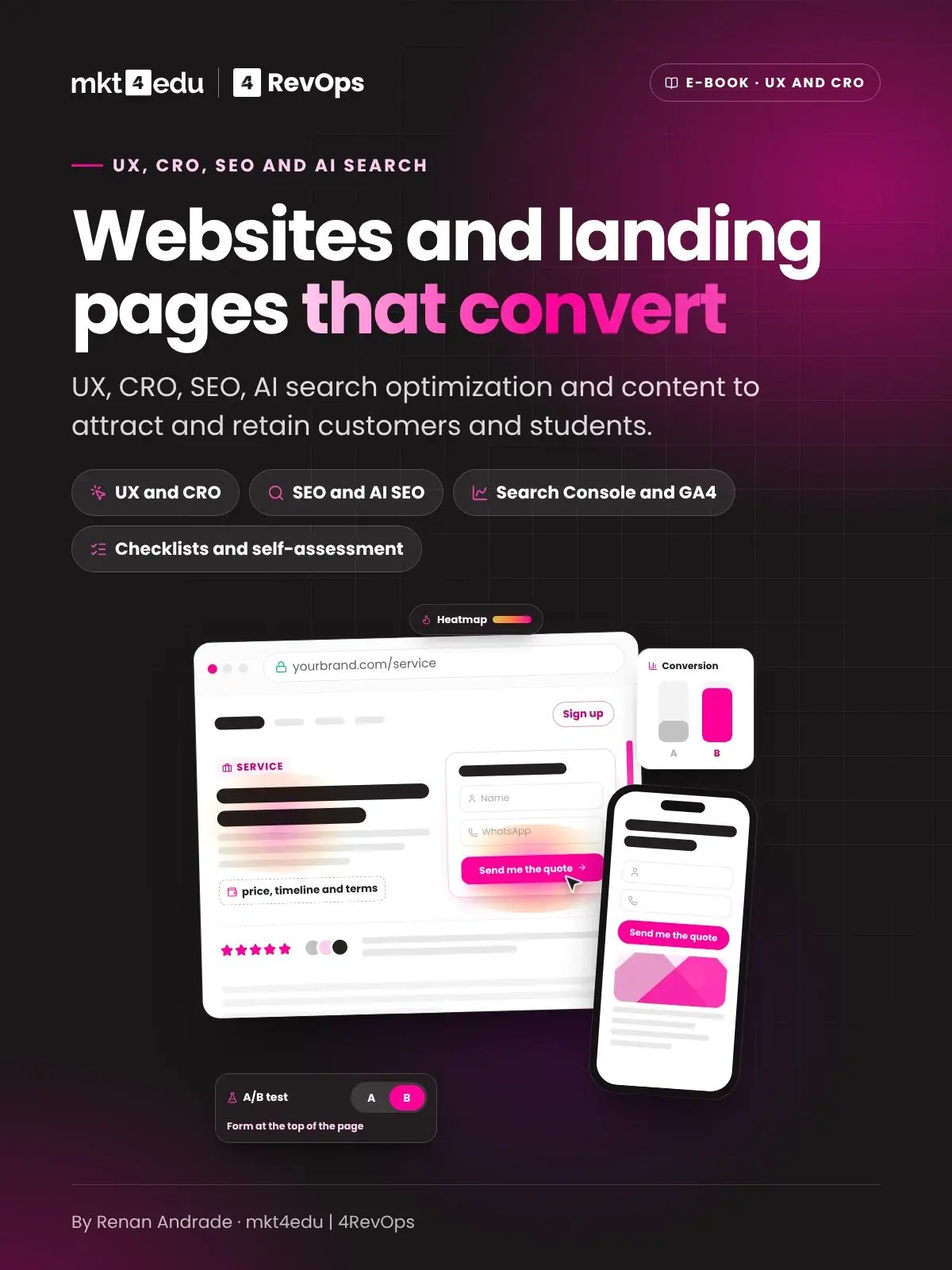
On the cover, you switch between versions A and B of a page and see what changes in the form, the heatmap and the conversion.
AudioBlogs from the mkt4edu | 4RevOps YouTube channel, in Portuguese, complement the chapters.
The legal obligation exists, but the gain goes beyond it. Better contrast helps those reading on a phone in the sun, captions help those watching without sound and clear labels help anyone fill in the form.
Source of the legal obligation in Brazil: Brazilian Inclusion Law, Law 13,146/2015, article 63
With the same logic, applied to a long, expensive decision full of doubts. The e-book dedicates a chapter to educational marketing strategy, student recruitment campaigns, the calendar and retention.
To be the landing point for every channel, with complete program pages: curriculum, format, duration, price or how to ask for it and admission routes.
The landing page separates the institution's own entrance exam, the ENEM score (Brazil's National High School Exam), transfer, second degree, Prouni and Fies, with a simple application integrated with the CRM.
By publishing before the peak: before applications open, before ENEM scores are released and before enrollment, with time for indexing, testing and adjustments.
A help center, re-enrollment that is simple on mobile and a student portal. In the ESPM case, the portal integrated with HubSpot received more than 60,000 tickets in six months.
For anyone who leads marketing, sales or student recruitment in any industry and needs the website to deliver results, not just visits. It makes the most sense for those who already have traffic but do not turn it into contacts or sales.
mkt4edu is an educational marketing and Revenue Operations (RevOps) agency, the discipline that brings marketing, sales and customer relationships together around revenue. 4RevOps, its sister brand, takes the same data, CRM and automation methodology to B2B, healthcare, finance, manufacturing and services businesses.
The e-book was written by Renan Andrade, SEO, GEO and content planning coordinator.
We are a 100% online agency, with operations in five countries: Brazil, Mexico, the United States, Portugal and the United Arab Emirates.
The website experience is about decision.
The website that converts is the one that treats each visit as a person with a real question, and answers it.
It is a website that takes visitors from the click to the decision without friction: it loads fast, works on mobile, answers the purchase questions, has a short form and responds quickly. The e-book shows the eight fronts that weigh most on this and how to prioritize them by the size of the measured loss.
It teaches UX, CRO, SEO, AI search optimization, content production, platform choice and CRM integration, for acquisition and for retention. It covers A/B testing without Google Optimize, privacy and cookie precautions, Search Console and GA4 setup, a four-phase plan and a chapter on educational marketing.
UI (User Interface) handles the look and the components. UX handles how people use the website. CRO measures and tests what increases conversion. SEO handles how the website is found in search. All four act on the same page, which is why they work best as a single effort.
With another tool and the same method: a clear hypothesis, one primary metric, enough traffic and time for the result to stabilize. Google Optimize stopped working on September 30, 2023, and Google moved to integrations with vendors such as AB Tasty, Optimizely and VWO. With little traffic, qualitative research and fixing obvious errors pay off more.
By installing both right at the start and adjusting what the defaults do not cover: a verified domain property and a submitted sitemap in Search Console; key events marked, data retention set to 14 months, an internal traffic filter and consent mode in GA4. To keep the history, both export to BigQuery. The step-by-step is in the e-book.
The ones that link behavior on the website to results: conversion rate per page, form abandonment, engagement rate, Core Web Vitals, time to first response to the lead, lead-to-sale or lead-to-enrollment conversion and cost per lead. Conversion rate alone is misleading: it has to be read by page, device and source.
With direct answers at the start of each section, pages organized around the audience's real questions, validated structured data, verifiable facts and monitoring of AI answers. Google states that no special optimization is required to appear in AI Overviews and AI Mode: SEO fundamentals apply.
Yes. After filling in the form, you get access to the interactive version, which opens in your browser, on your phone or computer, with checklists, a self-assessment, myth or truth cards and videos from our channel. To keep a copy, use the Download PDF button inside the e-book.