
 RevOps
How do you write a complete content brief?
The eight points every brief needs to answer before the first topic, from the business and offer to measurement.
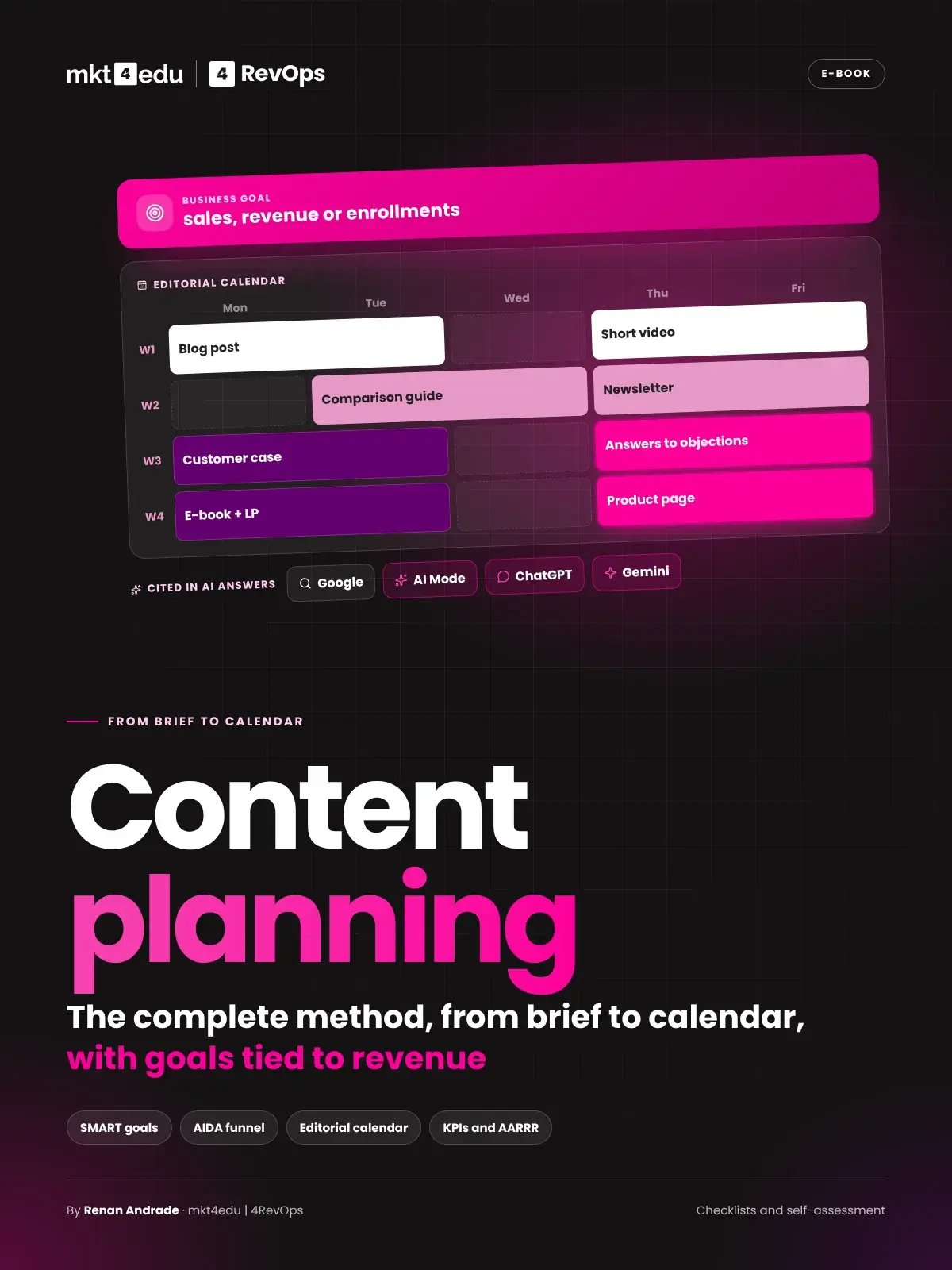
The mkt4edu | 4RevOps e-book shows, step by step, how to plan blog, e-book, website, social media and email content from SMART goals tied to leads, sales and enrollments. It is the method mkt4edu uses so content proves its value, from the brief to the quarterly review.
Get the free e-book
Fill in the fields and open the interactive version right away.
Content planning is the link between a business goal, the audience that needs to be convinced, the questions that audience asks and the formats that answer those questions, with goals that let you know, every quarter, whether you are on the right track. It is not a calendar full of dates.
What changed is the yardstick. Google's AI Mode has worked in Portuguese since September 2025, with questions two to three times longer, and visits became harder to win. That is why a visit is no longer a good goal on its own: the e-book shows how to tie content to leads, opportunities and revenue, tracked in the CRM (Customer Relationship Management).
Many teams produce content every week and, at the end of the quarter, cannot say what it brought to the business. The e-book's method starts with the business goal, not the topic, and ends in a calendar in which each piece has a role, a reader and an indicator.
The problem is rarely a lack of production. It is a lack of direction.
From the e-book's introductionYou will learn to write the brief, set SMART goals, break down the revenue goal, choose topics and formats, build the calendar and measure the results. There are 33 chapters organized as real questions, with a direct answer at the start of each section and linked sources.
The eight points every brief needs to answer before the first topic, from the business and offer to measurement.
The test for each letter, weak goals and goals that pass, and how OKRs organize the quarter's objectives and key results.
The backwards breakdown, using the real rates from the CRM, and the ESPM case study.
Strengths, weaknesses, opportunities and threats applied to content, and the four fronts of the website analysis, including AI visibility.
Useful personas, not decorative ones, content for each journey stage and a starting mix for the top, middle and bottom of the funnel.
Search data, customer service questions and AI search, which breaks the question into subtopics, organized into pillar and supporting pages.
Blog, website, video, e-books, newsletter and social media, with the right profile, a market reading and a matrix of effort and time to results.
What human review checks, what Google treats as scaled content abuse and when to update what already exists.
The five AARRR stages, a dashboard of indicators by stage and the four questions of the quarterly review.
In the mkt4edu method, planning goes through twelve steps, each with a well-known tool and a deliverable that feeds the next one. Skipping steps is what turns planning into a list of topics. The method works for a blog, for a single e-book or for the whole website: what changes is the depth of each step, not the order.
You read it in the browser, on your phone or computer, and apply it as you read: check off checklists, take a self-assessment, flip myth-or-truth cards and watch videos without leaving the page.
The brief, the human review and the four implementation phases become lists you check off as you go.
Check what applies to your company and see whether the method makes sense now or whether it is better to organize the foundation first.
Tap the pieces and the AIDA funnel stages to see the role and main metric of each format.
Data from Cetic.br, Pew Research Center, SparkToro, DataReportal, IBGE, Inep and Google, with links to check.
Volume without priority creates pages that compete with each other, rushed reviews and diffuse metrics. What usually works is publishing less, on the right topics, with steady quality, and updating what already exists.
In education, the method is the same, adjusted to the recruitment and retention rhythm of educational institutions, with a stricter calendar: admissions cycles, ENEM (Brazil's National High School Exam) scores, enrollment, re-enrollment and the start of the semester. With 10.6 million enrollments and 5.18 million new students in Brazil's 2025 Higher Education Census, the cost of attracting each student through media rises, and content that generates its own demand gains weight. The e-book dedicates a chapter to this.
By starting from the dates that move the market and working backwards, so content is indexed and distributed before the search peak.
By giving campaigns a destination that convinces: pages that answer the candidate's questions about course, study format, price and admission routes.
By answering the objections that block applications and enrollment, including Brazil's University for All Program (Prouni) and Student Financing Fund (Fies).
When the volume of courses, campuses and admissions cycles exceeds the team's capacity, or when content is not tied to enrollment goals.
For people who coordinate marketing, content or communications in any industry and need content to prove its value: both those who already produce content and cannot show results, and those who are about to start and want to do it right from the beginning.
mkt4edu is an educational marketing and Revenue Operations (RevOps) agency; RevOps is the discipline that brings marketing, sales and customer relationships together around revenue. 4RevOps, its sister brand, takes the same data, CRM and automation methodology to B2B, healthcare, finance, industry and services companies.
The e-book was written by Renan Andrade, SEO, GEO and content planning coordinator.
We are a 100% online agency, operating in five countries: Brazil, Mexico, the United States, Portugal and the United Arab Emirates.
Planning content is about deciding better.
The decision about what to produce, for whom and with which goal is what determines whether content becomes revenue or cost.
It is the link between a business goal, the audience that needs to be convinced, the questions that audience asks and the formats that answer those questions, with goals that let you know, every quarter, whether you are on the right track. It is not a calendar full of dates. The e-book shows the complete method, from the brief to the quarterly review, for blog, e-book, website, social media and email content.
They are objectives written so that anyone on the team understands what needs to be done, how it will be measured and by when. The acronym stands for Specific, Measurable, Achievable, Relevant and Time-bound. The e-book turns each letter into a checking question, with examples of weak goals and goals that pass the test.
A SMART goal is a format for writing an objective; an OKR (Objectives and Key Results) is a management system that organizes several objectives and the results that prove progress, and it distinguishes committed goals from aspirational goals. In practice, many teams use OKRs for the quarter and write each key result in the SMART format. The e-book includes an example applied to content.
By breaking the business goal down backwards, using the real conversion rates from the CRM: from the sales or enrollment goal to the marketing goal, the content goal and the tracking indicators. For the math to work, the CRM needs to record the source of every lead and follow it all the way to the sale or enrollment. The e-book walks through a complete hypothetical example.
In the mkt4edu method, there are twelve steps, each with a tool and a deliverable: brief, SMART goals, SWOT analysis, website analysis and SEO audit, personas, AIDA funnel, topics and clusters, formats, 5W2H and calendar, AI-assisted production, UX and CRO, and pirate metrics with KPIs. The method works for a blog, for a single e-book or for the whole website.
The size and shape of the question change. With AI Mode, people type the whole question, and the tool breaks it into subtopics and runs several searches at the same time; no special optimization is required, and SEO fundamentals apply. In topic planning, long, comparative and situational questions gain weight, and the goal starts to look at presence, conversion and revenue, not just visits.
Yes. There is a chapter on content planning in educational marketing, with a student recruitment calendar, support for educational marketing campaigns, student conversion and when it is worth working with an educational marketing agency or consultancy. Several examples in the e-book also come from higher education.
Fill in the form on this page. Right after that, you get access to the interactive version, which opens in the browser on computers and phones. Inside it, the Download PDF button creates a version through your browser that you can save or print.