
 RevOps
What is the difference between a rule-based chatbot, an AI assistant and an agent?
How each one works, what it does well and where it usually fails, and why mixing up the three frustrates the project.
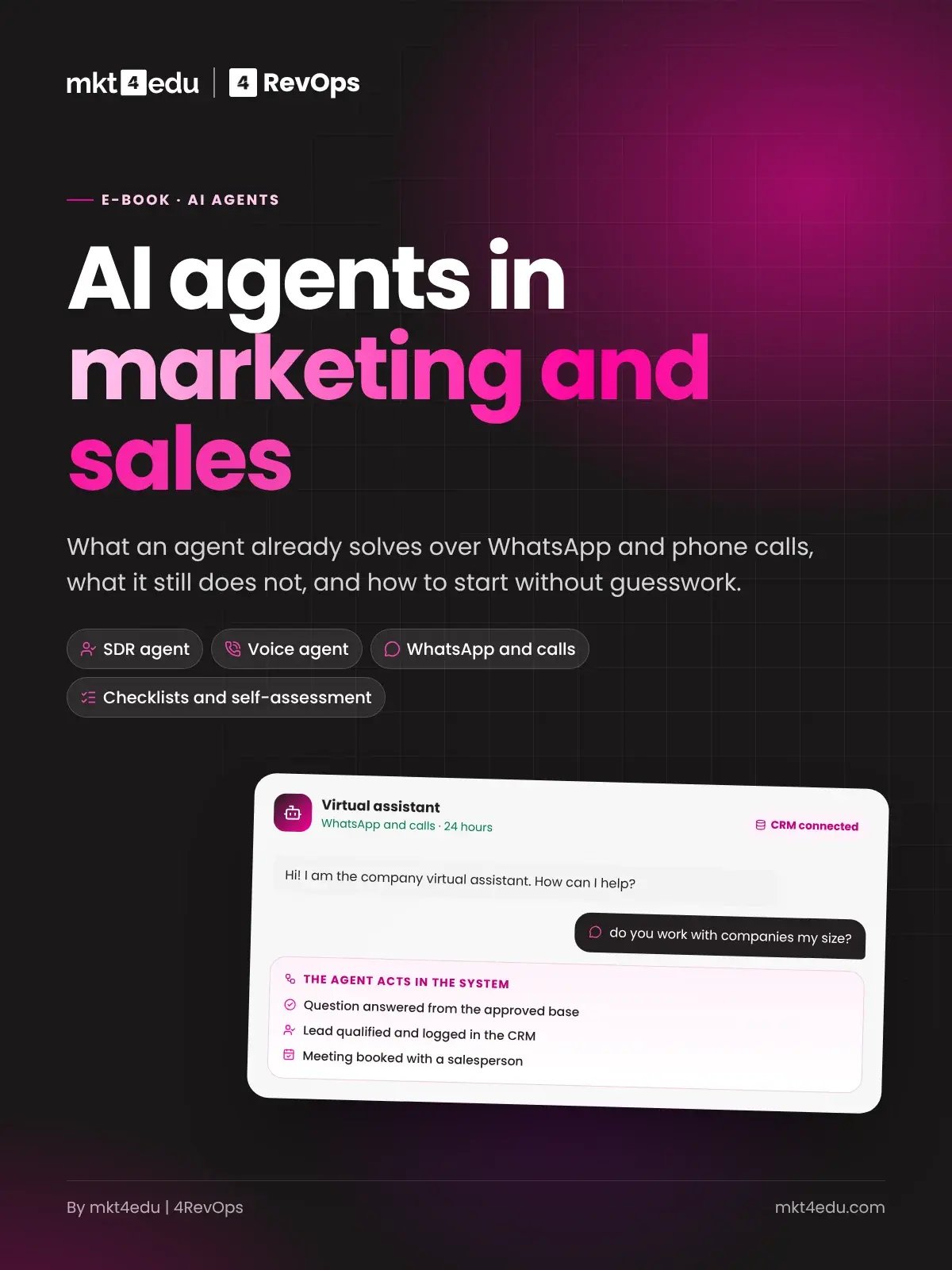
The mkt4edu | 4RevOps e-book shows what an Artificial Intelligence (AI) agent already handles in customer service, lead qualification and customer retention, what it still does not handle, and how to put an agent to work in your company, in any industry, without guesswork.
Get the free e-book
Fill in the fields and open the interactive version right away.
An AI agent understands natural language, looks up company information, records data in the CRM and carries out tasks within defined limits. The classic chatbot followed a script of buttons and keywords. The difference lies in how much each one understands and how much each one can do on its own.
The tool is the smallest part of the decision. What determines whether AI generates sales or just noise is the quality of the data in the CRM (Customer Relationship Management), the clarity of the sales process, the design of the conversations and the governance over what the agent can and cannot do on behalf of the company. The e-book covers each of these points.
The smart decision is not to "have AI", but to choose a front with a measurable problem, connect the agent to the CRM, measure it against the current operation and only then scale.
From the chapter "Everything you need to know before deciding"You will understand where the agent fits into the customer journey, what it already does over WhatsApp and phone calls, which fronts tend to pay off first, which mistakes sink projects and how to start safely.
How each one works, what it does well and where it usually fails, and why mixing up the three frustrates the project.
AI in research, WhatsApp at the center of the conversation and the weight of response time in the sale.
The signs that the company is ready and the signs that AI will speed up the problem instead of solving it.
24-hour customer service, SDR agent, voice agent, drop-off recovery, retention and custom agents.
Persona before script, tone of voice, when to hand over to a person and what the agent must never do.
What Brazil's LGPD (General Data Protection Law) requires of an agent and where the discussion on an AI law in Brazil stands.
From a ready CRM and knowledge base to a measured pilot, integration with the operation and scaling with governance.
Nine indicators, from first response time to retention in the first months, including the connection rate of calls.
What is myth, what is true and the questions that separate a real agent from a renamed chatbot.
An AI agent already performs four roles well, over WhatsApp and phone calls: answering questions at any hour, qualifying and routing leads to the sales team, re-engaging people who stopped halfway through a purchase and reaching out to customers at risk of canceling. For this guide, the work was organized into six fronts, compared side by side.
In the mkt4edu test, almost always longer than the lead expects. In the Response Radar study, a researcher signed up as a real applicant at 305 private higher education institutions in Brazil, between October and November 2026, and timed the first contact from each one.
The test was run in education, but the picture applies to any operation that generates leads through forms: interest comes in, the company takes too long and the lead cools off before the first conversation. Because the study is mkt4edu's own, it is a snapshot of that sample.
You read it in the browser, on mobile or desktop, and apply it as you read: compare the agent fronts, take a self-assessment, tick checklists and watch the videos without leaving the page.
The six agent fronts side by side: where they apply, which company they fit and what the routine looks like.
Tick what applies to your company and see whether an AI agent already makes sense now.
The four implementation phases become lists you tick as you move forward.
AudioBlogs from the mkt4edu | 4RevOps YouTube channel, in Portuguese, complement the chapters.
In education, the same fronts come with their own calendar, tight deadlines and regulated steps. AI comes in as the execution layer of an educational marketing strategy that already defines audience, priority programs, channels and targets.
At the peak of the admissions season, the agent makes first contact within minutes, asks about program, format and admission route and hands over to the advisor whoever is ready to talk.
By working between application and enrollment: re-engaging incomplete applications, sending exam and result reminders and guiding documents and payment.
It helps spot the risk earlier, with time for tutoring to act. Decisions about academic support or financial terms remain with people.
A knowledge base updated before each admissions opening and a pilot run off-peak, so the agent reaches the busiest weeks already fine-tuned.
For those who lead marketing, sales or customer relationships and need to make a well-founded decision about AI agents, whether in a company that sells to other businesses, a brand that sells to consumers, a clinic, a retailer with e-commerce or an educational institution.
mkt4edu is an educational marketing and Revenue Operations (RevOps) agency, the discipline that brings marketing, sales and customer relationships together around revenue. 4RevOps, its sister brand, takes the same data, CRM and automation methodology to B2B, healthcare, finance, industry and services. The AI agents the team deploys work over WhatsApp and phone calls and integrate with HubSpot and other CRMs, such as Salesforce.
The e-book was written by Tório Barbosa, co-founder of mkt4edu, and Renan Andrade, SEO, GEO and content planning coordinator.
We are a 100% remote agency, operating in five countries: Brazil, Mexico, the United States, Portugal and the United Arab Emirates.
The decision about AI agents is about operations.
The most useful agent is the one that solves a real bottleneck and frees the human team for what only people do well.
It is a system built on a language model that understands the customer in natural language, looks up company information, records data in the CRM and carries out tasks within defined limits, such as qualifying a lead, booking a meeting or handing the conversation over to a salesperson with the full history.
A rule-based chatbot follows buttons and keywords. A generative AI assistant answers in natural language from a knowledge base, but does not take actions. An AI agent accesses systems such as the CRM, calendar and telephony and acts within defined rules. The e-book compares the three.
Yes. The e-book shows how the agent works over WhatsApp and by phone and how the two channels complement each other: the call usually opens the contact, and WhatsApp carries the follow-up, reminders and meeting link. It also explains how the voice agent works, making and receiving calls in natural language and logging the transcript and summary in the CRM.
No. The agent takes on the repetitive volume, such as answering the same question many times, collecting interest and purchase timeline and sending meeting reminders. The salesperson keeps what requires judgment: negotiating, reassuring the customer and handling exceptions.
No front works in isolation from the CRM: that is where the agent records the conversation, moves the lead to the next stage and passes context to the salesperson. The integration does not depend on a specific CRM. mkt4edu, the first HubSpot Elite partner in Brazil, integrates its agents natively with HubSpot and also with other CRMs, such as Salesforce.
It is a test run by mkt4edu from the buyer's side. A researcher signed up as a real applicant at 305 private higher education institutions in Brazil, between October and November 2026, and timed the first contact. Only 8.5% reached him over WhatsApp or by phone within the first hour, and 25.2% made no contact at all.
Start small, with a clear problem and a number to beat. The e-book proposes four phases: organize the CRM and the knowledge base, run a pilot with one front and one indicator, integrate the agent with the rest of the operation and scale with governance, with a human owner for each agent. Each phase comes with a checklist in the interactive e-book.
No. The content applies to B2B companies, B2C brands, clinics, retailers with e-commerce, subscription services and educational institutions. Education, the market where mkt4edu was born, gets its own chapter as a detailed example, covering student recruitment, conversion and dropout.